For a lender, cloud data is business, market and financial information delivered over the internet from a provider’s servers and pulled into your credit process on demand, instead of being bought as a static file or kept on your own hardware. It is a different thing from cloud lending software, which runs your loan origination and servicing, and from cloud file storage, which only holds documents. This guide explains the difference, what data you can pull, how to connect it to your existing credit files, and which U.S. oversight expectations apply.
TL;DR
- Cloud data is the information (industry benchmarks, company financials, market trends); cloud lending software is the system that processes loans. You can adopt either one without the other.
- The most useful data for small business credit is comparative: how a borrower’s margins, leverage and cash flow stack up against its industry, region and size band.
- Connect data through a one-off report for a single file, or an API feed for repeatable underwriting and portfolio monitoring.
- U.S. regulators expect due diligence on cloud providers, tested security controls, and compliance with fair lending and the Fair Credit Reporting Act when you use non-traditional data.
- Before you buy any dataset, check its sources, sample sizes, definitions and update cycle. Large datasets can still be inconsistent.
Table of Contents
- What cloud data means for a lender
- Why lenders are moving to cloud-delivered data
- Which business data lenders can pull
- How lenders use cloud data across the loan lifecycle
- How to obtain and connect the data to your existing systems
- Checking quality before you rely on it
- Security, privacy and regulatory expectations in the U.S.
- Limitations and risks to plan for
- Our perspective
- Put benchmark data to work on your next file
- FAQ
- Sources
What cloud data means for a lender
Three different things get called “cloud” in lending, and mixing them up leads to the wrong purchase.
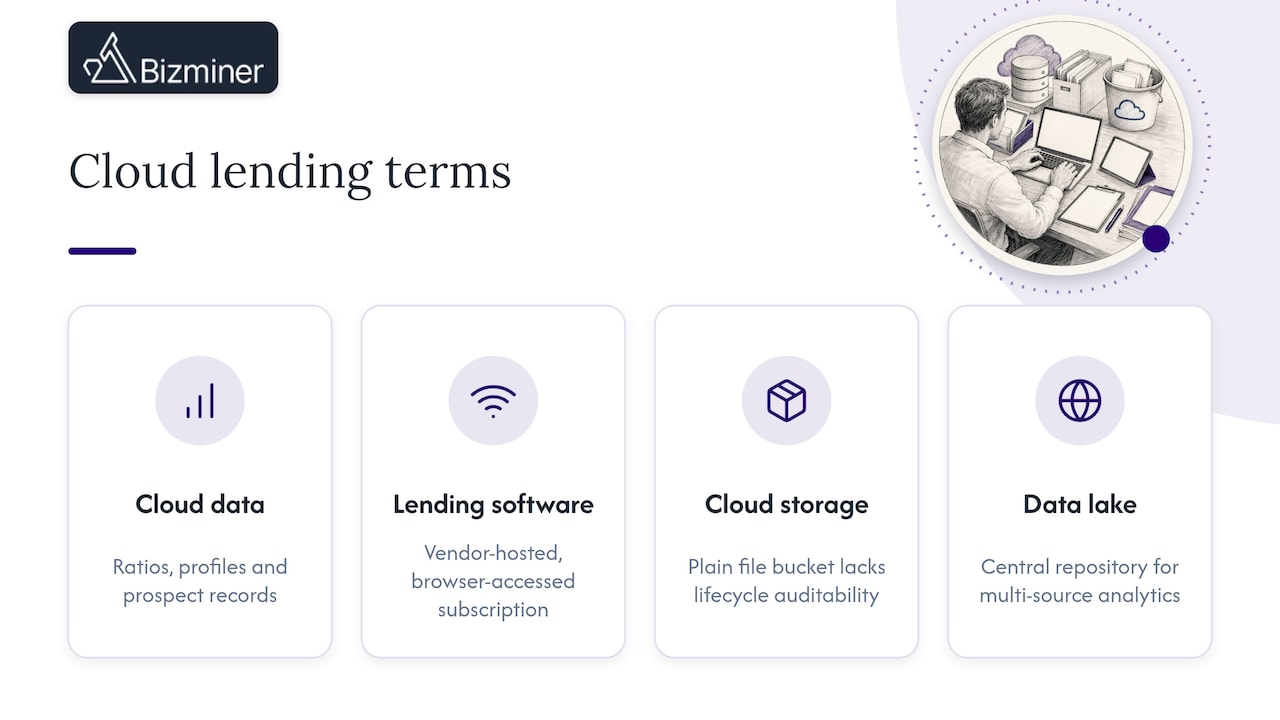
Cloud data is the content. Think industry financial ratios, company profiles, market size estimates and prospect records, delivered through a web platform or an API.
Cloud lending software is the delivery model for your systems. LoanTabs describes it as vendor-hosted software accessed through a browser, maintained and updated by the vendor, usually under a subscription. The software may hold your data, but “cloud-based” describes how it is hosted and delivered, not what information it contains.
Cloud storage is a place to keep files. Wolters Kluwer argues that purpose-built digital lending solutions differ from generic storage because digitized loan documents need auditability and legal enforceability across their lifecycle, which a plain file bucket does not provide.
A fourth term appears in vendor material: the cloud data lake. AWS describes it as a central repository for data from multiple sources that supports analytics, forecasts, risk assessments, compliance and machine learning. That is infrastructure you build, and it is only as good as the data you load into it.
The practical upshot: your cloud lending platform is where decisions get processed, your data lake or warehouse is where history accumulates, and a cloud data provider is where outside evidence comes from. This article is about the last one.
Why lenders are moving to cloud-delivered data
The general case for cloud is operational. Mortgage technology coverage notes that cloud hosting can give users remote access and reduce hardware purchases and in-house IT needs, though providers may restrict your access to your own data. The Rockport Group makes a similar point about platforms: vendors handle infrastructure, security and updates centrally, so lenders can scale capacity with demand without buying hardware.
For data specifically, the benefits are more concrete:
- Freshness. A web platform or API can be refreshed on the provider’s schedule, rather than waiting for an annual printed study.
- Speed on the file. An analyst can pull an industry comparison while the application is open, not request it from a research team.
- Consistency. When every analyst pulls benchmarks from the same source with the same definitions, credit memos become comparable across the desk.
- Defensibility. A documented source list is easier to defend in an exam, an audit or a dispute than a spreadsheet someone built from memory.
The trade-off is dependence. If the provider restricts export, changes definitions or raises prices, you feel it. Ask about those terms before you sign.
Which business data lenders can pull
Not all data helps a credit decision. For commercial and small business lending, the useful categories fall into a few groups.
Industry financial benchmarks
Median and quartile values for gross margin, operating margin, current ratio, debt to equity, interest coverage and debt service coverage, segmented by industry code, region and revenue size. These answer the question every credit memo eventually asks: is this borrower’s performance normal for its peers? Our guide to audit ready benchmarks for loan underwriting walks through how analysts use them, and our piece on commercial underwriting data in six categories covers the wider data set.
Company-level profiles and reports
Financial summaries, ownership and operating details, and valuation-style analysis for a specific business. These help when a borrower’s own statements are thin or when you want to cross-check them.
Market and local demand data
Market size, growth trends and competitive density in the borrower’s geography. For a restaurant, a self-storage facility or a dental practice, the local market often matters as much as the borrower’s last tax return. See our local market analysis guide for how to read it.
Alternative and cash-flow data
Fintech lenders use sources beyond financial statements. A study published through the FDIC notes that they rely on alternative information such as marketplace sales and postal shipping data to analyze and project business profitability. Cash-flow data, generally taken from bank account records, is used by some firms to assess income and expense activity over time and judge whether a borrower can meet recurring obligations.
Prospect lists
On the origination side, segmented lists of businesses by industry, geography and size feed outreach campaigns. Lists are a marketing input, not a credit input, and they should stay separate from underwriting data in your process.
How lenders use cloud data across the loan lifecycle
| Stage | What the data does | Typical form |
|---|---|---|
| Prospecting | Finds businesses in target industries and areas | Prospect list |
| Pre-screening | Tests whether a request is plausible for its industry | Benchmark lookup |
| Underwriting | Compares borrower ratios with peers; supports the credit memo | Industry report, company report, API call |
| Approval and pricing | Documents why a risk grade and rate were chosen | Saved report attached to the file |
| Monitoring | Flags borrowers drifting from peer norms, or industries weakening | Scheduled data feed |
| Portfolio review | Shows concentration and sector trend risk | Aggregated feed or periodic reports |
The agencies have said that alternative data may improve the speed and accuracy of credit decisions, including for people who might not get credit in the mainstream system. The same statement frames cash-flow evaluation as a legitimate way to judge repayment capacity, with borrower permission, transparency and explainability in mind.
A worked example shows the typical use. Suppose a borrower in a small trucking operation requests a term loan to buy two tractors. The borrower’s statements show a 1.2 debt service coverage ratio. A peer benchmark for similar-sized trucking firms in the region shows the median is meaningfully higher, and the borrower’s fuel and maintenance costs as a share of revenue are above the upper quartile. That does not decide the loan, but it tells the analyst exactly what to ask the borrower about, and it gives the credit committee a documented comparison. If you underwrite SBA loans, our SBA loan benchmarks guide covers the 1.15 DSCR threshold and how to document it. For bank-side data fields, see FR Y-14M fields that predict underwriting decisions.
How to obtain and connect the data to your existing systems
This is where most projects stall, so plan it in order.
- Define the decision first. Write down which credit questions the data should answer: peer margin comparison, sector outlook, valuation support. A vague mandate produces an expensive dashboard nobody opens.
- Match the delivery method to the volume. A community bank booking a handful of commercial loans a month can buy single reports. A lender running dozens of files a week, or monitoring a portfolio, needs a feed.
- Map identifiers. Industry codes (NAICS), geography and size bands must line up with how your loan system classifies borrowers. A mismatch here silently produces wrong comparisons.
- Pilot on closed files. Run the data against loans you already decided and see where it agrees, disagrees and adds nothing.
- Store the output with the file. Save the report or the API response with its date and source list, so the exhibit in the credit memo can be reproduced later.
- Set a refresh rule. Decide when benchmarks are re-pulled: at annual review, at renewal, on covenant breach.
On the delivery options for Bizminer data, a one-off report is the simplest. As published on our pricing page, an Industry Financial Performance, Industry Market or Company Profile report is $249 per report, and a Financial Report, Market Report, Valuation Report or Company Report is $349 per report. For repeatable use, our market data API feeds data into your own tools, and the API integration page explains how audit ready output is handled. API feeds are customized, and pricing is not published, so you request a quote.
Whichever provider you choose, ask these questions before you sign:
- Can I export the data, and in what formats?
- Is each figure traceable to a source list and sample size?
- How are industries defined, and do the codes map to mine?
- How often is the data refreshed, and is the refresh date shown?
- Can I keep the saved reports for the retention period my examiners expect?
Checking quality before you rely on it
Bigger is not automatically better. The CFPB has cautioned that alternative data may be inaccurate or incomplete, can be hard for consumers to correct, and can produce unintended or discriminatory effects. Although that guidance came in a consumer credit context, the discipline carries over to business lending: know what is in the data and what is not.
A short quality checklist for any dataset:
- Source list. Which public and private datasets feed it? Are they named?
- Sample size. How many companies sit behind a benchmark for a narrow industry in a small region? A median built on a handful of firms is an anecdote.
- Definitions. Does “operating margin” mean the same thing across sources? Inconsistent definitions are among the quiet reasons comparisons fail.
- Coverage gaps. Which borrower types are underrepresented, such as very small or new firms?
- Date. What period do the figures cover, and when were they last updated?
- Fallback. What do you do when the segment is too thin? Widen the geography or the size band, and document that you did.
This is also where granularity matters. A national average for “restaurants” tells you little about a fine dining place in a small town. Bizminer data covers more than 9,000 markets segmented by industry, geography and company size, so an analyst can narrow the comparison to something close to the borrower. Our data is accepted in U.S. Tax Court and used by government agencies, which is the kind of external scrutiny credit files benefit from.
Security, privacy and regulatory expectations in the U.S.
Using cloud services does not move your responsibility to the vendor. The FFIEC said in its 2020 statement that management should not assume effective controls exist simply because systems run in the cloud. The OCC’s guidance goes further: institutions should conduct due diligence and ongoing oversight of cloud providers, define shared security responsibilities, manage access and regularly test cloud security controls. The same bulletin flags misconfiguration of cloud resources as a prevalent vulnerability.
In practice, add these items to vendor onboarding:
- A written split of security duties between you and the provider.
- Access management for the people and systems that can call the data.
- Evidence of security testing, and your own periodic testing of what you control.
- An exit plan: how you retrieve your saved records if the relationship ends.
Fair lending and credit reporting
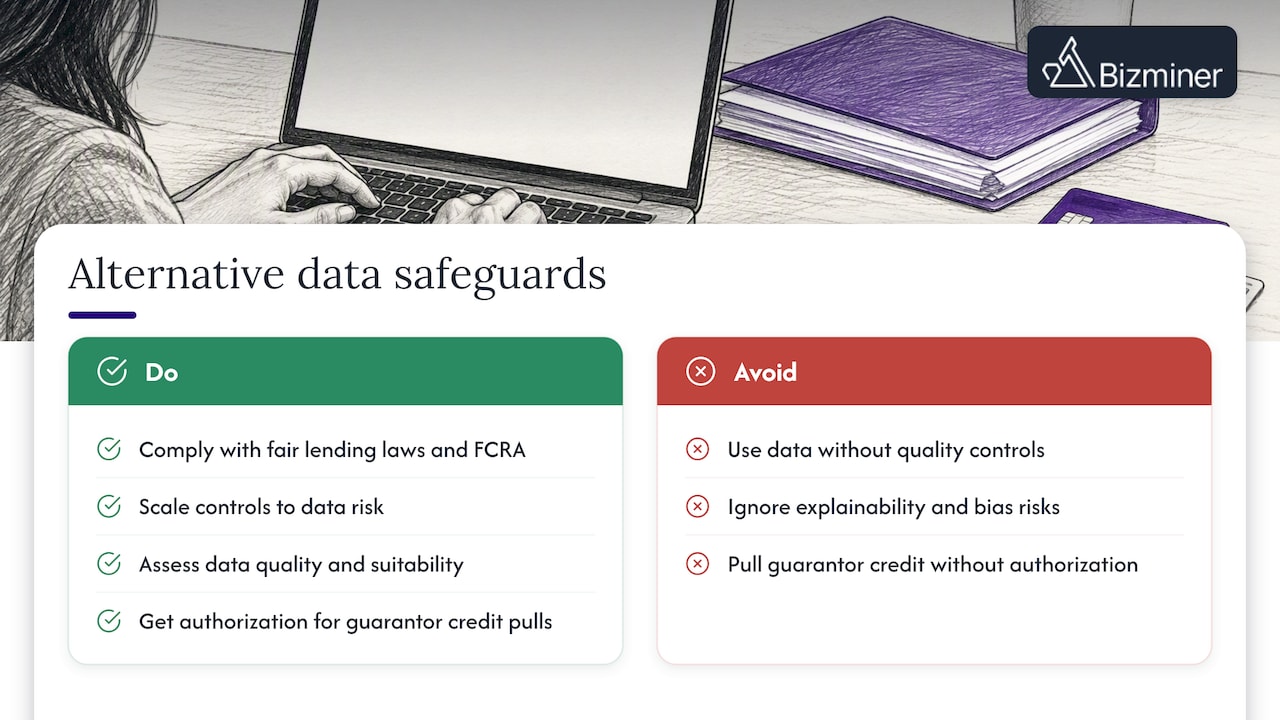
When the data goes beyond traditional financials, consumer protection law follows it. The federal banking agencies stress that firms using alternative data must comply with fair lending laws, the Fair Credit Reporting Act and the prohibition on unfair, deceptive or abusive practices, and they suggest a compliance management program whose rigor scales with the risk of the data used. The agencies also encourage responsible use, with controls to assess data quality and suitability.
If you personally pull a guarantor’s credit, authorization matters too. This overview of credit pull authorization rights and form checklists explains what a proper authorization should contain.
Models add another layer. A Congressional Research Service brief notes that machine learning in underwriting can find new patterns and improve accuracy but can also create risks such as poor explainability and bias against protected groups. If you plan to score with the data, read our guide to AI for underwriting first.
Consumer-permissioned data
Cash-flow data from bank accounts is covered by a separate rule. The CFPB’s October 2024 final rule on personal financial data rights requires providers to make consumers’ financial data available to the consumer and authorized third parties on request, and it limits use to the purposes the consumer requested. The rule’s status has been subject to change since its release, so confirm the current version with your counsel before building a process around it.
Limitations and risks to plan for
- Operational friction. FinRegLab noted that for cash-flow underwriting to scale, lenders must overcome data access hurdles and uncertainty about compliance and liability.
- Vendor lock-in. Providers may limit how you access or export data, as noted earlier.
- False precision. A benchmark to two decimals can still rest on a thin sample.
- Blind automation. A peer comparison is an input to judgment. It should not auto-decline a borrower in an unusual but healthy niche.
- Process drift. Without a refresh rule, the benchmark in a file from 2024 gets reused in 2026 without anyone noticing.
Our perspective
We built Bizminer for the people who have to defend a number: the credit analyst presenting to committee, the accountant testifying about value, the advisor telling a client what normal looks like. From that seat, the cloud is not the interesting part. Anyone can host data. What counts is whether the comparison is narrow enough to be fair to the borrower and documented well enough to survive questions months later.
So our advice to lenders is to start small and specific. Pick one loan product, one set of industries, and run the data against closed files. Keep the source list and sample size with every exhibit. Treat benchmarks as the start of a conversation with the borrower, not the end of one. Once the habit works on one desk, an API feed turns it into a repeatable process.
— Danny
Put benchmark data to work on your next file
If you want to test this on a live credit file, our platform gives you industry financial performance reports from $249 per report and company and valuation reports from $349 per report, and API feeds are built to your requirements. You can also use the custom report builder to filter by industry, geography and company size, or review all report prices and plans.
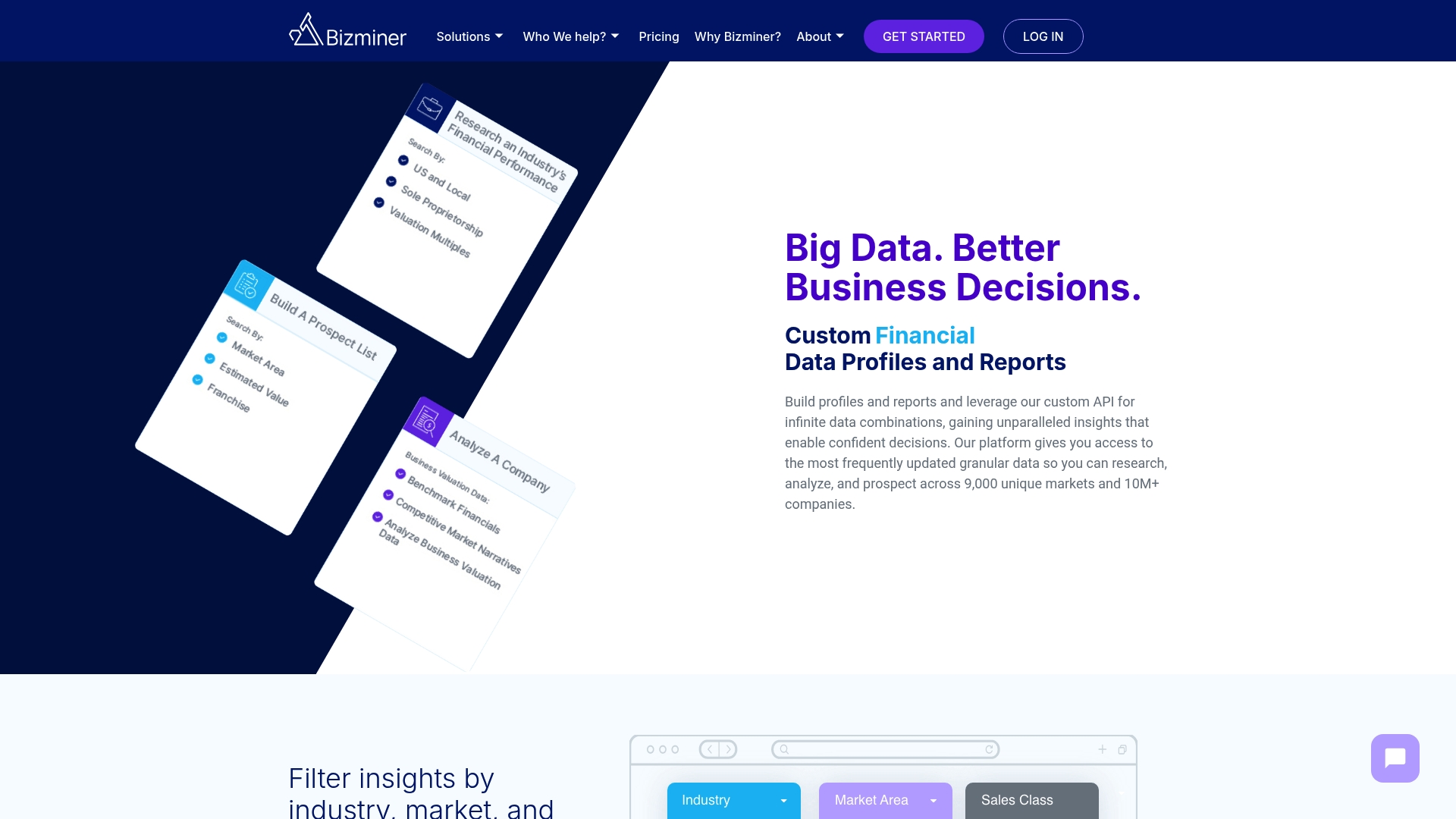
If origination is the bottleneck, our prospect list builder creates segmented lists, priced per record on the pricing page: $0.65, $0.60 or $0.55 per record depending on tier.
FAQ
Is cloud data the same as a cloud lending platform?
No. A cloud lending platform is software that runs origination, servicing or loan management, hosted by a vendor. Cloud data is the information you feed into decisions, such as industry benchmarks or company reports. Many lenders use both, but each is bought and evaluated separately.
Do banks use cloud services?
Yes, and U.S. regulators address it directly. The FFIEC issued a statement on risk management for cloud computing in 2020, and the OCC published supervision guidance the same year. Both stress due diligence, shared responsibility for security and regular control testing.
How can a lender get business data into its loan system?
The two common routes are saved reports attached to each file and an API feed that populates your systems directly. First map industry codes and size bands so the data lines up with how you classify borrowers. Then pilot on closed loans before using it on live decisions.
What should I check before trusting a dataset?
Check the named sources, the sample size behind each benchmark, how metrics are defined, the update date and the coverage of small or new businesses. Inconsistent definitions and missing segments can make large datasets hard to compare. When a segment is too thin, widen it and document the change.
Sources
- Take Charge of Your Data, Scotsman Guide
- Digitized loans and cloud storage services, Wolters Kluwer
- Why a Cloud Lending Platform matters for modern lending workflows, The Rockport Group
- Harness the power of your data, AWS
- Cloud-Based Loan Management Software Guide, LoanTabs
- Fintech Lending: Financial Inclusion, Risk Pricing, and Alternative Information, FDIC
- Interagency Statement on the Use of Alternative Data in Credit Underwriting, Federal Reserve
- Interagency Statement on the Use of Alternative Data, OCC news release
- The Use of Cash-Flow Data in Underwriting Credit, FinRegLab
- Using alternative data to evaluate creditworthiness, CFPB
- FFIEC Issues Statement on Risk Management for Cloud Computing Services
- Supervision Tip 2018-04, Identifying Risks Associated With Cloud Computing, OCC
- Interagency consumer protection statement on alternative data, FDIC
- Automation, Artificial Intelligence, and Machine Learning in Consumer Lending, Congress.gov
- CFPB Finalizes Personal Financial Data Rights Rule