A company SWOT analysis is a focused 2×2 exercise that sorts internal strengths and weaknesses against external opportunities and threats, then produces a short, prioritized list of strategic actions. It only works when each entry carries evidence, not opinion. Run one before a planning cycle, a product launch, or a quarterly strategy review, whenever a decision needs a clear picture of where the business stands.
TL;DR:
- Use specific, data-backed metrics for each SWOT entry to avoid vague or subjective claims that are hard to justify.
- Focus scope on one product, region, or business unit to enhance clarity and actionable insights rather than analyzing the entire company.
- Prioritize 3 to 7 key items per quadrant by impact and likelihood scores to maintain a manageable, decision-oriented list.
- Validate all entries by considering whether external sources, such as competitors or customers, would agree with them before including them.
- Incorporate industry-specific benchmarks and financial data to ensure SWOT findings are defensible during stakeholder or lender reviews.
Table of Contents
- What Is a SWOT Analysis, and How Do the Four Components Differ?
- Choosing the Right Scope and Timing for Your SWOT
- How to Run a Company SWOT Analysis, Step by Step
- How Do You Prioritize and Score SWOT Items?
- Turning SWOT Into Action: The TOWS Matrix
- Common SWOT Mistakes and How to Avoid Them
- A Ready-to-Use Template and Worked Example
- How Objective Financial Data Makes SWOTs Defensible
- Why Scoped, Data-Backed SWOTs Beat the Annual Ritual
- Bizminer for Data-Backed SWOTs
- Sources
What Is a SWOT Analysis, and How Do the Four Components Differ?
The framework splits into two axes: internal versus external, and positive versus negative. Strengths and weaknesses live inside the company. Cost structure, customer retention, staff expertise, proprietary technology. Opportunities and threats live outside it. Market shifts, competitor moves, regulation, supplier pricing. A SWOT analysis identifies internal strengths and weaknesses against external opportunities and threats, and the mistake most teams make is blurring that line. “Rising raw material costs” isn’t a weakness, it’s a threat, because the company doesn’t control it. “Slow product development cycle” is a weakness, because the company does control it.
The federal government’s own economic development guidance frames SWOT as a tool for identifying competitive advantages before setting strategy, which is a useful reminder that this isn’t a marketing exercise. It’s a diagnostic one.
Before an item earns a spot in any quadrant, run it through a quick filter:
- Is it specific enough to act on, or could it apply to almost any company in the industry?
- Does it have a number, date, or source attached, rather than a feeling?
- Is it clearly internal (something the company controls) or external (something happening to the company)?
- Would someone outside the room, a competitor, a customer, a lender, likely agree with it?
An item that fails two or more of those checks isn’t ready for the matrix yet.
Choosing the Right Scope and Timing for Your SWOT
A SWOT covering “the entire company” almost always produces mush: generic strengths, vague threats, nothing anyone can act on. Scope matters more than most teams realize. Focused SWOTs, built around a single product, channel, or region, produce sharper and more actionable results than a broad, company-wide sweep.
A few scoping and timing rules worth adopting:
- Anchor the analysis to one strategic question (“Should we expand into the Midwest?”) rather than “How are we doing?”
- Refresh a scoped SWOT quarterly, and trigger an ad-hoc one after a major market shift, a new competitor entry, or a leadership change.
- Involve four to eight people across finance, sales, operations, and product. University research guidance on building SWOTs specifically recommends pulling in multiple stakeholders rather than letting one department write it alone.
- Book 90 minutes for the workshop itself, and require pre-work so people arrive with data, not opinions.
How to Run a Company SWOT Analysis, Step by Step
Most SWOT sessions fail before anyone opens a whiteboard. They fail in the prep stage, when nobody bothered to pull real numbers, so the workshop turns into a brainstorm of hunches. Here’s a process that avoids that.
1. Define the scope and pull internal metrics first. Decide what you’re analyzing, a business unit, a product line, the whole company, and gather the financial and operational data that will anchor your strengths and weaknesses: revenue trends, gross margin, customer churn, Net Promoter Score, employee turnover. Whoever runs the session should arrive with a one-page data sheet, not a blank template.
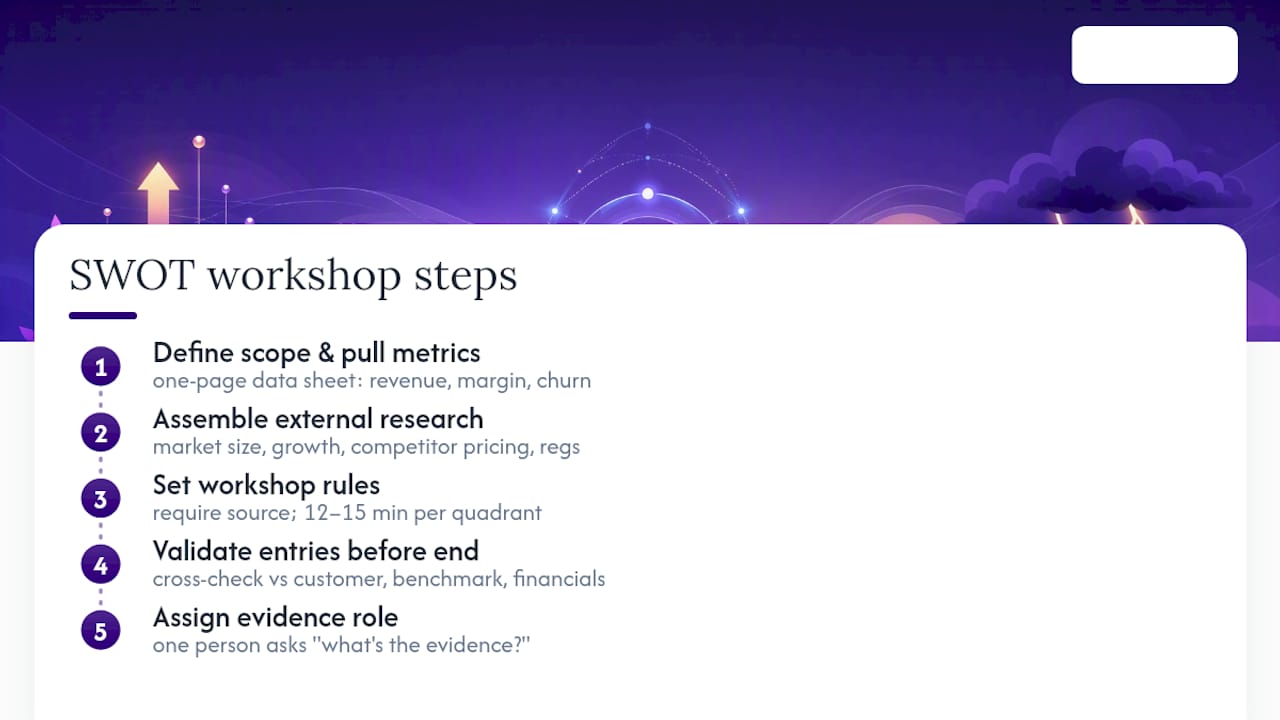
2. Assemble external research before the workshop, not during it. Market size, growth rate, competitor pricing moves, regulatory changes, supplier concentration. This is the research that separates a grounded SWOT from a guessing exercise, and it’s exactly where a custom market and industry report earns its keep, since pulling comparable industry data by hand for 20 competitors takes days that most teams don’t have.

3. Set workshop rules before anyone speaks. Three rules do most of the work: every item needs a source or a metric attached; each quadrant gets a strict time box (12 to 15 minutes tends to work); and the facilitator’s job is to challenge vague claims out loud (“what’s the evidence for that?”) rather than let them slide onto the board. Bias creeps in fast when the loudest voice in the room gets to define “our biggest weakness” by feel.
**4.
5. Validate every entry before the session ends. Two questions catch most of the weak entries: would a competitor agree this is really our strength? Would a customer agree this is really a weakness? Cross-check anything uncertain against a second source, an industry benchmark report, a customer survey, a financial statement, before it survives into the final matrix.
Pro Tip: Assign one person in the room the sole job of saying “what’s the evidence?” every time someone proposes an item. That single role catches more sloppy entries than any amount of good intentions.
The whole point of tightening the process this way is that it kills the two most common failure modes at the source: subjective, feel-based entries, and a matrix so long nobody can act on it. Grounding SWOT entries in empirical market data is what makes the difference between a wall of sticky notes and a document a board will actually use.
How Do You Prioritize and Score SWOT Items?
A 20-item quadrant isn’t a SWOT, it’s a brainstorm that never got edited. Best practice caps each quadrant at a small number of prioritized items, commonly 3 to 7, with 3 to 5 preferred when the goal is tight focus and real prioritization rather than exhaustive coverage.
The cleanest way to cut a long list down is scoring each item by impact and likelihood, typically on a 1 to 5 scale, then multiplying the two. An item that scores high on impact but low on likelihood might get archived, not deleted, just moved to a watch list.
| Impact × likelihood | Score range | Recommended response |
|---|---|---|
| High impact, high likelihood | 4 to 8 | Act now, assign an owner immediately |
| High impact, low likelihood | 12 to 15 minutes | Monitor closely, build a contingency |
| Low impact, high likelihood | 12 to 15 minutes | Handle through routine process, no special plan needed |
| Low impact, low likelihood | 1 to 5 | Archive, revisit at the next scheduled refresh |
Scoring this way does two things at once: it stops the loudest person in the room from dictating priority by tone of voice, and it gives you a defensible reason to leave something off the final list. That second part matters more than people expect, because a board or a lender will eventually ask why an item didn’t make the cut, and “it scored a 4” is a better answer than “it didn’t feel urgent.”
Turning SWOT Into Action: The TOWS Matrix
A SWOT that stops at the matrix is a filing exercise. The TOWS matrix is what converts it into strategy, by pairing quadrants against each other instead of listing them side by side.
- SO (Strengths to Opportunities): use an internal strength to capture an external opportunity. A strong direct-sales team plus a growing export market becomes “expand the sales team into the export region within two quarters.”
- WO (Weaknesses to Opportunities): fix a weakness to capture an opportunity that’s currently out of reach. Weak e-commerce infrastructure plus a growing online buyer segment becomes “rebuild the checkout flow before the next seasonal peak.”
- ST (Strengths to Threats): use a strength to blunt a threat. A loyal customer base plus a new low-cost competitor becomes “launch a loyalty pricing tier before the competitor’s launch date.”
- WT (Weaknesses to Threats): the defensive quadrant, minimize exposure where a weakness and a threat overlap. High supplier concentration plus rising input costs becomes “qualify a second supplier within six months.”
Pairing SWOT outputs into TOWS strategies and assigning ownership is the step most companies skip, and it’s the one that actually moves the needle. Every TOWS entry that survives should get four things attached before the meeting ends: an owner, a timeline, a KPI to measure progress, and a rough budget note if money is involved. Review the list monthly, not annually, or it drifts the same way the original SWOT would have.
Pro Tip: If a TOWS entry can’t be assigned an owner in the room, it’s not ready. Send it back for more definition rather than letting it sit on the list unowned.

Common SWOT Mistakes and How to Avoid Them
Three mistakes account for most SWOTs that end up ignored after the meeting:
- Vague, armchair entries. “Strong brand” and “increasing competition” say nothing. Insist on a number, a date, or a named source behind every item, or cut it.
- Over-listing without prioritization. A 30-item matrix is unreadable. Apply the quadrant limits above and score what’s left, rather than trying to capture everything anyone mentioned.
- Confusing internal and external. A price increase from a supplier is a threat, not a weakness. If the company can’t directly control the factor, it belongs outside the internal quadrants, full stop.
Beyond those three, governance is what keeps a SWOT alive past the meeting where it was created. Name an owner for the document, set a fixed refresh cadence, and build a rule that no quarterly strategy review proceeds without checking the current TOWS action list first.
A Ready-to-Use Template and Worked Example
A usable 2×2 template needs four boxes and one rule attached to each: every entry gets a short phrase, one supporting metric, and a priority score.
Template structure:
- Strengths (internal, positive): phrase plus metric plus score
- Weaknesses (internal, negative): phrase plus metric plus score
- Opportunities (external, positive): phrase plus metric plus score
- Threats (external, negative): phrase plus metric plus score
Here’s a worked example for a regional HVAC service company scoping its SWOT around residential growth:
- Strength: Repeat customer rate well above the industry norm. Impact high, likelihood high, act now.
- Weakness: Average technician response time longer than the regional standard. Impact high, likelihood high, act now.
- Opportunity: New residential construction permits increasing significantly year over year in the service area. Impact moderate, likelihood moderate, monitor and build a plan.
- Threat: Two new competitors entered the metro area recently with lower introductory pricing. Impact high, likelihood high, act now.
Adapting this to a different scope just means swapping the metrics: a software company might substitute churn and NPS for repeat rate, or market share data for permit counts.
How Objective Financial Data Makes SWOTs Defensible
“Weak marketing” is an opinion. That shift, from adjective to number, is what separates a SWOT a board will fund from one it will politely file away.
The kind of data worth attaching to each quadrant includes:
- Profitability and liquidity ratios benchmarked against industry-specific comparables, not generic averages
- Revenue growth trends over 12 and 36 month windows
- Market share estimates pulled from sector-level research
- Customer concentration or supplier concentration percentages
Most SWOT failures trace back to exactly this gap: entries built on impression rather than evidence. A financial advisor building a SWOT for a client ahead of a loan application or a board presentation needs numbers that hold up under scrutiny, not adjectives. That’s the practical use case for a custom benchmarking report: it turns “weak margins” into “gross margin of 28%, four points below the sector median,” which is the kind of line a lender or a board member can’t wave away.
Why Scoped, Data-Backed SWOTs Beat the Annual Ritual
Most companies run one SWOT a year, treat it as a compliance step, and shelve it by February. That’s backwards. A tighter, scoped SWOT run quarterly, tied to one real decision rather than a general checkup, produces far more usable output than a sprawling annual version nobody revisits.
The advisors who get the most mileage out of this framework are the ones who refuse to let a SWOT entry stand without a source behind it, then fold the resulting TOWS actions directly into the next planning cycle instead of filing them separately. When you’re packaging findings for a client or a board, lead with the metric, not the label.
— Danny
Bizminer for Data-Backed SWOTs
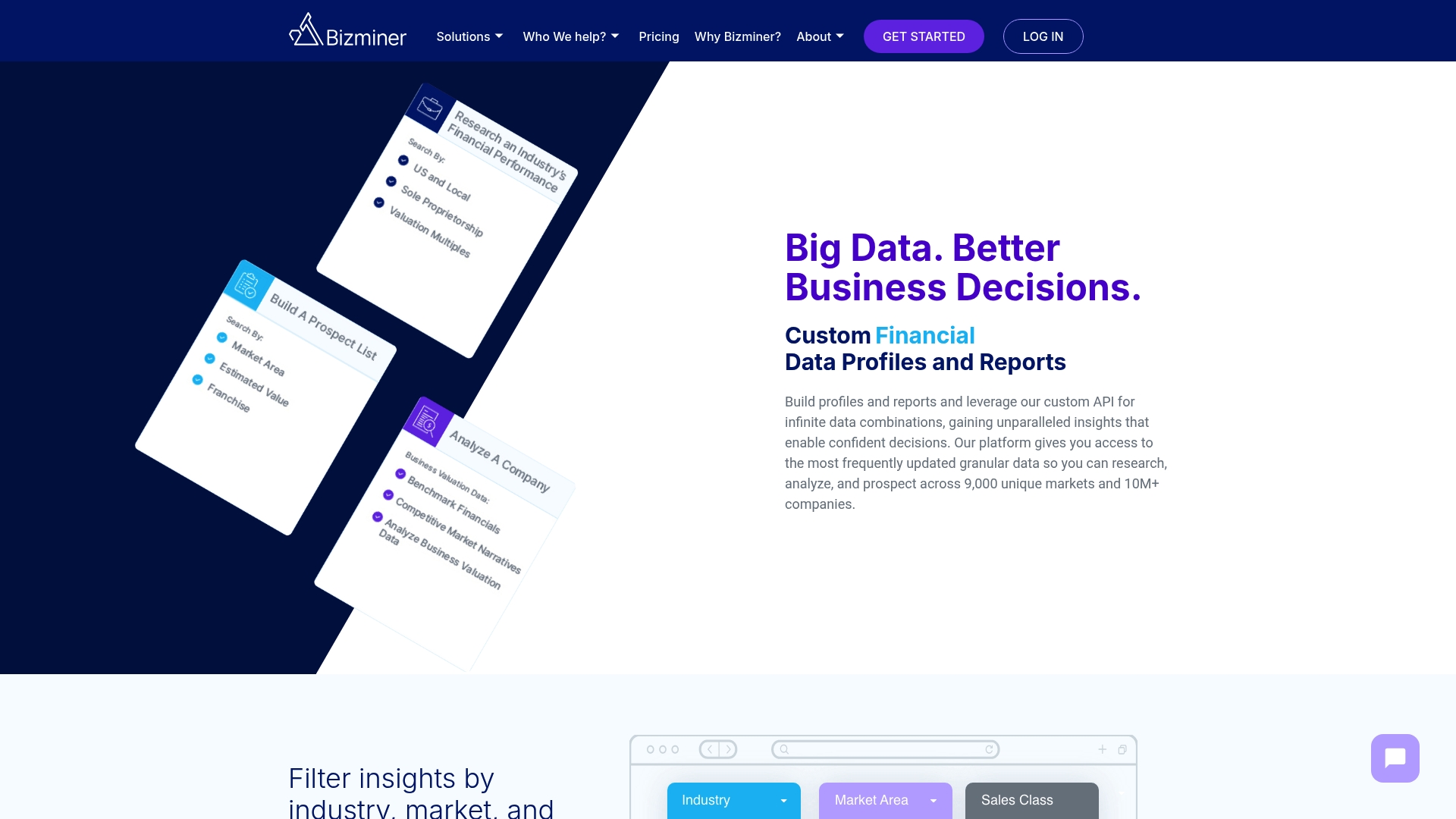
Most of the friction in building a defensible SWOT comes down to one problem: pulling accurate, industry-specific benchmarks by hand eats hours you don’t have, and generic averages don’t hold up when a board or lender pushes back. Bizminer closes that gap with granular financial profiles and benchmarks across more than 9,000 markets, segmented by industry, geography, and company size, so every strength or weakness you write down can carry a real comparable behind it.
Accountants, business advisors, and strategy teams use these reports to turn a soft claim into a hard one, replacing “margins seem tight” with a documented gap against a sector median a client or lender can verify. If you’re building a SWOT that needs to survive a board meeting or a loan committee, start by pulling a custom industry and market report for the specific sector and region your analysis covers, then attach those figures directly to your matrix before the next planning session.
Sources
For deeper methodology, the ClearPoint Strategy guide covers framework fundamentals and worked examples. The federal economic development office’s overview offers a government perspective on strategic planning use cases. For scoring and quadrant limits, see SWOTPal’s guide. For operationalizing outputs into growth plans, Kontrol Media’s consulting overview shows how strategy consultancies convert SWOT findings into marketing execution.
- What Is SWOT Analysis? The Complete 2026 Guide | SWOTPal
- SWOT Analysis Best Practices: Tips for Success
- SWOT Analysis: The Framework Everyone Uses and Almost Nobody Gets Right