AI now compresses market research that once took weeks into a process measured in hours, and it can process far more open-ended feedback than any human team working alone. That speed is real, but it comes with a catch: outputs are only as trustworthy as the validation layer behind them. Decision-makers who pair AI with authoritative benchmark data, like the kind Bizminer builds from public and private datasets, get faster answers without losing the evidence chain that makes those answers defensible.
TL;DR:
- Validating AI insights with authoritative benchmark data is essential, as AI models often smooth out anomalies that could be strategically important.
- AI is best suited for repetitive, quantitative tasks like social listening, coding open-ends, and early concept testing, but struggles with causal reasoning and outlier detection.
- Building a defensible pilot requires clear business goals, scope-limited testing, thorough documentation, and validation against human-reviewed sample results.
- Relying on structured industry and financial benchmarks from sources like Bizminer ensures AI-generated themes are grounded in credible, legally accepted data.
- AI adoption in market research emphasizes verification and traceability, with frameworks including regular audits, back-testing, and transparency to avoid hallucinations and bias.
Table of Contents
- What AI Changes in Market Analysis
- How Do Businesses Actually Use AI in Market Research?
- Which AI Tools Fit Which Research Task?
- Are AI-Generated Insights Reliable Enough to Act On?
- How Bizminer Anchors AI Outputs in Verifiable Data
- Building Your First AI Market Analysis Pilot
- A Researcher’s Take on AI’s Real Role
- How Bizminer Fits Into Your AI Workflow
- Sources
What AI Changes in Market Analysis
AI does not replace market research. It reallocates where the hours go. Tasks that used to eat up analyst time now run in minutes, while judgment calls that require context still belong to a person.
Generative models are genuinely strong at a specific set of jobs:
- Clustering thousands of open-end survey responses into coherent themes
- Coding qualitative data at a scale no human team could match manually
- Drafting synthesis summaries and pulling representative quotes
- Flagging early trend signals across social and text data
- Transcribing and summarizing interviews or focus groups in near real time
Where AI gets shakier is anything requiring causal reasoning or a stand-in for real human opinion. Research from NIM’s Marketing Intelligence Review found generative AI performs well at idea generation, pretesting, and coding open-ends, but performs worse when asked to substitute for actual respondents or to establish cause and effect. Synthetic “digital twin” respondents tend to average out responses, and that averaging can bury the odd, off-pattern answer that often turns out to be the strategically important one, according to MIT Sloan Management Review.
The inputs matter as much as the model. Unstructured text, survey verbatims, and social streams feed the qualitative side. Structured financial and industry benchmarks, the kind Bizminer compiles across more than 9,000 markets, give AI-driven trend detection something concrete to check itself against.
How Do Businesses Actually Use AI in Market Research?
The highest-value applications aren’t exotic. They’re the grinding, repetitive parts of research that used to require headcount.
- Concept pretesting. Run early-stage product or messaging concepts through AI-assisted screening before committing budget to a full quantitative study.
- Scaling qualitative coding. Feed thousands of open-end responses into a coding pipeline and get thematic buckets back in a fraction of the time a coder would need.
- Always-on social listening. Track subculture-level language shifts continuously instead of waiting for a quarterly report, catching product or category signals early.
- Pricing and competitive monitoring. Watch competitor pricing, positioning language, and review sentiment on a rolling basis rather than a one-time snapshot.
The workflow pattern behind all four looks the same: define the business decision first, run a scoped AI-assisted pilot, validate the output against a human sample, then scale what holds up. MIT Sloan’s research notes that traditional research often ran $15,000 to $50,000 and took four to twelve weeks; generative AI can compress a comparable exploration into days, sometimes less, which changes how frequently a team can afford to test.
Pro Tip: Run your first AI pilot on a decision you’d make anyway with a smaller budget. If the AI output disagrees with what your gut or your existing data says, that disagreement is more valuable than a dozen confirmations.
Which AI Tools Fit Which Research Task?
Instead of chasing a single “best” platform, it helps to think in categories, since different tools solve different parts of the pipeline.
- Transcription and analysis tools turn interviews and focus groups into searchable, codeable text.
- Open-end coding platforms cluster free-text survey responses into themes at scale.
- Social listening systems track sentiment and language shifts across platforms continuously.
- Synthesis and reporting tools draft summaries, pull quotes, and automate slide generation.
- API benchmark connectors pull in structured industry and financial data to check AI-generated conclusions against real numbers.
The prompt workflows that hold up under scrutiny share a structure: extract themes and require the model to link each theme back to a specific quote or data point, generate hypotheses and then explicitly ask the model to identify what evidence would prove them wrong, and run a deliberate “red team” pass where you ask the model to argue against its own conclusion. The UF Business Library’s prompt collection organizes similar sequences for market-sizing and competitive-landscape tasks, and it’s a useful template for building your own reusable prompt library.
Practitioners at BTInsights point out that the biggest reporting gains come from thematic clustering and slide automation, not from letting AI make the final call on what the findings mean. Anchoring those AI-generated themes against structured data, such as a Bizminer industry benchmark report, gives a theme extracted from qualitative text something quantitative to stand on.
One figure worth sitting with: the same MIT Sloan research that documents AI’s speed advantage also warns that models can miss the anomalous response that matters most, precisely because anomalies get smoothed out by averaging. Speed and completeness are not the same thing.

Are AI-Generated Insights Reliable Enough to Act On?
Speed and scale are the obvious wins. Iteration that used to take a month now takes days, and the cost per test drops enough that teams can afford to check an idea before betting a budget on it. A look at agency productivity gains from AI adoption echoes the same pattern outside pure research: the labor saved on repetitive drafting and coding work is the real dividend, not some abstract notion of “smarter” output.
The risks sit on the other side of the same ledger:
- Hallucination. Models can generate plausible-sounding conclusions that no data actually supports.
- Bias amplification. Training data skews carry through to thematic outputs, often invisibly.
- Sample quality gaps. Synthetic respondents smooth over the outliers that often drive real strategic decisions.
- Privacy exposure. Feeding proprietary customer data into third-party models can create compliance risk.
- Model drift. A pipeline validated in January can behave differently by summer without anyone changing a prompt.
None of these risks disqualify AI from research work. They define what a validation framework needs to cover. A defensible framework includes traceability from every insight back to its raw source, periodic sample audits comparing AI-coded themes against human-coded subsets, back-testing new outputs against known historical results, and adversarial “red team” review where someone actively tries to break the model’s conclusion. ESOMAR’s updated ethics guidance puts transparency and human oversight at the center of that same checklist, and it’s worth treating as a baseline rather than an aspiration.
Pro Tip: Before presenting any AI-assisted finding to leadership, ask one question: can I trace this exact claim back to the raw transcript or the raw number it came from? If the answer is no, the finding isn’t ready.

Industry commentary has moved past whether AI belongs in research at all. The live question, as Compeers AI’s 2026 analysis frames it, is where AI earns trust and where it still needs a human check. That shift from capability demos to verification standards is the defining story of AI adoption in research right now.
How Bizminer Anchors AI Outputs in Verifiable Data
AI-generated themes are only as credible as the numbers they get checked against. Bizminer builds custom financial data profiles and reports across thousands of markets, sourced from public and private datasets granular enough that the data has been accepted in U.S. Tax Court and used by government agencies. That kind of evidentiary standard matters when an AI-coded theme claims a shift in industry margins or competitive pricing.
A practical evidence-first workflow looks like this:
- Pull an industry or company benchmark as your quantitative anchor.
- Run AI coding on qualitative data (open-ends, interviews, social text).
- Check whether AI-identified themes line up with actual benchmark shifts.
- Audit a sample of AI-coded results against a human reviewer.
- Only then move the finding into a decision brief.
When evaluating any pilot, ask the provider for exportable evidence chains, API access to raw benchmark data, and sample-level exports you can audit independently, not just a polished summary slide. That’s the difference between an insight you can defend and one you’re hoping nobody questions.
Building Your First AI Market Analysis Pilot
A defensible pilot follows a set order. Skip a step and you end up validating nothing.
- Pre-flight: Define the exact business decision at stake, choose your data sources, and set success metrics upfront (accuracy lift, error rate, traceability rate).
- Pilot: Run the AI process on a minimal but representative dataset, with a fixed human-review sampling rate and written acceptance criteria for what counts as a good output.
- Scale: Once results hold up, add drift monitoring, assign clear governance roles, and version-control your prompts the same way you would version-control code.
- Document as you go: Record every prompt, every model version, and every human override so the next auditor (or the next skeptical executive) can retrace your logic.
Pro Tip: Treat your prompt library like a codebase. If you can’t tell someone exactly which prompt version generated last quarter’s report, you can’t defend last quarter’s report.
Bizminer’s business advisor resources offer a useful reference point for how to structure benchmark-anchored analysis before layering AI coding on top.
A Researcher’s Take on AI’s Real Role
AI has not made researchers obsolete. It has made the manual grind optional, which means the job shifts toward interpretation and evidence curation instead of data entry. That’s a better use of a skilled analyst’s time, but it only works if someone still owns the validation step.
My advice is to start smaller than feels comfortable, document every prompt and every human override from day one, and scale validation effort in proportion to the stakes of the decision. Pair AI’s speed with a data source you can actually defend under scrutiny. The teams getting real value out of this shift aren’t the ones with the fanciest model. They’re the ones who can show their evidence chain end to end.
— Danny
How Bizminer Fits Into Your AI Workflow
An example of an anchor many AI market analysis pipelines are missing is granular, sourced financial and industry data across thousands of markets that stands up to scrutiny, including some recognized by legal authorities. Instead of feeding AI on unverified web scrapes, you feed it benchmark data built for accountants, advisors, and analysts who need numbers they can defend in front of a client or a board.
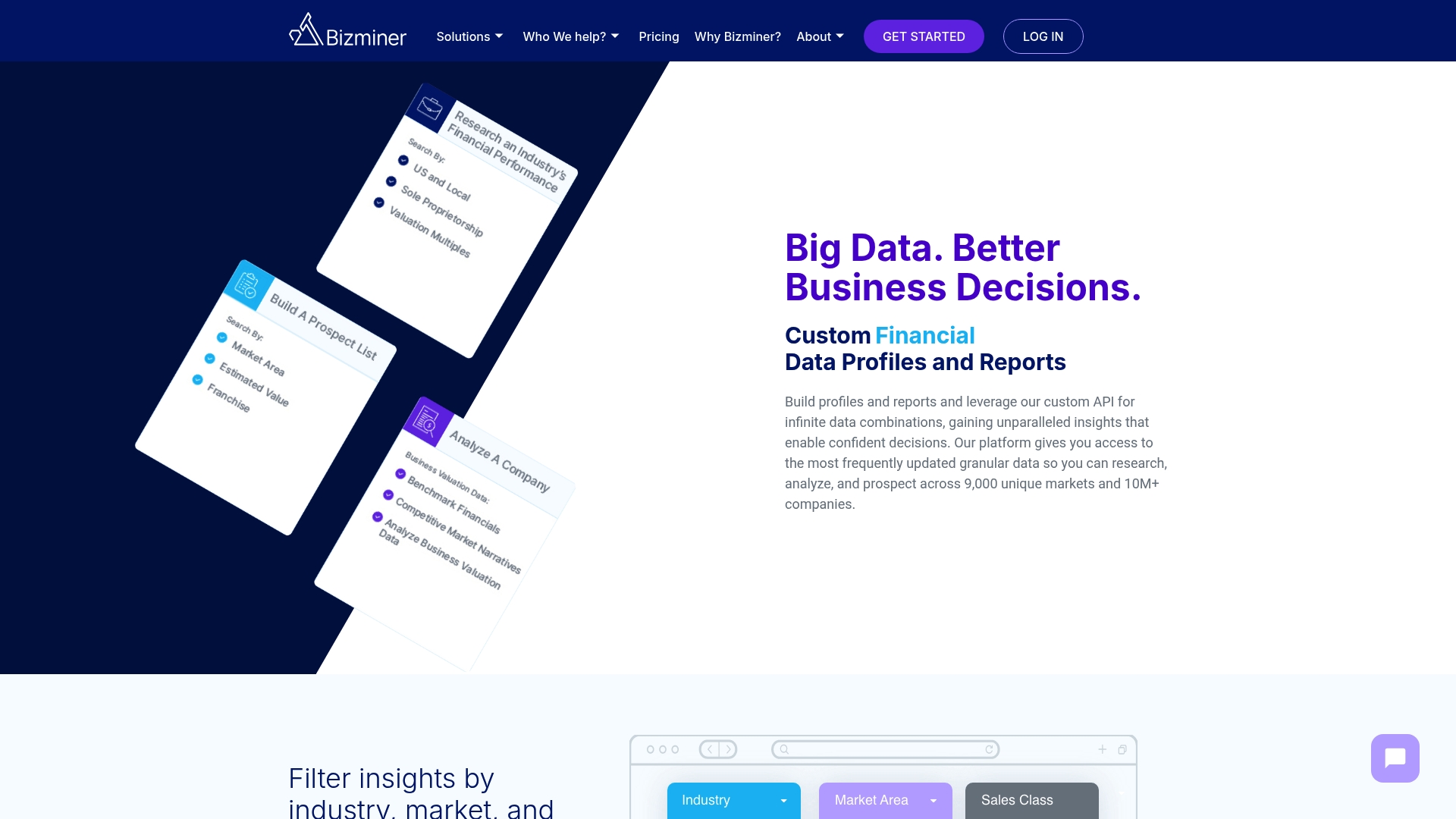
A pilot is straightforward to set up. Request a custom industry or market report for the sector you’re analyzing, or ask about API access so your AI pipeline can pull benchmark figures directly instead of relying on secondhand summaries. Either way, ask for the raw exports and sample-level detail, not just a finished chart. That’s what turns an AI-generated theme into something you can put in front of a decision-maker without hedging.
Sources
- Gain consumer insight with generative AI
- AI in market research (NIM Marketing Intelligence Review, 2026)
- The state of AI in market research in 2026: From hype to trust
- How generative AI is transforming market research