Start with IPEDS and NCES for institutional data, the Census API and BLS datasets for local economic context, the BEA API for regional accounts, SEC EDGAR for company financials, and PSEO or College Scorecard for graduate outcomes. These sources share three traits that matter for scholarly or institutional work: broad coverage, documented federal provenance, and programmatic access, so pick one, pull a small sample, and document every query parameter before you scale up.
TL;DR:
- Federal data sources like IPEDS, Census, BLS, and BEA offer broad coverage with documented methodology, but they often lack the granularity needed for firm-level or niche regional analysis.
- Commercial datasets provide detailed firm, industry, or geographic data and may include historical backfills, but they come with higher costs and restrictions on data sharing and reproducibility.
- When pulling data programmatically, record every query parameter and store raw responses with timestamps to ensure reproducibility and accurate referencing for future analysis.
- Merging datasets from different sources requires careful crosswalking of classification codes and aligning geographic and temporal units to ensure valid comparisons.
- Paid platforms like Bizminer fill the gap for niche industry benchmarks, offering transparent, audit-ready data tailored to specific sectors, regions, and company sizes at a reasonable cost.
Table of Contents
- Canonical federal sources for education and economic data
- Evaluating proprietary and subscription data options
- Pulling data programmatically without losing provenance
- Combining and validating data from different sources
- What years of working with market data taught me
- A direct option when you need granular, auditable benchmarks
- FAQ
- Sources
Canonical federal sources for education and economic data
Most research questions map cleanly onto one of four federal data families, and knowing which one answers your question saves weeks of searching.
IPEDS is the backbone of U.S. postsecondary research. It collects data through 12 interrelated survey components covering enrollment, completions, finance, and student aid, with new provisional data for the 2024-25 cycle slated for release on July 28, 2026. You can query it through the NCES Data Center for one-off lookups or the Trend Generator for multi-year comparisons, though most components lag the current academic year by one to two cycles.
The Census Bureau covers everything IPEDS does not: people, households, and firms. The American Community Survey (ACS) gives you demographic context around a campus or labor market, while the Economic Census and the Annual Business Survey describe the structure of local industries, down to employment and revenue by NAICS code. All three are queryable through API.census.gov, with geography and variable filters built into the request string.
BLS datasets fill in the labor-market side. OEWS (formerly OES) gives wage and employment estimates for more than 800 occupations and roughly 400 industries, built from unemployment insurance reports and multi-year samples, which makes its geographic detail unusually granular for a federal series. CPS tracks labor force participation and unemployment trends over time, while QCEW reports establishment-level counts tied to unemployment insurance filings.
BEA rounds out the set with regional income and GDP-by-industry data, both useful when you need to size a local market or adjust a national figure for a specific region.
A few examples of matching question to source:
- Regional market size for a feasibility study — BEA GDP-by-industry combined with Census Economic Census data.
Evaluating proprietary and subscription data options
Federal sources cover a lot of ground, but they rarely go deep enough for firm-level or hyper-local work. Commercial datasets fill that gap with firm-level detail, historical backfills, specialized panels, and local property or business microdata that federal surveys do not collect at that resolution.
The tradeoff is real. Licensing terms often restrict redistribution or republication, which can complicate a published paper’s reproducibility if other researchers cannot access the same source. Cost scales with coverage, and campus-wide or enterprise licenses can be substantial relative to a single federal API call, which is free.
Before committing budget or curriculum time to a commercial dataset, check:
- Sample frame: what population or geography the data actually represents.
- Documentation depth: whether methodology notes let you replicate a figure independently.
- Exportability: whether you can extract raw data for your own analysis pipeline or only view pre-built reports.
- Academic pricing: whether a campus subscription or institutional license is available versus one-off report purchases.
A dataset that scores well on all four tends to survive peer review and institutional audits better than one that only looks comprehensive on its marketing page.
Pulling data programmatically without losing provenance
Reproducible research starts with the smallest query that answers your question, not the biggest bulk download you can find. Run a narrow pull first, record every parameter, geography code, and date range, and store the raw response with a timestamp before you do anything else with it.

For the Census API, you will need a free API key, and most endpoints follow a predictable pattern: a base URL, a dataset year, a list of variables, and a geography filter. The Economic Census developer page shows example calls, such as pulling NAICS-coded employment and revenue figures for a specific state or metro area.
The BEA API requires registering for a 36-character UserID, after which you can call GetDatasetList to see what is available and GetData with dataset-specific parameters to pull NIPA or regional series.
For company-level work, Sec need no authentication at all. The companyfacts and xbrl endpoints return flattened, machine-readable financial data, and bulk archive files let you build longitudinal panels across many filers without hitting the API thousands of times.
Expect JSON from Census and BEA, JSON or XBRL from EDGAR, and CSV from most BLS downloads. A basic parsing script in R or Python handles all three formats without much custom code.
Pro Tip: Log the exact API call, including every parameter, alongside the raw response file; a query you can rerun six months from now is worth more than a polished chart you cannot trace back to its source.
Combining and validating data from different sources
Federal datasets rarely speak the same language. IPEDS reports programs by CIP code, BLS reports occupations by SOC code, and Census reports firms by NAICS code, so merging them means crosswalking between classification systems before any comparison means anything.
- Align frequency and geography — An annual IPEDS figure should not be compared directly to a quarterly QCEW number without first deciding on a common time window, and state-level BLS data should not be merged with metro-level Census data without reconciling the geography.
A short workflow sketch: pull IPEDS completions by CIP code, crosswalk to SOC, then pull BLS OEWS wage data for those SOC codes in the relevant geography. The result links a specific academic program to a defensible regional wage benchmark, with every step traceable.
What years of working with market data taught me
Public federal data wins on provenance and cost: it is free, documented, and citable down to the API call. What it rarely offers is the granularity a dean or a loan committee actually needs, like a percentile benchmark for a narrow NAICS segment in a single metro area. That gap is where paid platforms earn their keep, provided they publish their sample sizes and methodology as openly as the data they are built from. Documented sourcing matters more to me than flashy dashboards, because the people using this data are ultimately accountable for the decisions it supports.
— Danny
A direct option when you need granular, auditable benchmarks
Federal sources get you most of the way, but when your project needs industry benchmarks filtered by niche segment, geography, and company size, with a documented sample behind every figure, we built Bizminer for exactly that gap. Our data spans more than 9,000 industries, and our reports are built to be audit-ready: our benchmarks are used by government agencies, which means the sourcing behind every percentile is documented well enough to survive scrutiny.
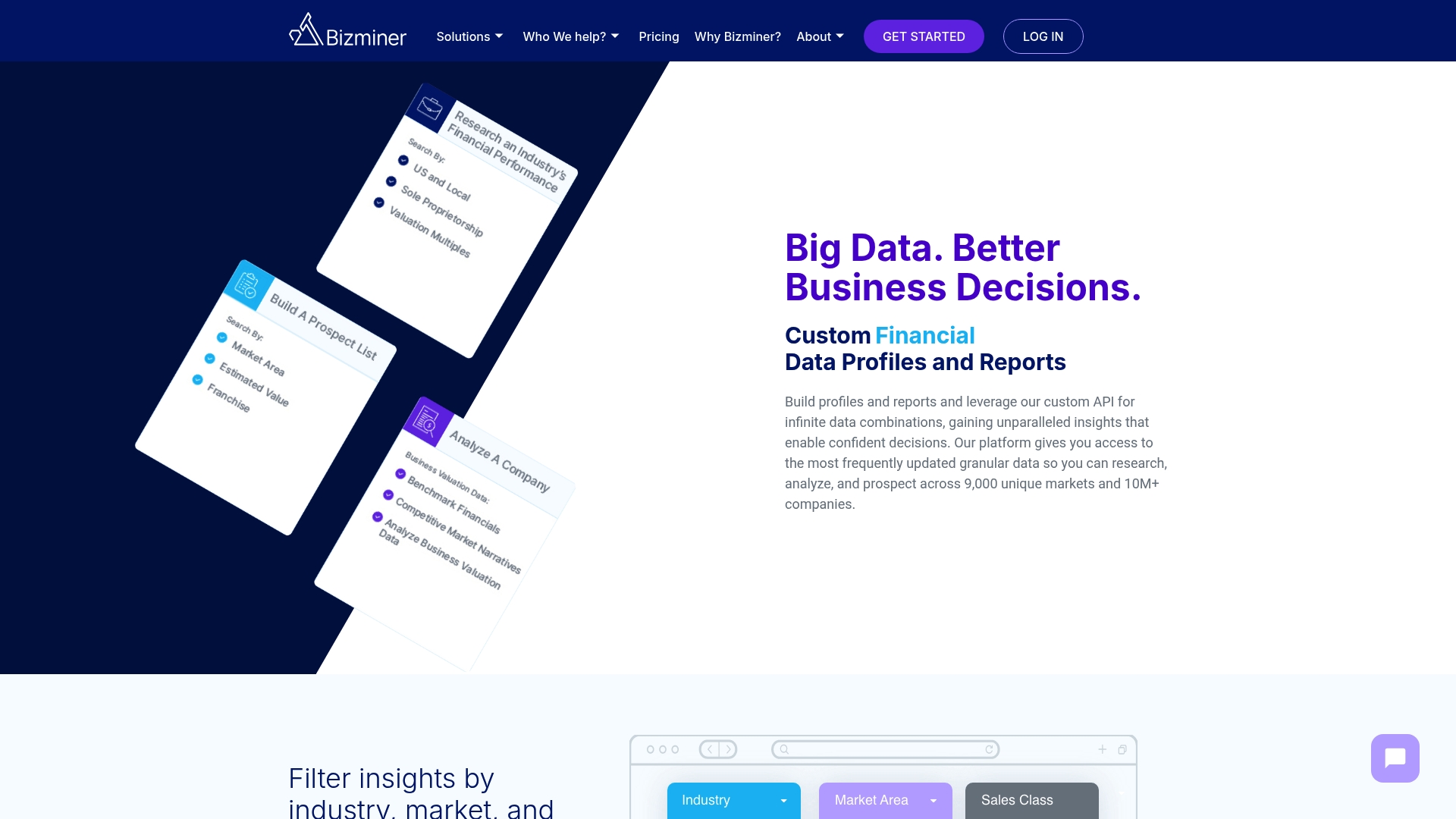
For academic and institutional work, we offer:
- Customizable reports filtered by NAICS segment, geography, or company size, not just national averages.
- An API feed for teams that want to pull benchmarks directly into their own research pipeline.
- Turnkey industry reports priced per report, starting at $249, so a single department can access specific data without a full subscription.
If your next step is validating a market-sizing claim or benchmarking a program against real industry data, our market and industry research page is the fastest way to see what a custom report for your specific question looks like, and our pricing page lists every report type and cost.
FAQ
What is the best starting source for academic market research?
Start with IPEDS if your question involves institutions, enrollment, or completions, since it is the authoritative federal source for postsecondary data. For economic or labor-market context around that institutional data, pair it with Census or BLS datasets.
Is PSEO data reliable for every institution?
PSEO data only covers institutions that participate in the program, so you should check the participation list before assuming it represents your target school. Where an institution is missing, College Scorecard or your own institutional records may be a better substitute.
How is College Scorecard different from PSEO?
College Scorecard earnings figures come from matching federal financial aid records to tax data, so the underlying sample is limited to students who received federal aid, while PSEO draws on a broader transcript-to-job-record match for participating institutions. The two can report different earnings for the same program because they measure different populations.
Can I cite federal API data directly in published research?
Yes, and doing so generally improves reproducibility, since a raw API call or bulk file download gives other researchers an exact path to the same data. Document the endpoint, parameters, and pull date alongside any figure you report.
Sources
Paid platforms make sense when you need granularity federal sources do not provide, such as firm-level detail for a narrow industry segment or a specific metro area. Evaluate any paid source on documentation depth and sample transparency before relying on it for institutional decisions.
- IPEDS survey components — NCES
- EDGAR Application Programming Interfaces — SEC
- BEA Web Service API user guide — BEA
- PSEO documentation — LEHD/Census