A competitor SWOT maps a rival’s buyer-visible strengths, weaknesses, market opportunities, and near-term threats, and it only earns its place on your calendar if it produces action. The method that works: gather evidence from at least three independent sources, score every finding on impact, likelihood, and confidence, and assign each surviving item an owner and a deadline. Skip any of those steps and you get a brainstorm, not a strategy tool.
Start this quarter with one priority competitor. Before the workshop, pull:
- Win/loss notes from your CRM for the last two quarters
- The 30 most recent reviews on G2, Capterra, or TrustRadius
- Current job postings and product changelogs
- Pricing pages and any recent funding or press signals
A weighted scoring approach using Impact × Likelihood × Confidence turns a list of observations into a ranked action plan, which is the difference between a SWOT that gets filed away and one that changes what your sales team says on Tuesday’s call.
Key Takeaways
An evidence-first competitor SWOT built on triangulated sources and Impact × Likelihood × Confidence scoring converts scattered observations into assigned, deadline-bound actions.
| Point | Details |
|---|---|
| Scope narrowly | Pick 3 to 5 competitors by buyer scenario, mixing direct and indirect rivals. |
| Require triangulation | Confirm findings with three independent sources or two Strong-tier ones before scoring them. |
| Score before debating | Use silent Impact × Likelihood × Confidence scoring to surface disagreement instead of letting the loudest voice anchor the room. |
| Cut to the top three | Keep only the highest-priority finding per quadrant in the decision table; park the rest on a watchlist. |
| Refresh quarterly, re-score on signals | Default to quarterly reviews, but re-score immediately after funding, pricing, or product news. |
| Anchor confidence with real data | Bizminer’s NAICS-sliced financial benchmarks provide Strong-tier evidence for scoring competitor moves with real numbers instead of guesswork. |
Table of Contents
- What Is a Competitor SWOT Analysis and How Do You Run One?
- How Do You Score and Prioritize SWOT Findings?
- How Do You Turn SWOT Findings Into Action?
- Where Does Classic SWOT Fall Short?
- How Does Bizminer Data Strengthen a Competitor SWOT?
- What the Data Actually Tells Us About Competitor SWOT
- Get Sharper Competitor Data Without Building a Research Team
- Sources
What Is a Competitor SWOT Analysis and How Do You Run One?
A competitor SWOT analysis is the same four-quadrant structure you’d use on your own company, aimed instead at a specific rival: their strengths and weaknesses as buyers experience them, and the market opportunities and threats their moves create for you. The standard SWOT framework for competition dates back decades, but most teams misuse it by treating every quadrant entry as equally important. It isn’t. A pricing weakness backed by 40 reviews matters more than a rumor from one sales call, and your process needs to reflect that from the first step.
Step 1: Scope the competitor set (10 minutes). Pick three to five rivals, mixing direct competitors (same product, same buyer) with one or two indirect ones solving the same problem differently. Scope by buyer scenario, not by company size. If you lose deals to a specific rival in mid-market accounts, that’s your priority competitor this quarter, regardless of how big their logo is.
Step 2: Pull evidence before anyone opens a whiteboard (2 to 3 days, assigned to one analyst). Export CRM win/loss reasons, screenshot the last 30 reviews on relevant platforms, check SimilarWeb or a comparable traffic tool for momentum, and scan job boards for hiring patterns that hint at product direction. Grab their current pricing page and note any recent changelog entries.

Step 3: Build competitor cards (1 day, analyst). One page per competitor: five bullet points per quadrant, each tagged with its source. No open-ended claims. If a bullet doesn’t cite where it came from, it doesn’t make the card.
Step 4: Run a 60 to 90 minute workshop with silent scoring first. Distribute the cards as pre-read. Open the session with five minutes of silent, individual scoring on paper or in a shared doc, then compare. This avoids the common failure mode where the loudest voice in the room anchors everyone else’s numbers before anyone has thought it through.
Step 5: Assign actions before the meeting ends. Every item that survives scoring gets an owner and a due date on the spot. An item without an owner by the time people leave the room typically never gets revisited.
Pro Tip: Book the workshop for 90 minutes but plan the agenda for 70. Competitor SWOT sessions almost always run long once people start arguing about scores, and that ten-minute buffer keeps the meeting from bleeding into everyone’s next call.
How Do You Score and Prioritize SWOT Findings?
Score every surviving finding on three 1 to 5 scales: Impact (how much this matters to your win rate or positioning if true), Likelihood (how confident you are the finding is real and current), and Confidence (how strong the underlying evidence is). Multiply the three together for a Priority score between 1 and 125, then rank everything within each quadrant.
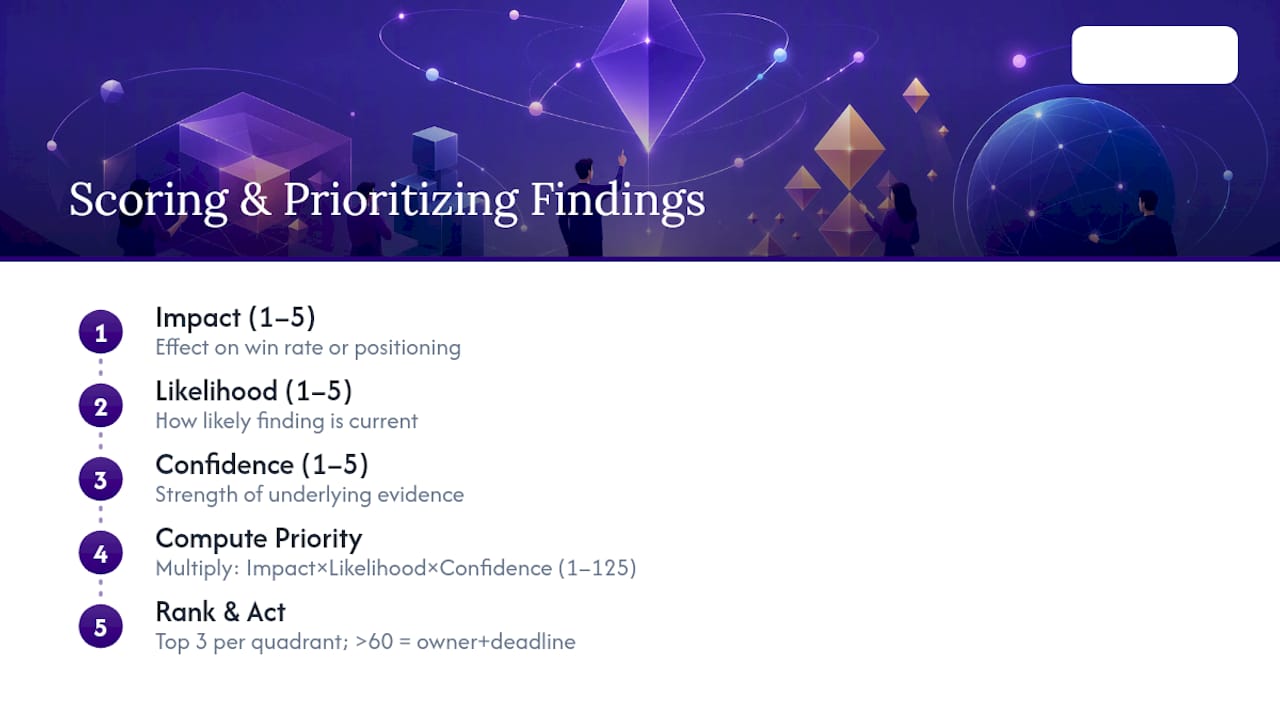
Cut ruthlessly. Keep only the top three findings per quadrant for the decision table; everything else goes in an appendix for reference, not for action. A common threshold: anything scoring above 60 gets a named owner and a deadline this cycle; anything between 30 and 60 goes on a watchlist; anything below 30 gets dropped unless a single dimension (usually Impact) is a 5, in which case it becomes a flagged wildcard worth a follow-up conversation even without full confidence.
Pro Tip: Don’t average scores across a group during the workshop. Averaging hides disagreement. If three people scored an item a 5 on Impact and two scored it a 2, that spread is information, not noise, and it usually means you need more evidence before committing an owner’s time to it.
How Do You Turn SWOT Findings Into Action?
A SWOT that stops at the matrix is a report nobody rereads. Forcing prompts and an action column are what convert a competitor observation into something your sales and product teams actually use, and a TOWS session is the fastest way to get there.
Run TOWS immediately after scoring, using the same room if possible:
- Match strengths to opportunities: where does your existing advantage let you exploit a gap the competitor just created?
- Match strengths to threats: what defends your position against their move?
- Match weaknesses to opportunities: what would you need to fix to capture a market shift?
- Match weaknesses to threats: what’s the minimum defensive action to avoid losing ground?
Sort every resulting initiative on an effort versus impact grid. Quick wins (low effort, high impact) get assigned that week. Strategic bets (high effort, high impact) go into the next planning cycle with a named sponsor. Everything low-impact gets parked.
- Set a quarterly refresh as the default cadence for the full matrix.
- Re-score immediately after a major signal: a funding round, a pricing change, a significant product launch.
- Track KPIs tied directly to the actions you assigned: win rate against that specific competitor, time-to-close on contested deals, and adoption of any feature you built in response.
Where Does Classic SWOT Fall Short?
SWOT’s biggest flaw isn’t the framework itself, it’s treating it as a one-time snapshot with every quadrant item weighted equally. A qualitative study of senior managers found that practitioners routinely criticize SWOT for being static and subjective, and the fix those same managers landed on was integrating it with predictive analytics and scenario planning rather than abandoning it.
Weighted scoring solves the equal-weight problem. Scenario planning and PESTLE solve the static-snapshot problem, since they’re built for macro shifts (regulation, technology, economic cycles) that a single competitor card won’t surface. Porter’s Five Forces earns its place when the question is industry structure, not one rival’s moves. As competitive intelligence tooling matures into dedicated platforms, per Gartner’s inaugural coverage of competitive and market intelligence platforms, continuous monitoring is displacing the pure quarterly-snapshot model for organizations that can support it.
A workable rule of thumb: use SWOT for tactical competitor scans, PESTLE or scenario planning for strategic market shifts, and weighted scoring layered on top of both to decide what gets worked on first. For deeper background on combining these methods, this guide to SWOT analysis enhancements covers the template variations in more depth.
How Does Bizminer Data Strengthen a Competitor SWOT?
Most competitor SWOTs run thin on the Confidence axis because teams rely on scraped reviews and guesswork about financials. Bizminer closes that gap with data drawn from over 9,000 industry segments, sliced by NAICS code, geography, and company size.
- Use industry financial benchmarks to validate whether a competitor’s pricing move is sustainable given typical margins in their category.
- Pull market share and growth estimates for the competitor’s specific NAICS segment to size an opportunity before assigning it a Priority score.
- Cite Bizminer figures directly in the Evidence Summary column of your decision table, and weight them as Strong-tier since Bizminer data is accepted in U.S. Tax Court.
Pro Tip: Run a 30-day pilot: pull one custom Bizminer report on your priority competitor’s industry segment, then build a single working SWOT around it before committing to a full quarterly rollout.
What the Data Actually Tells Us About Competitor SWOT
The conventional advice on competitor SWOT treats it as a one-afternoon whiteboard exercise, and that’s exactly why so many of them end up forgotten in a shared drive by February. The research on this is fairly blunt: managers themselves call the classic version static and subjective, then quietly rebuild it with scoring and monitoring layered on top because the plain version doesn’t hold up under real decision pressure.
What gets underrated is how much of the value sits in the evidence-gathering step, not the workshop. Teams love the meeting because it feels strategic, but the meeting is only as good as the data pulled beforehand. A room full of smart people scoring bad evidence still produces bad priorities, just with more confidence attached.
If you take one thing from this, take the triangulation rule. It’s the cheapest fix and the one teams skip most often under time pressure. Three sources before you trust a finding isn’t bureaucracy, it’s the difference between a SWOT that survives contact with your VP’s questions and one that doesn’t.
— Danny
Get Sharper Competitor Data Without Building a Research Team
Most of the evidence work in a competitor SWOT, the financial ratios, the market share estimates, the industry benchmarks, doesn’t have to come from guesswork or a scraped review site. Bizminer supplies that data directly, sliced by NAICS code, geography, and company size across more than 9,000 industry segments, so the Confidence score on your matrix is backed by numbers instead of a hunch.
If you’re a business advisor or accountant running competitor SWOTs for a client, Bizminer’s tools built for advisors give you the financial ratios and benchmarking data to fill the Strength and Weakness quadrants with figures a client can actually act on. If you need a one-off deep dive rather than an ongoing subscription, a custom analysis report covers a specific competitor’s market with the kind of granular detail that holds up even in U.S. Tax Court proceedings.
Start with one priority competitor: pull a custom report for their industry segment and drop the figures straight into your next SWOT workshop.
Sources
Not all evidence carries the same weight, and treating a single glowing review the same as a pattern across 40 reviews is how SWOTs fill up with noise dressed up as insight. Rate every source on a simple three-tier scale before you let it anywhere near the matrix.
- From insight to action: enhancing SWOT analysis for an actionable plan
- How to Run an Evidence-Based Competitor SWOT Analysis (With Weighted Scoring)
- SWOT analysis for competitors: 2026 guide
Triangulation, the practice of cross-checking a claim against at least three independent sources, is standard practice in evaluation research for exactly this reason: single-source observations get mistaken for patterns constantly. Applied here, the rule is simple. Require three independent signals, or two Strong-tier ones, before an observation earns a spot in the matrix. A competitor’s “poor mobile experience” claim needs a CRM loss reason, a cluster of review complaints, and ideally one more corroborating signal like a support forum thread. One angry review from a disgruntled former customer doesn’t clear that bar.
Log every piece of evidence with a timestamp and a source link in a shared working file, not just a summary bullet on the card. Six months from now, when someone asks why you flagged a competitor’s support team as a weakness, you want to point to the actual reviews and the date you pulled them, not reconstruct your reasoning from memory.