A dataset citation follows the same logic as a journal citation: it names who produced the data, what it is called, which version you used, who publishes it, and where a reader can find it. No single body owns the standard. APA, Chicago and MLA each give a pattern, and community principles such as FORCE11’s fill in the rest. This guide gives you the elements, the APA 7 pattern with examples, the adjustments for changing data and commercial market data, and a way to make benchmark citations hold up when someone checks them.
TL;DR
- Every dataset citation needs a producer, a date, a title, a version, a publisher and a persistent locator such as a DOI or a stable URL.
- In APA 7 the format is Author. (Year). Title (Version) [Data set]. Publisher. DOI or URL.
- Data that changes needs a version ID, a retrieval date or a documented query, so a reader can recreate the exact slice you used.
- For market and benchmark data, name the producing organization, the industry code, the geography, the size band and the release you pulled.
- A citation format only makes data traceable. Audit and court review also depend on documented sources and sample sizes.
Table of Contents
- Why dataset citation has standards at all
- What every dataset citation should contain
- How to cite a dataset in APA 7
- Chicago and MLA: adapting general patterns
- Citing data that changes
- Citing market data from a commercial report or database
- Why benchmark citations need more than a format
- Where Bizminer fits
- Our perspective
- FAQ
- Sources
Why dataset citation has standards at all
The FORCE11 Joint Declaration of Data Citation Principles treats data as a legitimate, citable product of research. It says that whenever a claim relies on data, the data should be cited. It also says citations should credit all contributors and carry a persistent, machine-actionable, globally unique identifier.
There are three practical reasons to follow this:
- Credit. The University of Michigan Library explains that a data citation acknowledges the original producer and helps others find the resource. It also puts your use of the data into the scholarly record.
- Transparency. Michigan’s health sciences data management guide says citing data makes your own work more transparent, just as citing earlier research does.
- Reproducibility. The DCC guide to citing datasets notes that a good citation gives the information needed to locate and access the data. It also lets datasets use the infrastructure that journal papers already rely on.
For an accountant, lender or analyst the stakes are practical. A benchmark in a valuation, a loan memo or a grant application is a claim. When a reviewer asks where the number came from, the citation is your answer.
What every dataset citation should contain
The University of Michigan Library lists the core elements: author, title, year of publication, publisher (often the archive), edition or version, and access information. Use a DOI in place of a URL when one exists.
The DCC guide, written by Alex Ball and Monica Duke, adds detail on several elements:
| Element | What to record |
|---|---|
| Creator | The person or organization responsible for the data |
| Date | The later of the date made available, the date quality assurance finished, or the end of any embargo |
| Title | The name the producer gives the dataset |
| Edition | The level of processing |
| Version | A number that increases when the data change |
| Resource type | For example, data set |
| Publisher | The archive or distributor |
| Identifier and location | A persistent identifier, plus where the data can be found |
Producer versus distributor
A dataset can have a producer, the organization that sponsored the research or made it possible, and a distributor, the organization that makes it available for download. Michigan’s guide says you can tell them apart with brackets such as [producer] and [distributor]. APA does not require a publisher when an electronic retrieval location is given.
Persistent links beat direct links
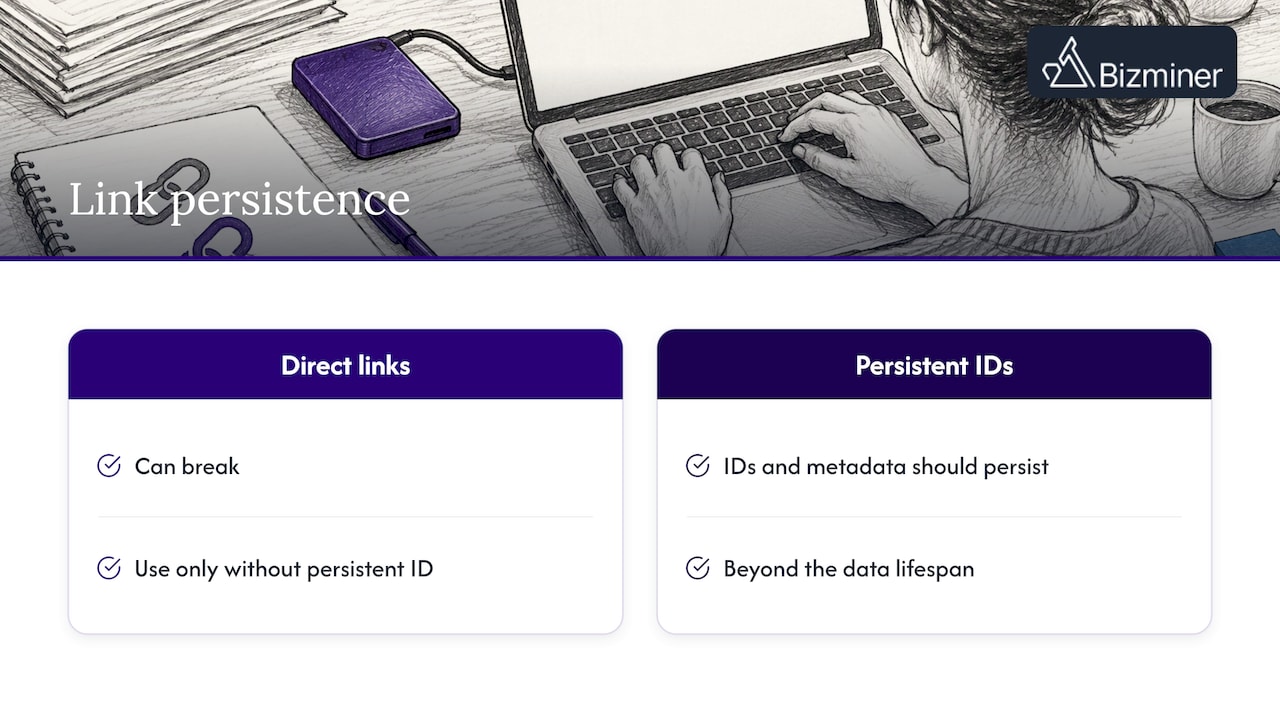
The U.S. Geological Survey points out that direct access links are not persistent and can break. It recommends them only when a product has no DOI or other persistent identifier. FORCE11 goes further: identifiers and metadata should persist even beyond the lifespan of the data.
How to cite a dataset in APA 7
The APA Style website gives this reference entry as its model:
O’Donohue, W. (2017). Content analysis of undergraduate psychology textbooks (ICPSR 36966; Version V1) [Data set]. ICPSR. https://doi.org/10.3886/ICPSR36966.v1
Read it piece by piece:
- Author. The person, group or organization that produced the data.
- Date. The publication year of the version you used.
- Title. Italicized, followed by the identifier and version in non-italic parentheses, separated by a semicolon.
- Description. The bracketed [Data set] label. APA says the wording is flexible.
- Publisher. Goes in the source element, followed by the DOI or URL.
In-text citations are parenthetical, (O’Donohue, 2017), or narrative, O’Donohue (2017).
UIC’s APA guide shows the generic template with a version: Author, A. A., & Author, B. B. (Year). Title of data set (Version #) [Data set]. Publisher Name. DOI or URL. For raw data that is not published, it gives a separate [Unpublished raw data] pattern with a retrieval date and URL. You can see the full pattern in UIC’s APA data examples.
Corporate authors and web-based data
Most business datasets come from an organization, not a person. Butler University’s APA guide for business majors shows a corporate author in this example: DataUSA. (2021). United States workforce and wage by location [Data set]. https://datausa.io/profile/geo/united-states#workforce-and-wage-by-location
The same guide adds a useful rule. If you have no direct URL to the file, such as a spreadsheet, use the URL of the page that offers the download. In the example, that page is a visualization with an option to download the full data as a CSV file.
Data set or the publication it came from?
APA asks for a data set reference when you have run secondary analyses on publicly archived data, or when you are archiving your own data for the first time. If you are citing existing data or statistics, cite the publication they appeared in, whether a journal article, report or webpage. The test is simple: did you work with the data file, or did you quote a figure from a document?
Chicago and MLA: adapting general patterns
The Michigan guide notes that neither the MLA Handbook nor the Chicago Manual of Style specifically addresses datasets. It gives adapted patterns, using a federal dataset as the example:
- MLA 9th: Bureau of Transportation Statistics. 2020 National Census of Ferry Operators. United States Department of Transportation, 01 March, 2022, Washington DC. www.bts.gov/NCFO
- Chicago 16th, bibliography style: Bureau of Transportation Statistics, 2020 National Census of Ferry Operators (Washington DC: United States Department of Transportation, 2022), https://www.bts.gov/NCFO
- Chicago author-date: Bureau of Transportation Statistics. 2020 National Census of Ferry Operators. Washington DC: United States Department of Transportation, 2022. https://www.bts.gov/NCFO
The elements are the same in all three: producer, title, publisher, year, location. Only punctuation and order change. If your institution or client mandates a style, apply its pattern to the elements in the table above. For paste-ready layouts you can adapt for notes and quotations, these templates to cite passages are a handy companion.
Citing data that changes
Financial and market data is rarely frozen. Industry averages are refreshed, companies are added or removed, and a query run today may return a different set next quarter. That is why citation standards put so much weight on versions.
The guidance converges on a few rules:
- Record a version ID. USGS says versioned and dynamic data citations should include one.
- Document the subset. For a subset of a dynamic product, USGS recommends query parameters written in plain text when the string is short and simple. If it is long, describe it elsewhere in the manuscript. The goal is that others can understand and recreate the subset.
- Prove it is the same slice. FORCE11 asks for provenance and fixity information, enough to verify that the timeslice, version or granular portion retrieved later matches the one originally cited.
- Do not rely on non-persistent methods. The DataCite Metadata Schema warns that citing dynamic data without a unique identifier means following the citation does not lead to the resource as cited. That limits reproducibility.
- Version the infrastructure. The Research Data Alliance’s 2025 guidance on dynamic data says that when earlier states must be reproducible, the system must version changes and timestamp when each change becomes visible. It must also assign a new persistent identifier to a query if the query is new or the result set differs because the data changed.
Access dates
USGS notes that a data citation for a product released alongside a journal article does not need an access date in that publication. The recommended citation on a landing page should not carry one either. The access date is added by the person citing the product. If you pulled data from a live source with no version ID, add your retrieval date.
Citing market data from a commercial report or database
Market and industry data raises a question the academic guides only partly answer. The producer is often a company, the file sits behind a login, and there is no DOI. Apply the same logic as above to the pieces you do have.
For a corporate source, the Butler guide’s DataUSA model is a sound pattern: organization as author, year, title, [Data set], then the URL of the page where the data lives. For a report or a table pulled from a platform, a reference like this works:
Organization name. (Year of release). Title of report or dataset (Release or version) [Data set]. Publisher. URL of the platform or landing page
Then add the details that make a business benchmark checkable. These go in a note or an appendix beside the reference:
- Industry definition. The NAICS code, which is the federal system that classifies businesses by industry, and its level of detail.
- Geography. National, state, metro or county, exactly as filtered.
- Size band. Revenue or employee range of the companies included.
- Release date. The refresh you used, because the next one may differ.
- Metric definition. For example, which ratio and how it is calculated.
These are the same ideas as the query-parameter rule from USGS, applied to a business dataset. Anyone who repeats your filters should land on the same figure.
A short checklist before you submit
- Is the producer named, and is the distributor named too if they differ?
- Does the reference carry a version, release date or retrieval date?
- Can a reader reach the source through a DOI or stable URL?
- Are the filters (industry code, geography, size) written down?
- Did you cite the data set when you worked with the file, and the publication when you quoted a figure from it?
Why benchmark citations need more than a format
A perfectly formatted citation proves where a number came from. It does not prove the number deserves trust. For work that may be examined, such as a tax position, a loan file or an audit, reviewers also ask how the data was built: how many companies, from which sources, and how they were grouped.
That is the idea behind data provenance, the documented history of where data came from and how it was handled. Our guide to data provenance covers it in detail. For academic work, our page on reproducible academic market data shows how to keep an analysis repeatable. If your benchmark may be challenged in tax controversy, see our notes on building court-ready data benchmarks.
Where Bizminer fits
Bizminer provides financial data profiles and reports across more than 9,000 markets, segmented by industry, geography and company size. Our data is accepted in U.S. Tax Court and used by government agencies. Our reports include larger sample sizes and detailed source lists, so the citation you write points at documentation a reviewer can follow.
Reports are sold one-off: Industry Financial Performance, Industry Market and Company Profile reports are $249 each, and Financial, Market, Valuation and Company reports are $349 each. A subscription and a customizable API feed are also available. You can see all options on our pricing page. If you need to pull defensible industry data programmatically, see our market data API.
Our perspective
Most citation guides are written for a world where a dataset is a file with a DOI. Our customers work in a world where the “dataset” is a benchmark for one industry, in one region, at one size, and it has to be defended in front of an examiner, a credit committee or a judge.
That is why we focus on granularity and on documentation. When you can filter by niche segment, geography and business size, your citation can name exactly what you used, and the next person can repeat it. When the report lists its sources and sample sizes, the citation leads somewhere solid.
Our advice is to cite the producer, the release, and every filter you applied, then keep the report in your workpapers. Accountants, advisors and lenders who do this spend less time answering the question “where did this number come from?” because the answer is already written down.
Danny
FAQ
How do I cite a dataset in APA 7?
Use Author. (Year). Title (Version) [Data set]. Publisher. DOI or URL. The date is the publication year of the version you used, and the bracketed description is flexible. In text, write (Author, Year) or Author (Year).
Do I need an access date for a dataset?
Not when the data is a fixed, versioned product with a persistent identifier, since the version pins down what you used. USGS says the recommended citation on a landing page should not include one. Add a retrieval date when you cite changing data that has no version.
How do I cite market data in APA?
Treat the publishing organization as the author, add the year, the title, [Data set] and the URL of the page that offers the data. Then record the industry code, geography, size band and release in a note, so the figure can be reproduced.
Should I cite the dataset or the report it appeared in?
APA says to cite the data set when you analyzed the archived data yourself. If you are quoting an existing figure or statistic, cite the publication that contains it, such as the report or webpage.
Sources
- Citing Data & Statistics, University of Michigan Library
- Citing Data, Research Data Management (Health Sciences), University of Michigan
- Joint Declaration of Data Citation Principles, FORCE11
- How to Cite Datasets and Link to Publications, DCC
- Data Citation Frequently Asked Questions, U.S. Geological Survey
- Citation of dynamic datasets, DataCite Metadata Schema
- Precise, Actionable Reference to Dynamic Data, Research Data Alliance
- Data set references, APA Style
- Data sets, Citing Guide for Business Majors, Butler University
- Citing Data Examples in APA 7th Edition, UIC