U.S. Tax Court accepts industry benchmarks, public filings, comparable transactions, and statistical datasets as a basis for expert opinions when the expert reasonably relies on them under the standards of Federal Rules of Evidence 702. The single most important action you can take is to document your selection criteria, methodology, and workpapers so the Court and opposing counsel can trace every figure back to its source.
TL;DR:
- Experts can rely on industry benchmarks, public filings, and statistical data if they are appropriately documented and based on reliable principles.
- Proper documentation of source selection, data lineage, and methodology is crucial for the data to withstand cross-examination and potential court scrutiny.
- Use granular NAICS classifications and disclose sample sizes, source links, and calculations to improve the credibility of valuation estimates.
- Vendor benchmarks must include source lists, methodology, and sample details to be admissible and persuasive in valuation disputes.
- File expert reports at least 15 days before trial, including raw data, methodology, and source documentation, to avoid exclusion of testimony.
Table of Contents
- What the rules require for admissible data-based opinions
- Where to find data the court will accept
- How to document and defend your data in an expert report
- Turning raw data into a court-ready benchmark
- A compact checklist before you file
- Lessons from the valuation trenches
- Getting court-ready benchmarks without building them from scratch
- FAQ
- Sources
What the rules require for admissible data-based opinions
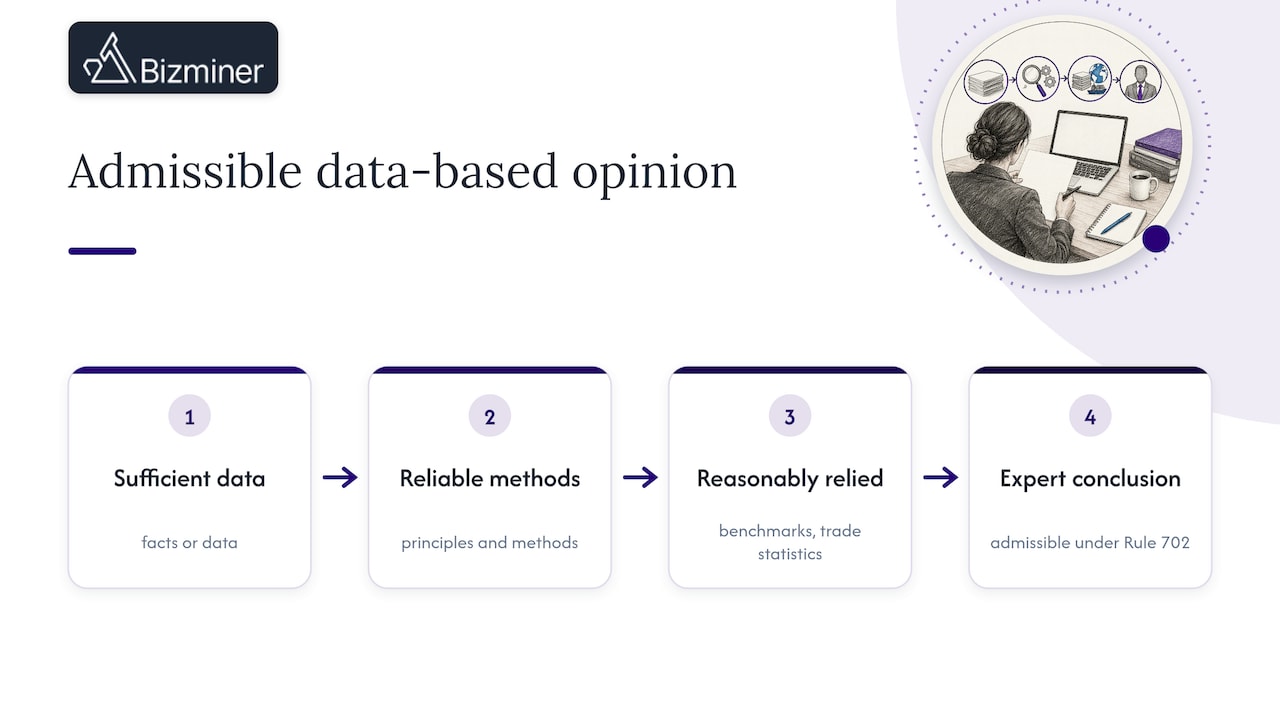
Federal Rule of Evidence 702 permits expert testimony grounded in “sufficient facts or data,” so long as the expert applies reliable principles and methods to the facts of the case. The rule does not demand that every underlying number be independently admissible. It requires that the data be the kind reasonably relied upon by experts working in that field, which is why industry benchmarks, trade statistics, and vendor reports can support an opinion even when they would not stand alone as evidence.
Rule 705 adds a practical wrinkle: an expert may state a conclusion without first walking through every underlying fact or data point, but opposing counsel can compel disclosure of that data on cross-examination. That means you should treat every spreadsheet, extraction script, and vendor source list as discoverable from the start rather than as backup material you might never need to produce.
Procedurally, the U.S. Tax Court’s rules of practice require written expert reports detailing the facts, data, and reasoning behind an opinion, generally furnished no later than 15 days before the trial calendar call. Missing that window risks exclusion of the testimony entirely, regardless of how sound the underlying analysis is.
Where to find data the court will accept
Several categories of data show up repeatedly in Tax Court valuation and benchmarking disputes, each with its own strengths and documentation burden.
- Government sources: SEC EDGAR filings, Bureau of Labor Statistics wage and productivity data, Census Bureau economic surveys, and Bureau of Economic Analysis figures carry built-in credibility because they are public, methodologically transparent, and free of commercial bias.
- Public and state company filings: 10-Ks, proxy statements, and state corporate filings give you verifiable financial detail, but you need to document exactly which line items you pulled and how you normalized them for comparison.
- Industry benchmarks and ratio databases: NAICS-coded financial benchmarks let you show comparability on industry, revenue size, and geography, which the Court expects to see spelled out rather than assumed.
- Trade associations, periodicals, and peer-reviewed studies: these are useful when you can show the sampling method and publication provenance; an unsourced trade magazine statistic carries little weight.
- Vendor-purchased benchmarks: the Court will expect the vendor’s source list, sample size, and methodology notes to accompany any benchmark you cite, not just the final ratio.
The IRS Valuation Guidelines make clear that weight depends more on the thoroughness of the data and the quality of reasoning than on any single authoritative source. A well-documented industry benchmark from a mid-tier vendor can outweigh a prestigious but poorly explained one.
How to document and defend your data in an expert report
Building a defensible report is less about which source you pick and more about how completely you show your work. Follow a consistent sequence for every engagement:
- State explicit selection criteria: industry code, revenue size band, geography, and time period, written out before you pull a single comparable.
- Keep an itemized comparables log: list each candidate, note why it was included or excluded, and tie the decision back to your stated criteria.
- Document data lineage: record the original source link or file, the extraction method, every transformation applied, and the resulting calculation.
- Map your methodology to a recognized valuation approach: asset, market, or income, as the IRS valuation framework describes, and include sensitivity analyses that show how conclusions shift under different assumptions.
- Attach raw tables and workpapers as appendices: a report that only shows final ratios invites skepticism, while one with reproducible tables invites scrutiny you can survive.
- Anticipate cross-examination: prepare exhibits for the data points most likely to be challenged, especially any comparable selections that required judgment calls.
Comparable selection deserves special attention. Guidance on intangible property valuation calls for an itemized list of selection criteria, covering functions, contractual terms, risks, and economic conditions, with an explicit explanation of how each comparable satisfies those criteria. Skipping this step is one of the fastest ways to see a benchmark discounted or disregarded.
Pro Tip: Build your comparables log as you go, not after the fact. Reconstructing why you excluded a comparable six months later rarely survives a sharp cross-examination.
Turning raw data into a court-ready benchmark
A repeatable workflow keeps your reports consistent across engagements and easier to defend when challenged. Six steps cover most of the ground: identify candidate data sources, vet them for methodology and sample size, extract the relevant figures, adjust for comparability, document every step, and assemble the final report with its appendices.
- Courts want to see a source list, disclosed sample sizes, NAICS-level industry granularity, and calculation steps laid out as reproducible tables rather than summarized conclusions.
- Granular NAICS segmentation lets you match a subject company to its narrowest relevant peer group instead of a broad industry average, which strengthens the comparability argument.
- Combining vendor benchmarks with SEC filings or BLS data gives a report two independent legs to stand on instead of one.
- Version control and a documented audit trail matter as much as the data itself: if a number changes between drafts, the report should show why.
Our industry financial benchmarks resources walk through how granular NAICS filtering supports exactly this kind of itemized workpaper, and our benchmarking playbook for CPAs covers the documentation habits that hold up under cross-examination.
Pro Tip: Treat every vendor report you cite as if it will be subpoenaed. Retain the vendor’s source list and methodology notes alongside your own workpapers from day one.
A compact checklist before you file
Attach the narrative, the methodology section, the full source list, raw data tables, and supporting workpapers to every expert report, not just the summary conclusions. Remember the 15-day rule: reports furnished after the deadline risk exclusion regardless of their quality.
- Common mistakes include advocacy language that reads like legal argument, missing comparability notes, and opaque vendor data with no disclosed methodology.
- Fix these with a plain limitations statement, raw-data appendices, and early disclosure to opposing counsel rather than waiting for discovery requests.
Lessons from the valuation trenches
I have seen valuation disputes turn less on the underlying numbers and more on whether the expert could show their work. In one engagement, a benchmark that initially drew skepticism survived scrutiny once we rebuilt the comparables log with explicit NAICS and revenue-band criteria attached to each entry. The ratio did not change. The documentation did, and that was enough to shift how the opinion was received.
My practical advice after years of reviewing these reports: standardize your documentation template across every engagement and include vendor provenance notes as a default section, not an afterthought. The experts who struggle in cross-examination are rarely wrong about the math. They just cannot show where the numbers came from.
— Danny
Getting court-ready benchmarks without building them from scratch
Assembling NAICS-level comparables, sourcing documentation, and reproducible tables for every engagement takes real time, and most of that time goes into formatting and provenance rather than analysis. We built our reporting around that problem: our Industry Financial Performance and Company Profile reports come with itemized source lists and NAICS-level segmentation already documented, so the workpapers you attach to an expert report are ready rather than reconstructed.
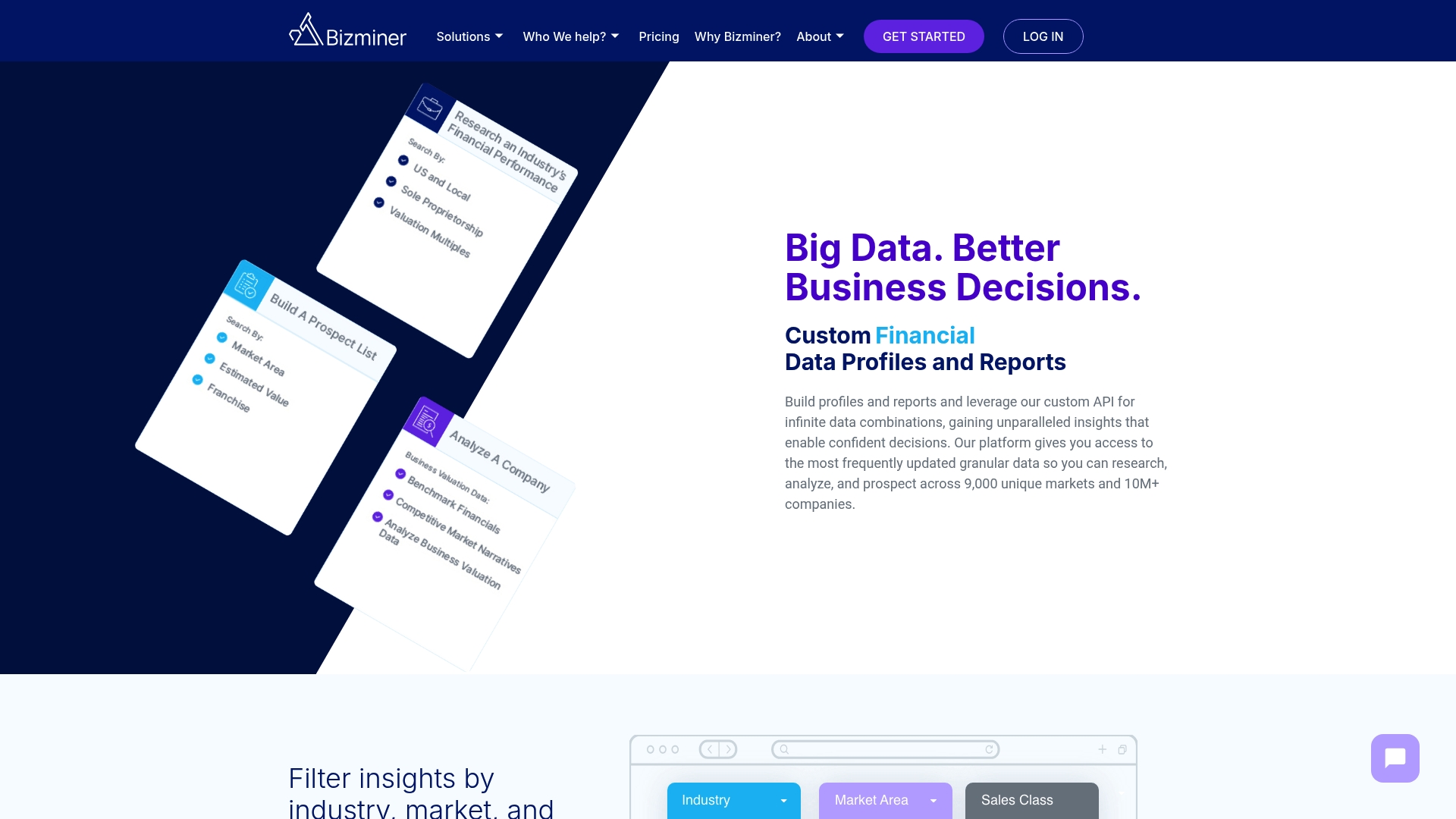
- Granular NAICS filtering lets you match a subject company to a narrow peer group instead of a broad industry bucket.
- Custom financial reports arrive with source lists and calculation detail built in, which can cut the documentation burden on your side.
- Reports are priced per deliverable, starting at $249 for an Industry Financial Performance report and $349 for a full Valuation Report.
If you need a sample of what a court-ready output looks like before an engagement, our custom financial reports page outlines what is included, and you can schedule a demo to see the underlying data before you commit to a report.
FAQ
When must expert reports be filed in Tax Court?
Written expert reports generally must be furnished to the Court and opposing parties no later than 15 days before the trial calendar call, under the Tax Court’s rules of practice. Missing this deadline can result in the testimony being excluded.
How do I show a comparable is valid in a valuation report?
Document explicit selection criteria such as industry code, revenue size, geography, and time period, then keep an itemized log explaining why each comparable meets those criteria. The IRS intangible property guidelines specifically call out this itemized documentation as a factor in how much weight a comparable receives.
Can vendor-purchased financial benchmarks be used as evidence?
Yes, provided the vendor discloses its source list, sample sizes, and methodology alongside the benchmark figures. We provide reports with this documentation built in, including our Company Report and Market Report offerings.
What happens if underlying data is not independently admissible?
Under FRE 702, an expert may still rely on data that would not be admissible on its own, as long as it is the type of data reasonably relied on by experts in that field. The expert should still be ready to produce and explain that data if challenged during cross-examination.
Sources
The Court accepts industry benchmarks, public filings, comparable transactions, and statistical data when an expert reasonably relies on them under FRE 702. The underlying data does not need to be independently admissible, but the expert must be prepared to disclose it on cross-examination under Rule 705.
- 4.48.4 Business Valuation Guidelines | Internal Revenue Service
- Rule 702. Testimony by Expert Witnesses | Federal Rules of Evidence | LII / Legal Information Institute
- Complete Rules of Practice and Procedure | U.S. Tax Court