An establishment is a single physical place where business happens: one store, one factory, one office. A firm is the legal business that owns one or more of those places. A corner bakery is both at once. A national pharmacy chain is one firm with thousands of establishments. Every U.S. business dataset picks one of these units, and the choice changes the counts, the size bands and the job numbers you read from it.
If you advise clients, assess loans, teach, or plan local development, you will meet this distinction in every Census and BLS table. This guide gives the official definitions, shows where the two units diverge, and explains how to pick the right one for the question in front of you.
TL;DR
- An establishment is one physical location, classified by its main activity. A firm is a legal business that can own one, a few or many establishments.
- For a single-location business the two coincide. For a multi-location business, they do not, and counts, size bands and job flows shift depending on the unit.
- Use establishment data for local and detailed-industry questions. Use firm data when you care about the decision-maker, such as ownership, corporate size or a company’s overall financial health.
- Check each table’s glossary before you cite it: Census and BLS define a firm slightly differently across programs.
- Bizminer reports segment data by industry, geography and company size across more than 9,000 markets, so you can match the unit to the question.
Table of Contents
- What an establishment is
- What a firm is
- Establishment vs firm at a glance
- Can one firm have multiple establishments?
- Why the unit changes your numbers
- Which unit should you use?
- Common mistakes when mixing the two
- Worked example: a six-office accounting group
- Perspective
- How Bizminer fits into this work
- FAQ
- Sources
What an establishment is
The Census Bureau’s Statistics of U.S. Businesses glossary defines an establishment as a single physical location where business is conducted or where services or industrial operations are performed. When several activities take place at one location under one owner, they are generally grouped as one establishment and classified by the major activity.
The Bureau of Labor Statistics uses the same idea in its Quarterly Census of Employment and Wages (QCEW) concepts page: an economic unit such as a farm, mine, factory or store that produces goods or services. Establishments are typically at one physical location and engage in one, or predominantly one, kind of economic activity, so a single industry code can be assigned to them.
That industry code comes from the North American Industry Classification System (NAICS), the standard federal statistical agencies use to classify business establishments, as the County Business Patterns glossary explains. This is why establishment data is so useful for local work: each location gets its own industry and its own geography.
The same glossary notes that County Business Patterns establishment counts represent locations with paid employees at any time during the year. Establishments with no payroll fall outside that count, which matters when you size a market of very small operators.

What a firm is
A firm is a legal business, corporate or otherwise, that may have one, a few or many establishments. That is how the BLS describes it in its Business Employment Dynamics size class Q&A. In that program, firms are identified by the IRS Employer Identification Number (EIN), and establishments sharing an EIN are counted as one firm.
The Census SUSB glossary words it a little differently: a firm is one or more domestic establishments in the same geographic area and industry under common ownership or control. The words “same geographic area and industry” matter. In SUSB tables, a firm is counted within the geography and industry being tabulated, so a company with outlets in three states can show up as a firm in each state’s table.
The Census Bureau’s Business Dynamics Statistics (BDS) works at the enterprise level instead. Its glossary for the visualization tools describes firms as aggregating establishments under common ownership using Census company identification numbers. The lesson: “firm” is not one fixed definition across federal sources. Read the glossary of the table you are using.
Establishment vs firm at a glance
| Establishment | Firm | |
|---|---|---|
| What it is | A single physical location | A legal business, corporate or otherwise |
| Industry code | One, based on major activity | Can span several industries |
| Geography | One address, county or ZIP | Can span many places |
| Identifier in BLS size-class data | Location record | Employer Identification Number |
| Best for | Local market and detailed-industry analysis | Ownership, corporate size, decision-making |
| Relationship | Many can belong to one firm | Can own one or many establishments |
Can one firm have multiple establishments?
Yes, and most of the interesting analysis starts there. SUSB covers more than 6 million single-unit establishments and more than 2.0 million multi-unit establishments. A single-unit enterprise owns or operates one establishment; a multi-unit enterprise owns or operates two or more.
Three everyday cases show how it plays out:
- A solo accounting practice with one office. One firm, one establishment. The counts match.
- A regional accounting group with six offices. One firm, six establishments. Each office has its own address, county and headcount.
- A retailer that also runs a distribution center. One firm with two kinds of establishments: stores, classified as retail, and a warehouse, classified under its own industry code. The firm is not a single “retailer” in the data. Its locations are classified separately.
The Census Bureau’s own wording is that an establishment is not necessarily identical to a company or enterprise, which may consist of one or more establishments.
Why the unit changes your numbers
Size bands shift
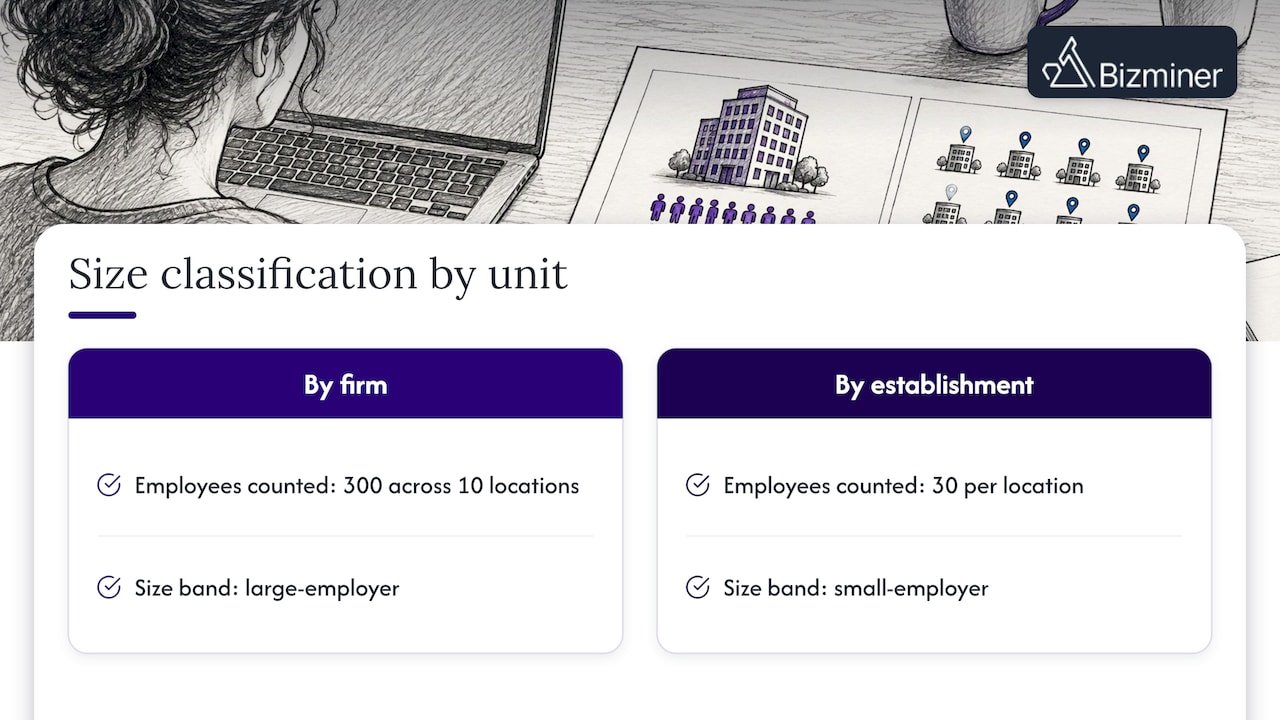
Say a firm has 300 employees spread over 10 locations of 30 each. Count by firm and those workers sit in a large-employer band. Count by establishment and they sit in a small one. The BLS says that for its size-class data, using establishments as the unit would shift employment into smaller size classes. It also says firm-level size classes are used because they better reflect corporations’ role as economic decision makers.
For anyone benchmarking a client, this is the first trap. A “small business” benchmark built from establishments can include branch offices of large companies. A benchmark built from firms does not.
Job gains and losses can cancel out
A BLS Monthly Labor Review article, Why size class methodology matters in analyses of net and gross job flows, explains that gains at one establishment and losses at another within the same multi-establishment firm can offset when aggregated. Gross job flows therefore depend on whether the establishment or the firm is the unit. A firm that opens a new branch while closing another looks flat at the firm level and active at the establishment level.
Births and deaths are defined differently
The Census BDS codebook defines firm death as a firm exiting in its entirety, which requires all of its establishments to exit. A firm with 100 establishments is not dead if one of them continues under different ownership. Establishment death is much easier to trigger: closing a single site counts.
When you read a failure rate or a startup count, find out whether it measures firms or establishments. The BDS glossary also notes that a new firm can result from a startup, a merger or a spinoff, so a new firm is not always a brand-new business.
Which unit should you use?
The BLS authors of Establishment, firm, or enterprise: does the unit of analysis matter? make the point that analysts need the unit that matches their question. Establishment-level data supports precise industry and geographic analysis, down to the county and detailed NAICS levels. Firm-level data is less precise geographically and by industry when a firm operates across locations or industries, but it suits questions about corporate behavior.
Here is how that maps to the work you do:
- Sizing a local market (a lender, an SBDC, a non-profit). Use establishments. You want to know how many locations of a given type operate in a county or ZIP code, because customers visit places, not legal entities.
- Benchmarking a client’s financials (an accountant or advisor). Use firms, or financial data built from company-level filings, because ratios like margin and leverage belong to the legal business. Match the size band to the client’s firm, not to one branch.
- Assessing loan risk. Look at both. The firm shows who is liable and how strong the whole business is; the establishment shows how exposed the borrower is to one location’s local market.
- Studying job creation or business dynamics (an academic or policy team). Choose the unit to match the claim. A statement about startups or corporate growth belongs with firms. A statement about a neighborhood belongs with establishments.
- Building a prospect list. Decide whether you are calling headquarters or sites. A firm-level list gives you decision-makers; an establishment-level list gives you every storefront.
For a deeper look at selecting a band that fits your client, see our guide to industry benchmarks by size. The broader question of how data shapes decisions is covered in an article on big data and strategic business planning.
Common mistakes when mixing the two
- Comparing an establishment count to a firm count. A county can show 400 establishments in an industry and 250 firms. Neither is wrong. They answer different questions.
- Assuming “firm” means the same thing in every table. SUSB, BLS size-class data and BDS each define it with their own rules. Cite the definition alongside the number.
- Reading a branch’s headcount as the company’s size. A 12-person office can belong to a firm of 5,000.
- Treating a closure as a failure. An establishment closing says nothing about whether the firm survives.
- Forgetting coverage limits. Payroll-based counts exclude businesses without employees, so a market of sole proprietors can look smaller than it is.
If your work will be reviewed, by an auditor, a court or a credit committee, record which unit you used and where its definition comes from. Our pages on defensible local business patterns and business counts by ZIP code walk through how to document that choice, and the industry data by geography workflow shows how to pull the same market at different levels.
Worked example: a six-office accounting group
Imagine you advise a regional accounting group with six offices and 90 employees in total, and you are asked, “How does this firm compare with its peers?”
If you answer from establishment data, each office has 15 employees. Peers in the 10 to 19 band look like the right comparison, and the picture includes every small solo practice and branch in the county.
If you answer from firm data, the group has 90 employees, and the right comparison is other firms of that size, which tend to have different cost structures, partner leverage and revenue per employee.
The first view is the right one for asking, “How many accounting offices serve this county, and where are the gaps?” The second is the right one for asking, “Is this firm’s profitability in line with comparable firms?” Both answers are correct for their question. Presenting the first as the answer to the second is the error the BLS authors warn about.
Perspective
We hear the same question from accountants, lenders and development offices: “Which number is the right one?” The answer is that it depends on what the number is meant to prove.
When the question is about a place, a county, a ZIP code, a downtown corridor, count establishments. When the question is about a business, its margins, its peers, its worth, work at the company level and match it to the right size band. Problems start when the two get blended and nobody records which was used.
That is the reason we segment our data by industry, geography and company size across more than 9,000 markets. You choose the cut that fits the question, and you can show your reviewer how you made it. Our data is accepted in U.S. Tax Court and used by government agencies, and that standard of defensibility is the one we hold ourselves to: say what you measured, say where the definition comes from, and make it repeatable.
Danny
How Bizminer fits into this work
Once you have chosen your unit, you need data cut to match. Bizminer provides industry financial performance reports, industry market reports and company profiles at $249 per report, and financial, market, valuation and company reports at $349 per report. Each report can be filtered by industry, geography and company size. For outreach, prospect lists are priced per record: $0.65 for Tier 1, $0.60 for Tier 2 and $0.55 for Tier 3. A subscription and a customizable API feed are also available; see the pricing page for details.

If you build lists for client development, build a B2B prospect list from the platform, or see how advisors use trigger events and a scorecard to prioritize them.
FAQ
Is an establishment the same as a company?
No. An establishment is one physical location, while a company or firm is the business that owns it. They coincide only when the business operates from a single site. The Census Bureau states that an establishment is not necessarily identical to a company or enterprise, which may consist of one or more establishments.
How do I tell whether a dataset counts firms or establishments?
Open the program’s glossary or methodology page and look for the unit definition. SUSB, County Business Patterns and QCEW describe establishments as locations. BLS size-class data identifies firms by EIN, and BDS aggregates establishments under common ownership into firms. Write the unit next to every figure you cite.
Why are there more establishments than firms?
Because multi-location firms contribute one firm but several establishments. SUSB covers more than 6 million single-unit establishments and more than 2.0 million multi-unit establishments, and the multi-unit group belongs to far fewer firms.
Which is better for local market analysis?
Establishments. They carry a single address and a single industry code, so they support analysis down to the county and detailed NAICS level. Firm data is better suited to questions about ownership, corporate size and company-level finances.
Sources
- Statistics of U.S. Businesses (SUSB) Glossary, U.S. Census Bureau
- Statistics of U.S. Businesses Methodology, U.S. Census Bureau
- County Business Patterns (CBP) Glossary, U.S. Census Bureau
- BDS Visualization Tools Glossary, U.S. Census Bureau
- BDS Variable Codebook (2018 Release), U.S. Census Bureau
- Concepts, Quarterly Census of Employment and Wages, U.S. Bureau of Labor Statistics
- Business Employment Dynamics Size Class Data: Questions and Answers, U.S. Bureau of Labor Statistics
- Why size class methodology matters in analyses of net and gross job flows, Monthly Labor Review, 2004
- Establishment, firm, or enterprise: does the unit of analysis matter?, Monthly Labor Review, 2016