NAICS (North American Industry Classification System) is the current standard for classifying businesses by industry in the United States. SIC (Standard Industrial Classification) is the older system it replaced in 1997. NAICS uses six digits and 20 sectors. SIC used four digits and 10 divisions. The numbers in the two systems are unrelated, so you cannot convert one to the other by arithmetic. You need a crosswalk, and even then some matches are only approximate.
This guide explains what separates the two systems, why SIC still appears in legacy records, and how to move from a SIC code to a NAICS code without corrupting your benchmark or your market sizing.
TL;DR
- NAICS has been the official U.S. standard since 1997. SIC is retired from federal statistics but still appears in older records and some databases.
- NAICS has six digits and 20 sectors. SIC has four digits and 10 divisions. The two code sets have no numerical relationship.
- NAICS groups businesses by the production process they use. SIC sometimes grouped by other criteria, such as class of customer.
- Converting SIC to NAICS requires a crosswalk, and a single SIC code can map to several NAICS codes, or the reverse.
- For benchmarking, valuation or lending work, always label which system and which NAICS year your comparison data uses.
Table of Contents
- What industry classification codes do
- A short history: from SIC to NAICS
- NAICS vs. SIC: the differences side by side
- Is SIC still used?
- How to convert a SIC code to a NAICS code
- Why the code you choose changes your analysis
- A note on NAICS 713900
- Our perspective
- Find the right NAICS code and the benchmarks behind it
- Practical rules for working with both systems
- FAQ
- Sources
What industry classification codes do
An industry classification system sorts every business into a standard category so that statistics can be compared. The Library of Congress research guide notes that these systems serve statistical purposes and database indexing. That is why a bank, a tax agency, a trade association and a census economist can all talk about “the same industry” and mean the same group of establishments.
Government agencies also use the codes beyond statistics. A state revenue department, for instance, notes that although NAICS was designed for statistical purposes, agencies may also use it for regulatory, administrative and taxation functions. For an accountant or advisor, the code you pick often decides which peer group a client gets compared with.
A short history: from SIC to NAICS
The SIC grew out of lists of industries that the federal government began assembling in the 1930s. The Census Bureau’s history page explains that the SIC committee finished its classification in 1939, and that the manual was revised regularly through 1987.
The economy changed faster than the manual did. Software, information services, health care delivery and e-commerce barely existed in the framework. The Office of Management and Budget adopted NAICS in 1997 to replace the SIC. The 2022 NAICS manual says it was developed with Canada and Mexico so that economic statistics are comparable across North America.
NAICS is not frozen. It is revised on a five-year cycle, and the current edition is the 2022 version. The manual reports 20 sectors and 1,012 industries in 2022 NAICS United States. When you cite a code, it is good practice to cite the edition too, because codes can be split, merged or retitled between revisions.
NAICS vs. SIC: the differences side by side
| Feature | SIC | NAICS |
|---|---|---|
| Status | Retired from federal statistics | Official U.S. standard since 1997 |
| Code length | 4 digits | 6 digits (U.S. national industries) |
| Top level | 10 divisions | 20 sectors |
| Grouping logic | Mixed, sometimes by customer class or product | Production process |
| Coverage | Built around a 1930s-1980s economy | Built to capture services and emerging industries |
| Geography | United States | United States, Canada, Mexico |
| Update cycle | Last manual in 1987 | Revised on a five-year cycle |
The structural facts in the table come from the Bureau of Labor Statistics, which states that NAICS uses a six-digit hierarchy with 20 sectors, while the retired SIC used four digits in 10 divisions, and that there is no direct numerical relationship between the two sets of codes.
Structure: four digits against six
A SIC code like 5812 has a major group (58), an industry group (581) and an industry (5812). NAICS adds depth. Reading left to right, the digits mean:
- Two digits: sector
- Three digits: subsector
- Four digits: industry group
- Five digits: NAICS industry
- Six digits: national industry (the U.S. detail level)
The extra digits matter because they let you separate businesses that SIC lumped together. A six-digit NAICS code can describe a niche, such as one type of manufacturer, where a four-digit SIC code would have covered a broad family of them.
Logic: process against product and customer
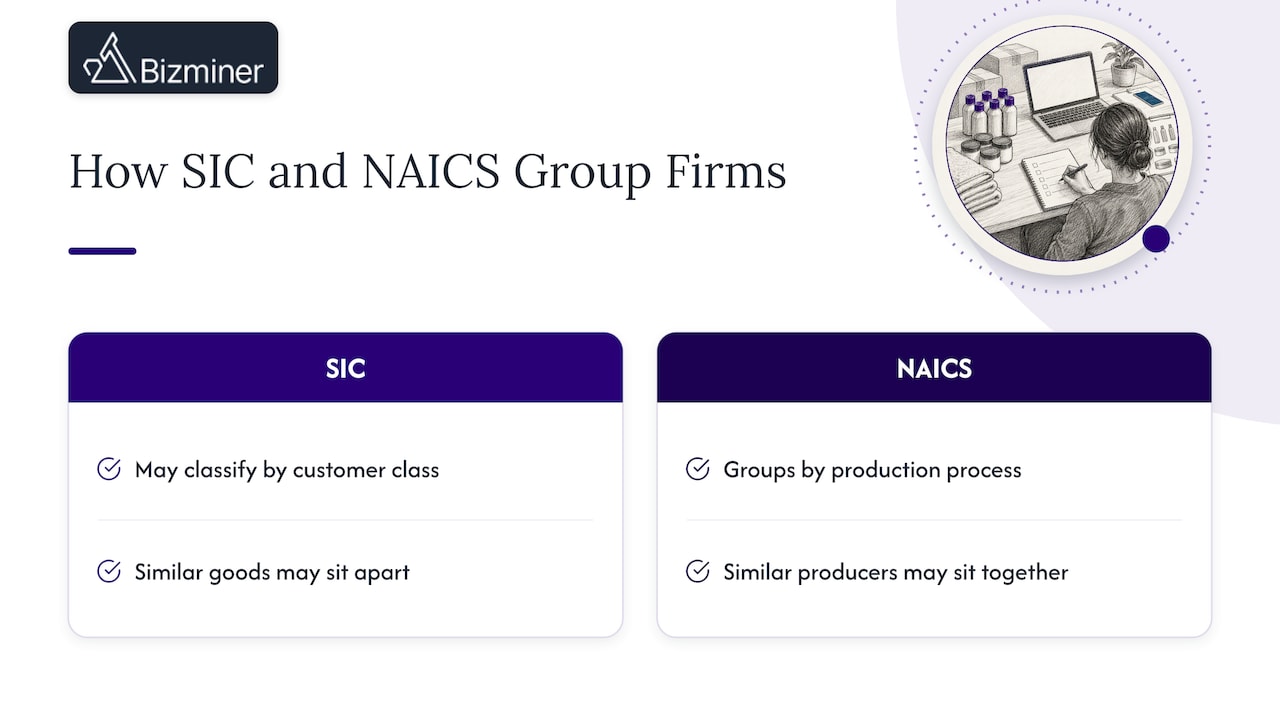
The biggest conceptual change is how businesses are grouped. According to the BLS, NAICS is production-oriented and groups establishments by the processes they use, while SIC sometimes used different criteria, such as the class of customer. The result is that a business can land in a quite different place in the two systems, even when the underlying activity has not changed.
A practical example: two companies that make similar goods but sell to different customers could sit apart in SIC and sit together in NAICS, because NAICS looks at how they produce rather than whom they serve. For benchmarking, that is usually what you want. You are comparing cost structures and margins, and those follow the production process.
Coverage: newer industries
NAICS was designed to make room for industries that SIC handled poorly. The Library of Congress guide says NAICS covers e-commerce and related industries better, but it also notes that SIC codes are better for some industries, notably retail. That is a fair reminder that neither system is perfect for every purpose, and that historical SIC data can still carry value.
Is SIC still used?
For federal statistics, no. NAICS is the working standard. In practice, SIC survives in three places:
- Legacy records. Older contracts, filings, internal databases and CRM exports often carry a four-digit SIC field that nobody ever migrated.
- Historical comparisons. Research that runs back before 1997 has to start from SIC-based data.
- Third-party data fields. Some commercial lists and directories still publish a SIC code beside the NAICS code, so users with older workflows can keep their filters.
If you are building anything new, such as a market sizing model, a loan portfolio view or a prospect list, use NAICS as the primary key and treat SIC as a lookup attribute. If you are inheriting old data, convert it once, document the method and keep the original SIC code in a separate column for audit purposes.
For a broader view of how classification fits into a data workflow, there are useful tools for data analysis that show how coded business data feeds into reporting and research.
How to convert a SIC code to a NAICS code
The short answer: use an official crosswalk, then check the result by hand. The Census Bureau publishes concordance tables that show the relationships between 1987 SIC codes and NAICS codes, as well as between NAICS versions.
Step by step
- Start from the 4-digit SIC code. Confirm it against the original source. Data-entry errors are common in legacy fields.
- Open the SIC-to-NAICS concordance from the Census Bureau and look up the code.
- Read every NAICS match, not just the first. One SIC code can point to several NAICS codes.
- Check the business description. Compare what the company actually does with the title of each candidate NAICS code.
- Pick the code that fits the primary activity, usually the one that produces the most revenue.
- Record the NAICS edition (for example 2022) and the date you converted.
Why the match is rarely clean
Because the two systems group activity differently, the mapping is not one to one. The Washington Department of Revenue puts it plainly: SIC codes do not convert seamlessly to NAICS codes, and a firm may end up under a completely different NAICS code. You will see three patterns:
| Pattern | What happens | What to do |
|---|---|---|
| One to one | One SIC code maps to one NAICS code | Accept, but still verify the description |
| One to many | One SIC code splits across several NAICS codes | Choose by the company’s primary activity |
| Many to one | Several SIC codes merge into one NAICS code | Accept, and note that detail is lost on the way |
The one-to-many pattern is where mistakes creep in. If you convert 1,000 records by taking the first listed match, you will misclassify some of them, and any benchmark built on that list will be a blend of the wrong peers.
A quick worked example
Say a legacy client file lists a company under a four-digit SIC code for a manufacturing line. You look it up and the concordance returns two NAICS candidates. One describes making the product from raw materials. The other describes assembling it from purchased parts. You check the client’s operations: they buy components and assemble. You assign the second code, and write “converted from SIC, 1987 concordance, NAICS 2022” in the notes. Six months later, a reviewer can see exactly why that choice was made.
Why the code you choose changes your analysis
The classification is not clerical. It sets the peer group, and the peer group sets the numbers.
- Benchmarking. Operating margins, current ratios and revenue per employee are only meaningful against comparable businesses. A code that is too broad mixes unlike cost structures. A code that is too narrow may leave too few peers.
- Valuation. Multiples and risk adjustments depend on the industry. A valuation analyst who defends a conclusion needs to show why the comparison set fits.
- Lending. A lender comparing a borrower’s ratios to an industry norm needs the industry defined the same way the data publisher defined it.
- Prospecting. Filtering a target list by the wrong code either drops good prospects or floods a campaign with poor fits.
A six-digit NAICS code gives you the most precision, but a data source may only publish at four or five digits when sample sizes are small. Know which level your data supports before you promise a client a niche comparison.
A note on NAICS 713900
Readers often search for specific codes. According to the 2022 manual, 713900 is listed as Other Amusement and Recreation Industries. It sits in the Arts, Entertainment and Recreation sector (71). If you are matching a business to a code like this, read the full six-digit list in the manual and choose the most specific title that fits.
Our perspective
Most of the classification mistakes we see are not about choosing NAICS over SIC. Everyone agrees NAICS is the standard. The mistakes happen after that: a SIC code converted by taking the first match, a four-digit code used where six digits were available, or a benchmark pulled without saying which edition it uses.
Our view is that granularity is what separates a defensible comparison from a rough one. That is why we built our reports around thousands of narrowly defined markets, segmented by industry, geography and company size, rather than a handful of broad categories. When an accountant or advisor has to defend a number to a client, a lender or a court, the peer group has to be specific and the sources have to be listed.
Bizminer data is accepted in U.S. Tax Court and used by government agencies, and we write our reports with that standard in mind: larger sample sizes, detailed source lists and benchmarks that can stand up to an audit. If you are cleaning up SIC-era data, start with the crosswalk, then test each converted code against a real benchmark. If the peer group looks wrong, the code probably is.
Danny
Find the right NAICS code and the benchmarks behind it
If you already know your NAICS code, you can see what comparison data exists for it in our NAICS industry benchmarks, which cover more than 9,000 markets. If you are still working out which code applies, the NAICS industry search tool lets you browse by industry and drill down to the niche.
For client work that needs a full report, pricing is published per report: Industry Financial Performance, Industry Market and Company Profile reports are $249 each, and Financial, Market, Valuation and Company reports are $349 each. Prospect lists are priced per record, from $0.55 to $0.65 depending on tier. API feeds and subscriptions are quoted on request. See the pricing page for the details, or look at our custom analysis reports if you need to filter by niche, geography and business size.
Teams that need to convert and keep classification data current across many clients can also look at the market data API, which delivers industry data into your own workflow.
Practical rules for working with both systems
- Make NAICS your primary field. Keep SIC only as a reference column.
- Never convert on autopilot. Review every one-to-many match against the company’s real activity.
- State the edition. Write “NAICS 2022” or the edition you used. Codes shift between revisions, and the Census Bureau also publishes concordances between NAICS versions.
- Use the most specific level your data supports, and say when you had to fall back to a broader level.
- Document the conversion. A line in the work paper about method and date saves hours in a review.
- Re-check old benchmarks. A comparison built on SIC-era data may not line up with today’s NAICS-based peer groups.
FAQ
Is a NAICS code the same as a SIC code?
No. NAICS is a redesigned system that replaced SIC in 1997, and it uses different, unrelated numbering. NAICS has six digits and 20 sectors, while SIC has four digits and 10 divisions. A SIC code never equals a NAICS code by number, only by crosswalk.
Which should I use today, NAICS or SIC?
Use NAICS for anything new, since it is the current federal standard and covers newer industries better. Keep SIC only if you need to match old records or run a historical comparison. If you must use both, store them in separate fields so each stays traceable.
Can I convert SIC to NAICS automatically?
You can start automatically with the Census concordance, but you should not stop there. Because a SIC code can map to several NAICS codes, the final choice should rest on what the business actually does. Review the multi-match cases by hand, and record the NAICS edition you used.
Why did NAICS replace SIC?
The SIC dated from the 1930s and was last revised in 1987, so it handled newer industries poorly. NAICS was created with Canada and Mexico so that economic statistics could be compared across all three countries, and it groups businesses by production process.
Sources
- Classification Codes, Library of Congress industry research guide
- North American Industrial Classification System (NAICS), Library of Congress
- What Is NAICS?, U.S. Bureau of Labor Statistics
- North American Industry Classification System, United States, 2022 (Census Bureau)
- Classifying Businesses, Census Bureau history
- NAICS concordances, Census Bureau
- SIC and NAICS Codes, Washington Department of Revenue