NAICS codes change on a fixed five-year cycle, and the next revision, NAICS 2027, is due on the Census Bureau’s website in January 2027. For anyone who benchmarks clients, underwrites loans or builds market studies, each revision splits, merges or renumbers some industries, so a peer group built on last cycle’s codes can quietly stop matching the industry you meant. This guide covers who decides the changes, what moved in 2022, what is proposed for 2027, and how to keep your analysis defensible through both. Our own benchmarking work is built around 6-digit NAICS granularity, so we pay close attention to this cycle.
TL;DR
- NAICS is reviewed every five years, in years ending in 2 and 7. The Office of Management and Budget (OMB) makes the final call after public comment.
- The 2022 revision created 111 new industries from 156 NAICS 2017 industries or their parts. Retail Trade (44-45) and Information (51) changed most.
- The 2027 revision proposes consolidations such as urban transit codes merging into 485110, plus a few renamed and moved codes. Check the final OMB publication before remapping anything.
- Federal contracting and SBA size standards follow NAICS on their own schedule, so a new code is not usable in contracts until SBA publishes a matching size standard.
- The practical risk is comparability: a benchmark or loan file tied to a retired code needs to be mapped to the new one before you compare periods.
Table of Contents
- Who decides NAICS changes, and how often
- What changed in the 2022 revision
- Where the 2027 revision stands
- What revisions do to your data
- Federal contracting and SBA size standards
- How to update records when a code changes
- Bizminer reports for a revision year
- Our view
- FAQ
- Sources
Who decides NAICS changes, and how often
NAICS, the North American Industry Classification System, is the federal standard for sorting businesses into industries. The U.S., Canada and Mexico use it so that statistics line up across borders. Its first digits give the broad sector, and each added digit narrows the industry, down to the 6-digit national industry.
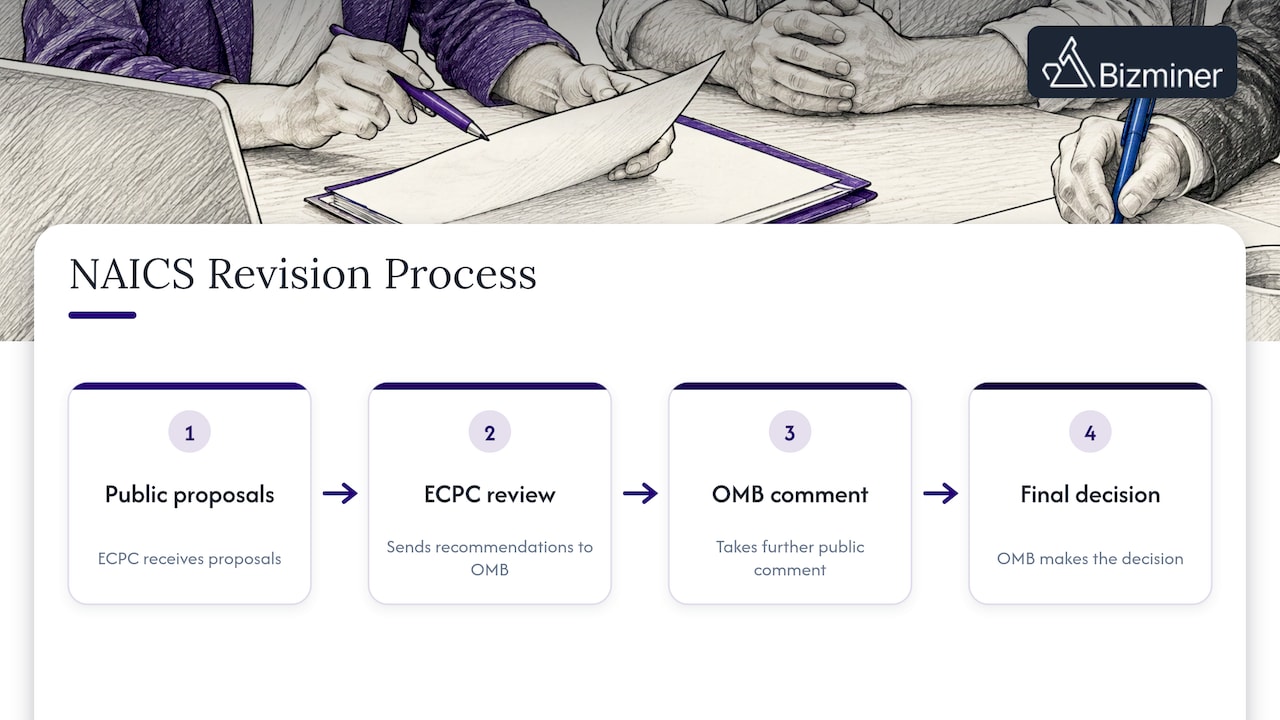
The Census Bureau’s fact sheet states that NAICS is reviewed every five years, in years ending in 2 and 7. OMB charged its Economic Classification Policy Committee (ECPC) with maintaining it. The ECPC takes public proposals and sends recommendations to OMB. OMB then takes further public comment and makes the final decision.
The same fact sheet says the committee weighs the cost of changing statistical programs and the loss of comparability over time against the cost of ignoring structural change in the economy. That balance explains why revisions are periodic rather than continuous: a code does not shift because one company’s business model changed.
The timing is deliberate. A Census Bureau staff post explains that the review comes ahead of the Economic Census, so that census data reflect the current economic structure and other federal surveys then adopt the updated categories.
OMB’s December 2024 notice described the 2027 review as the sixth since OMB adopted NAICS in 1997. So you can plan around it: the revision years are 2022, 2027, 2032 and so on, with agencies adopting them over the following months and years.
What changed in the 2022 revision
The 2022 revision is the one your current data most likely sits on, so the details matter.
According to SBA’s September 2022 final rule, NAICS 2022 created 111 new industries by reclassifying, combining or splitting 156 NAICS 2017 industries or their parts. The same rule breaks the 111 down:
- 79 (71%) were created by merging two or more 2017 industries or parts.
- 11 (10%) got a new 6-digit code with the title unchanged.
- 14 (13%) got a new title with the code unchanged.
- Seven (6%) came from changing a single industry’s title, code or definition.
- Nine 2017 industries were split into two or more 2022 industries.
The code-only and title-only changes are the ones that cause quiet errors. A title change with the same code usually means the definition was clarified. A code change with the same title means a lookup by code will return nothing or the wrong industry.
Retail Trade and Information moved most
The Census Bureau identifies the elimination of Subsector 454, Nonstore Retailers, as the most significant change. Those establishments are now grouped with store retailers and classified by what they sell, not by whether the sale happens in a storefront, online or by direct sales. The same page reports that Sector 51 (Information) lost the Internet as an industry distinction, with minor content and coding updates in Sectors 21, 31-33, 42, 52 and 81.
The Library of Congress research guide adds that in Sector 52 many 2017 codes were collapsed and given new numbers. If you work with banks, credit unions, insurers or brokers, expect to find your old codes missing.
For scale, the 2022 NAICS Manual lists 1,012 total 6-digit U.S. industries, with Manufacturing the largest sector at 346.
A worked example
The Bureau of Labor Statistics lists seven 2017 industries updated for 2022. One is 212113 Anthracite Mining, which maps to 212114 Surface Coal Mining and 212115 Underground Coal Mining. One old code becomes two new ones. A borrower tagged 212113 in a 2019 loan file has no single 2022 equivalent until someone decides, from the company’s actual operations, which of the two fits. That is a judgment call, and it belongs in the file.

Where the 2027 revision stands
The Census Bureau’s tentative schedule had OMB’s final decisions in March 2026, the 2027 U.S. Manual going to OMB in June 2026, and the classification available on the NAICS website in January 2027. OMB’s July 13, 2026 Federal Register notice sought public comment on the ECPC’s recommended updates, which clarify definitions, recognize new and emerging industries and combine industries. It states that the revised NAICS would be used by OMB-recognized statistical agencies beginning with reference year 2027, for establishment data covering periods that begin on or after January 1, 2027.
The notice’s detail is worth reading if you cover manufacturing, transportation or media clients. As proposed, it:
- moves electric motors for electric vehicles from 335312 to 336310, renamed Motor Vehicle Engine and Engine Parts Manufacturing;
- renames 48811 as Airport and Spaceport Operations;
- merges four 48511x codes into 485110 Urban Transit Systems;
- merges 332111 and 332112 into 332113 Iron, Steel, and Nonferrous Forging;
- combines 332992 through 332994 into 332995 Small Arms, Ammunition, Ordnance, and Ordnance Accessories Manufacturing;
- splits 516210, creating 516213 Media Streaming Distribution Services and Broadcasting Networks.
Those crosswalk entries come from the Federal Register version of the notice. It also says lab-created meat, seafood and dairy are handled through new product codes (NAPCS) rather than new NAICS industries, and that the ECPC proposed no bioeconomy industry updates after Executive Order 14236 rescinded Executive Order 14081.
Because that notice was a proposal, treat the list as the direction of travel and confirm each code against the final 2027 publication when it posts in January 2027. Do not rewrite client files from a draft crosswalk.
Publication is also not adoption. The Census Bureau’s 2022 implementation page says it plans to move most Economic Directorate programs from 2017 to 2022 NAICS by the end of calendar year 2027. Expect the same lag after 2027: a published code list arrives first, and the data built on it follows over the next couple of years.
What revisions do to your data
A code change is a classification event, not an economic one. A company did not change what it does because OMB renumbered its industry. But your analysis can change anyway.
Time series break
The Census Bureau says programs that keep time series will restate historical estimates to align with 2022 NAICS whenever possible, with methods in each program’s documentation. Some programs adopt later: the Vehicle Inventory and Use Survey in 2028 and the Commodity Flow Survey in 2030. The first publications with detailed industry statistics on 2022 NAICS came out in December 2024 (the 2022 Economic Census Geographic Area Statistics, the 2023 Annual Business Survey and the 2022 Nonemployer Statistics).
The scale can be large. BLS updated its national payroll series to NAICS 2022 in February 2023, and roughly 10 percent of CES employment was reclassified into different industries. If a tenth of employment can shift between industries in a revision, a peer group drawn from a single 6-digit code can change materially.
Benchmarks and peer groups
When you benchmark a client’s margins, liquidity or leverage against peers, three things must line up: the code vintage of the client, the code vintage of the benchmark, and the period covered. Mixing a 2017-coded client with 2022-coded peers can move a client into or out of a peer group without anyone noticing, and a merged code blends businesses that were once measured separately.
This is why granularity and documentation matter. A benchmark that shows its sample size and source list lets you see whether a merged or split code still describes your client’s business. Our 6-digit NAICS benchmarks cover more than 9,000 markets segmented by industry, geography and company size, and our data is accepted in U.S. Tax Court and used by government agencies. For CPAs who need a method that holds up in review, our seven-step benchmarking approach walks through the steps.
Federal contracting and SBA size standards
Contractors and the advisors who support them should keep two clocks separate: OMB’s classification and SBA’s size standards.
SBA adopted NAICS 2022 into its size standards table in a rule published September 29, 2022 and effective October 1, 2022. Applying the standards to the 111 new industries raised the standard for 22 industries and 29 parts of two industries and lowered it for seven industries and 53 parts of two industries. One industry moved from receipts to employees as its measure, and 117 industries plus 19 parts of seven others saw no change. A reclassification can therefore change whether a client counts as small.
A later SBA rule, effective December 19, 2022, adjusted monetary size standards for inflation on a NAICS 2022 basis, with an additional 13.65 percent inflation increase on top of the five-year review adjustments.
FAR 19.102 sets the contracting rules: new NAICS codes are not available for federal contracting until SBA publishes corresponding size standards. Contracting officers apply the size standard in effect on the date the solicitation is issued, and each solicitation gets one code, the industry that best describes the principal purpose of the acquisition. For a fuller walk-through of how codes drive contracting and tax rules, see our NAICS codes explainer.
How to update records when a code changes
When a revision lands, work through your files in this order.
- Pull the official concordance. Census publishes a crosswalk between versions. Use it as the starting map, and use only the final published version, not a notice still open for comment.
- Sort codes into three groups. One-to-one renumbering is mechanical. Many-to-one merges are easy to map but lose detail. One-to-many splits need a decision per client.
- Decide splits from operations. BLS instructs establishments to select the 2022 code that best describes their main business activity. Use the same test: what generates the most revenue? Write the reasoning into the file.
- Record the vintage. Store the code and the NAICS version side by side, for example “212114 (2022)”. Never overwrite the old code without keeping it.
- Re-run the peer group. Re-pull benchmarks on the new code and check whether the sample is larger or smaller than before. A merged code often has a larger, broader sample.
- Flag the break. Where a trend line crosses a revision year, label it so a reader or reviewer knows the series was restated or remapped.
- Check size standards separately. If a client bids on federal work, confirm the code against SBA’s current table before the solicitation date.
If you are unsure which code fits a client, our NAICS industry search tool helps find the right industry. If your records still carry SIC codes, this NAICS vs. SIC guide covers the conversion.
Bizminer reports for a revision year
If you need current peer data for a client in a recoded industry, our industry reports are priced per report on our pricing page: Industry Financial Performance, Industry Market and Company Profile are $249 each, and Financial Report, Market Report, Valuation Report and Company Report are $349 each. A subscription and a customizable API feed are also available; those have no published price. Prospect lists run $0.65, $0.60 or $0.55 per record by tier.
For lenders and advisors who also work from NAICS to find new business, we explain how to build a prospect list by industry, geography and company size.
Our view
Every revision cycle, the same thing happens. The classification changes on paper, and the analysis quietly breaks in a spreadsheet. A client’s ratio drops out of its peer group, a trend line jumps in the year of a recode, or a reviewer asks why last year’s report used different peers.
We built our data around granularity because a coarse code hides exactly these problems. When you can filter to a 6-digit industry, a geography and a company size band, you can see what a merged or split code did to your comparison, and you can show a reviewer the sample behind it.
That is also why we put weight on larger sample sizes, detailed source lists and benchmarks that are accepted in U.S. Tax Court. A revision year is when defensibility gets tested, and we want the file to hold up when someone asks how the peer group was chosen.
Our advice to CPAs, lenders and advisors: record the NAICS version with every code, document how you handled each split, and benchmark at the most specific level your client’s business supports.
Danny
FAQ
How often is NAICS updated?
Every five years, in years ending in 2 and 7. OMB, working through the Economic Classification Policy Committee, makes the final decisions after public comment. The current version is NAICS 2022, and NAICS 2027 is scheduled to appear on the Census Bureau’s site in January 2027.
How can I update my business’s NAICS code?
It depends on who holds the code. For a federal survey, the respondent instructions say to choose the code that best describes your main business activity. For a state tax account or a federal registration, use that agency’s own update process, since each agency adopts new versions on its own timeline. Keep the old code and the version on file alongside the new one.
Can my business have two NAICS codes?
Many registrations let you list several codes, but a single federal solicitation is assigned one code based on the principal purpose of the acquisition. For statistics and benchmarking, pick the code that matches the activity generating the most revenue as your primary one.
Do NAICS changes change my SBA size standard?
They can. SBA adopts a new NAICS version into its size standards table separately. In the 2022 adoption, some industries saw higher standards, some lower and most were unchanged. New codes cannot be used in federal contracting until SBA publishes matching size standards.
Sources
- Schedule for 2027 Revision of NAICS, U.S. Census Bureau
- The Census Bureau’s Implementation of the 2022 NAICS
- Industry Classifications Reflect Changing Economy, Census Bureau
- Statistical Policy Directive No. 8, Federal Register, December 20, 2024
- Small Business Size Standards: Adoption of 2022 NAICS, Federal Register, September 29, 2022
- Small Business Size Standards: Inflation Adjustment, Federal Register, November 17, 2022
- 2022 NAICS United States Manual
- North American Industrial Classification System, Library of Congress research guide
- 2022 NAICS, Bureau of Labor Statistics respondents page
- NAICS 2022 in the Current Employment Statistics program, BLS
- Federal Register, Volume 91 Issue 132, July 13, 2026 (govinfo)
- Statistical Policy Directive No. 8, Federal Register, July 13, 2026
- 48 CFR 19.102, Small business size standards and NAICS codes