AI for underwriting automates the analyst layer of commercial credit review: document intake, financial spreading, multi-entity cash-flow consolidation, risk flagging, and draft credit memo generation. Use it when manual spreading is your bottleneck, your analysts spend more time gathering data than judging it, or you need consistent decisioning across a growing distant-borrower portfolio.
- Primary benefit: Agentic AI systems report productivity uplifts of 40–80% per use case in credit review, compressing multi-day reviews toward near real time.
- Governance caveat: Model risk management under SR 11-7 applies. Explainability, audit trails, and bias surveillance are not optional.
- ROI signal: Census microdata analysis links higher AI adoption to lower charge-offs and lower interest spreads for distant borrowers.
Evidence is in Section 4. Data requirements are in Section 3. The pilot checklist is in Section 6.
Key Takeaways
AI underwriting automates the analyst layer of commercial credit review, and lenders who pair it with granular industry benchmarks and SR 11-7-compliant governance see measurably lower charge-offs, faster decisions, and more consistent credit quality.
| Point | Details |
|---|---|
| Start with one use case | Pilot a single portfolio segment with clear KPIs before scaling. |
| Benchmarks are required inputs | Industry ratio comparators from sources like Bizminer are needed for spreading normalization and PD calibration. |
| Governance is non-negotiable | SR 11-7, CFPB adverse-action rules, and audit trail requirements apply from day one of any pilot. |
| Charge-off evidence is real | Census microdata links a one-standard-deviation AI increase to a 0.96–1.20% reduction in distant-borrower charge-offs. |
| Bizminer strengthens auditability | Bizminer’s court-accepted benchmark data gives AI-generated risk flags a defensible, examiner-ready foundation. |
Table of Contents
- What can AI actually do in commercial underwriting?
- What data inputs does AI underwriting actually need?
- What does the empirical evidence say about AI underwriting benefits?
- What governance does U.S. regulatory guidance require?
- How do you build a pilot-to-production roadmap?
- What should you ask vendors before signing?
- Which metrics tell you if AI underwriting is working?
- How does Bizminer strengthen AI underwriting models?
- How does AI change the underwriting workforce?
- What ethical obligations go beyond bias in AI underwriting?
- How does AI underwriting compare to traditional methods?
- What lenders who piloted AI actually learned
- Bizminer’s industry benchmarks plug directly into your AI pilot
- Sources
What can AI actually do in commercial underwriting?
The honest answer: quite a lot at the analyst layer, and almost nothing at the judgment layer without human review. The distinction matters for procurement.
Practitioner guides define AI underwriting as automation of four concrete jobs: document intake and classification, financial spreading and normalization, multi-entity consolidation, and credit memo drafting. Add risk flagging and portfolio early-warning monitoring, and you have the full functional map.
- Document intake and OCR: Classify and extract from tax returns, CPA-prepared statements, rent rolls, and K-1s without manual indexing.
- Financial spreading: Normalize multi-year income statements and balance sheets into a consistent format, reconciling entity-level differences automatically.
- Multi-entity roll-ups: Consolidate global cash flow across operating companies, holding entities, and guarantors, a task that consumes hours in SBA 7(a) and owner-occupied CRE files.
- Risk flagging and triage: Surface anomalies (revenue-to-bank-deposit mismatches, covenant proximity, concentration risk) before the analyst opens the file.
- Credit memo drafting: Generate a structured first draft the credit officer edits rather than writes from scratch.
- Portfolio monitoring: Flag early-warning signals on existing credits using updated financials and industry benchmarks.
In an SBA file with multiple entities and three years of tax returns, an add-on AI platform can produce analyst-quality spreads in a fraction of the time a manual process requires. Equipment finance deals with clean vendor invoices are even faster. Owner-occupied CRE with mixed personal and business returns is where the messy-file test matters most.
Pro Tip: Before signing any vendor contract, run their tool on the three messiest files currently sitting in your pipeline. Clean demo files tell you nothing about production performance.
What data inputs does AI underwriting actually need?
The model is only as good as what you feed it. Required inputs for commercial and small-business underwriting include:
- Multi-year business tax returns (Form 1120, 1120-S, 1065) and CPA-prepared financial statements
- Personal returns and K-1s for guarantors and pass-through entities
- DDA and transaction history where available (especially useful for thin-file borrowers)
- AR/AP aging schedules and debt schedules
- Ownership structure documentation for multi-entity consolidation
- Industry benchmark data for ratio comparators and cash-flow normalization
Data-quality checklist before model ingestion:
- Source matching: does the tax return figure reconcile with the financial statement?
- Figure reconciliation: are depreciation add-backs consistent across schedules?
- Entity consolidation: are intercompany eliminations applied?
- Timestamping: are all documents dated and version-controlled?
- Completeness check: are all required schedules present before extraction begins?
Understanding what financial benchmarking contributes here is critical. Without industry-level ratio comparators, a spreading model produces numbers with no context. With it, the risk flag fires automatically. That single data point can change the credit decision.
Pro Tip: Map every data input to the model task it feeds: extraction, spreading, benchmarking, or scoring. Inputs that serve no mapped task add noise, not signal.
What does the empirical evidence say about AI underwriting benefits?
The research base is now substantial enough to move past anecdote.
Census confidential microdata shows that between 2017 and 2019, the share of banks using AI rose from roughly 14% to 43%. Higher AI adoption correlates with more lending to distant borrowers, lower charge-offs among those borrowers, and lower interest spreads at origination. An increase in AI use is associated with a reduction in distant-borrower charge-offs in specified tests, indicating improved loan performance with AI adoption.
Stat: A one-standard-deviation increase in bank AI use reduced distant-borrower charge-offs by 0.96–1.20%, per Census microdata analysis.
On the productivity side, McKinsey’s survey of credit executives finds 20% of institutions have implemented at least one gen AI use case, with 60% expecting to within a year. Portfolio monitoring and credit memo drafting are the leading pilots. Governance and model validation remain the top barriers to scaling.
IFC analysis reinforces that AI and alternative data complement human judgment by reducing bias and extending consistent baseline decisioning to underserved borrowers, including those with limited soft-information histories.
What governance does U.S. regulatory guidance require?
SR 11-7 applies to any model that feeds a credit decision, and AI underwriting models are models. The OCC’s vendor oversight guidance adds a second layer for third-party tools. CFPB adverse-action rules require that any AI-influenced denial produce a specific, explainable reason. CECL model feeding adds a third consideration when AI-generated PD estimates flow into allowance calculations.
Top operational and model risks:
- Hallucinated figures with no source-document traceability
- Training data that reflects historical lending bias
- Model drift as borrower populations or economic conditions shift
- Data lineage failures when inputs change format or source
- Vendor documentation that covers only 40–60% of examiner expectations
Governance checklist:
- Confirm the model has a written validation report from an independent party.
- Require source-document traceability: every extracted figure links back to its page and line.
- Document the model’s training data, including any demographic or geographic exclusions.
- Establish a bias-surveillance cadence (at minimum quarterly fairness checks).
- Maintain a full audit log of every AI-generated output and every human override.
- Require the vendor to supply SR 11-7 documentation samples before contract execution.
Red flags during procurement: no source-document traceability, vendor-only SR 11-7 templates with no institutional customization, no adversarial testing results, and no named reference bank at your asset-size tier. Agentic AI governance frameworks recommend layered control architectures with critic subagents specifically to catch these gaps before they reach an examiner.
How do you build a pilot-to-production roadmap?
Start narrow. One portfolio segment, one use case, ninety days.
Step-by-step implementation:
- Identify the use case with the highest manual-hour cost and clearest success metric (e.g., spreading time for SBA 7(a) files).
- Define pilot population: 50–100 files from a single NAICS segment or loan type.
- Set success KPIs: target extraction accuracy, spread accuracy, time-to-decision reduction, and human-override rate.
- Select and validate data sources: confirm benchmark feeds, document sources, and LOS integration points.
- Build or configure the MVP: document intelligence layer, rules/foundation model layer, orchestration, LOS connector, and audit log store.
- Run parallel testing: AI output vs. analyst output on the same files, blind-scored.
- Apply go/no-go criteria: if extraction accuracy falls below your threshold or override rate exceeds your ceiling, do not advance.
Add-on platforms typically reach production in weeks. LOS-replacement approaches take months. Choose based on your deployment velocity requirement, not the vendor’s feature list.
Pro Tip: Assign a named credit analyst as the pilot’s human-in-loop reviewer from day one. Their override log becomes your model validation evidence.
| Role | Responsibility |
|---|---|
| CRO / CCO | Governance sign-off, regulatory posture |
| Credit analyst | Human-in-loop review, override logging |
| IT / data engineer | Pipeline build, LOS integration, audit log |
| Legal / compliance | SR 11-7 documentation, CFPB adverse-action review |
What should you ask vendors before signing?
Procurement questions that separate capable vendors from capable marketers:
- Show me source-document traceability on a messy real file, not a demo file.
- Provide a sample SR 11-7 model risk documentation package.
- Name a reference bank at my asset-size tier I can call.
- What is your retraining cadence and who triggers it?
- How do you test for demographic bias in extraction and scoring outputs?
- What encryption standards apply to document storage and API transit?
- Is pricing volume-based, seat-based, or per-file? What are the overage terms?
On pricing: volume-based models favor high-throughput lenders; seat-based models favor smaller teams with variable file counts. Negotiate a cap on per-file overages and a minimum pilot period before annual commitment locks in.
Layered agent architectures with context, deterministic rules, human review, and monitoring layers are the current deployment standard. Any vendor who cannot describe their architecture in those terms is worth scrutinizing.
Which metrics tell you if AI underwriting is working?
Track leading indicators daily, lagging indicators monthly.
| Metric | Type | Monitoring Cadence |
|---|---|---|
| Extraction accuracy | Leading | Daily |
| Spread accuracy vs. analyst | Leading | Weekly |
| Human-override rate | Leading | Weekly |
| Time-to-decision | Leading | Weekly |
| PD / ROC / AUC | Lagging | Monthly |
| Calibration (predicted vs. actual default) | Lagging | Monthly |
| Charge-off / default rate | Lagging | Quarterly |
| Adverse-action frequency | Lagging | Monthly |
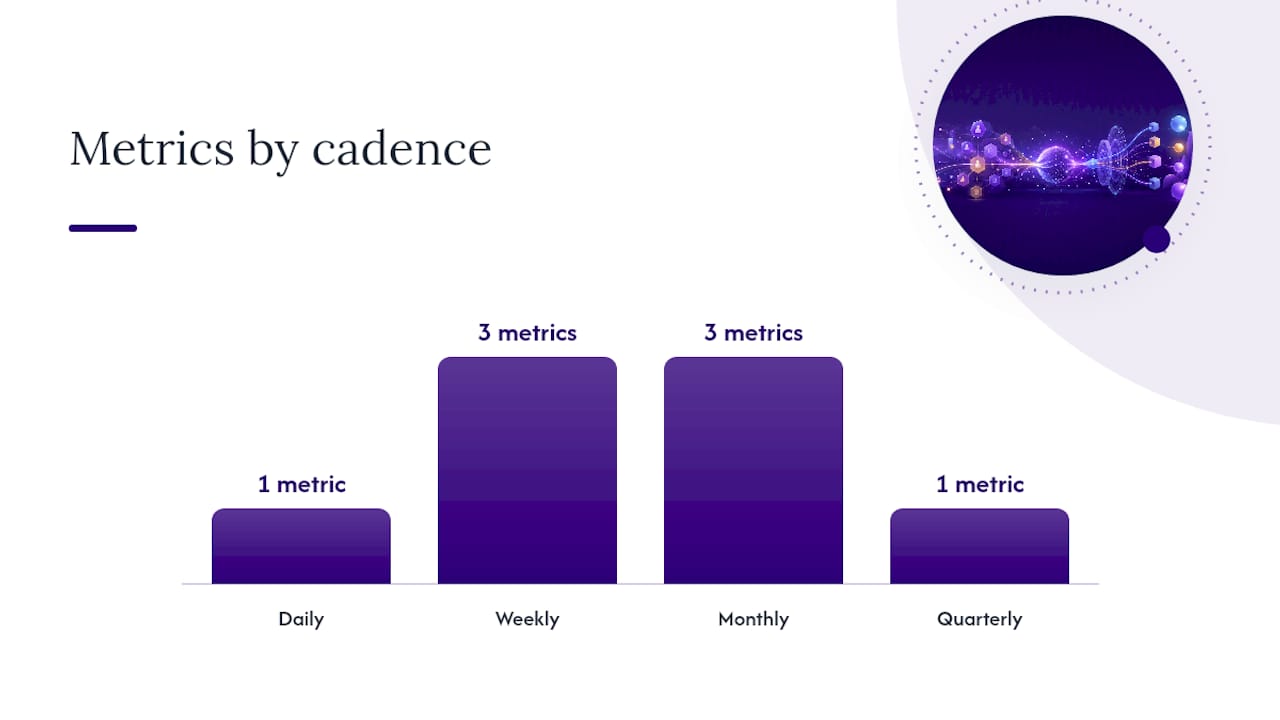
Escalation triggers: if extraction accuracy drops more than 5 percentage points from baseline, pause the pipeline and audit the document source. Fairness checks run monthly at minimum; governance reviews quarterly.
How does Bizminer strengthen AI underwriting models?
Granular industry benchmarks are the comparator layer that makes AI-extracted spreads meaningful. Without them, a model can tell you what a borrower’s numbers are. With them, it can tell you whether those numbers are normal for that industry, geography, and company size.
Bizminer supports financial institutions with benchmark data across more than 9,000 industry segments, segmented by NAICS code, geography, and revenue band. In an AI underwriting workflow, that data plugs in at three points:
- Spreading normalization: benchmark ratios anchor the model’s interpretation of extracted figures, flagging outliers automatically.
- PD estimation: industry-level default and charge-off patterns inform probability-of-default calibration.
- Early-warning thresholds: portfolio monitoring triggers fire when a borrower’s updated financials diverge from their industry cohort.
Bizminer data is accepted in U.S. Tax Court and used by government agencies, which matters directly for audit trail integrity. When an examiner asks why a risk flag fired, a benchmark sourced from court-accepted data is a defensible answer.
Pro Tip: When selecting your pilot NAICS segment, pull a Bizminer benchmark report for that segment first. The ratio distributions tell you which financial statement lines carry the most variance, and those are the lines where AI extraction errors will have the largest credit-decision impact.
Custom reports and API access let you feed benchmark data directly into your AI pipeline rather than manually pulling reports per file.
How does AI change the underwriting workforce?
The analyst role does not disappear. It shifts from data gatherer to data judge. That is a better use of a trained credit professional’s time, and it is also a harder job to hire for.
Skills that become more valuable: data literacy, model output interpretation, and the ability to spot a plausible-looking but wrong AI-generated spread. Skills that become less central: manual spreading mechanics and document indexing.
Change management is where most pilots stall. Analysts who feel the tool is checking their work rather than supporting it will find ways to route around it. Frame the tool as a first-draft generator, not a performance monitor. Training should include explicit instruction on when to override and how to document the override reason.
What ethical obligations go beyond bias in AI underwriting?
Bias is the most-discussed risk, but it is not the only one.
Data privacy: Borrower tax returns, bank statements, and K-1s are among the most sensitive documents in commercial finance. Any AI tool that ingests them must meet your institution’s data retention, access control, and breach-notification obligations. Confirm where documents are stored, who can access them, and how long they are retained after the credit decision.
Transparency: Borrowers have a right to understand why a credit decision was made. An AI-generated adverse action notice that cites “model output” without a specific reason fails CFPB expectations and erodes trust. Every AI-influenced decision needs a human-readable explanation.
Fairness beyond protected classes: Geographic concentration in training data can disadvantage rural borrowers even when no protected-class variable is present. Test for this explicitly. Loan approval factors that disadvantage specific geographies or industries without a documented credit rationale are a fair-lending exposure.
How does AI underwriting compare to traditional methods?
Traditional underwriting is analyst-driven, sequential, and time-intensive. An analyst receives a file, manually indexes documents, spreads financials into a template, researches industry comparators, and writes a memo. Each step depends on the previous one finishing. A complex SBA file can take days.
AI underwriting runs document intake, extraction, spreading, and risk flagging in parallel. The analyst receives a pre-populated spread with flagged anomalies and a draft memo. Their job is to verify, judge, and decide, not to build from scratch. The credit quality of the output depends on the quality of the model and the benchmarks feeding it, not on which analyst happened to pick up the file.
The practical difference: AI underwriting produces more consistent outputs across analysts and time periods. Traditional underwriting produces outputs that reflect individual analyst skill, workload, and familiarity with the borrower’s industry. Neither is universally superior. For high-volume, standardized loan types, AI wins on speed and consistency. For highly complex, relationship-driven credits, human judgment remains the primary value driver.
What lenders who piloted AI actually learned
The pilots that worked shared one characteristic: they started with a single, well-defined use case where success was measurable in weeks, not quarters. The pilots that stalled started with a vision of end-to-end automation and discovered that data preparation alone consumed the first three months.
Data prep is the unglamorous truth of AI underwriting. Before a model can extract reliably, your document intake process needs to be consistent. That often means fixing upstream problems in your LOS or document collection workflow before the AI tool ever touches a file.
Vendor documentation gaps surface fast. SR 11-7 templates supplied by vendors are written for a generic institution. Rewriting them in your bank’s voice, with your specific model use cases and validation protocols, takes time and requires legal and compliance involvement from the start, not after deployment.
Operational changes to expect: a new workflow handoff between the AI output queue and the analyst review queue, a formal override-logging process, and a monthly model performance review that did not exist before. None of these are burdensome. All of them require someone to own them.
Bizminer’s industry benchmarks plug directly into your AI pilot
Lenders building an AI underwriting pilot need two things the model cannot generate on its own: granular industry financial benchmarks and a data source that holds up under regulatory scrutiny. Bizminer delivers both.
Bizminer’s benchmark data covers more than 9,000 industry segments by NAICS code, geography, and revenue band. It feeds directly into AI spreading normalization, PD calibration, and early-warning thresholds via API or custom report. Because Bizminer data is accepted in U.S. Tax Court and used by government agencies, it gives your audit trail a defensible foundation when an examiner asks why a risk flag fired.
The practical next step: pull a Bizminer industry benchmark report for the NAICS segment you are targeting in your pilot. Use the ratio distributions to identify which financial statement lines carry the most variance in that industry. Those are the lines where your AI model needs the tightest extraction accuracy, and where benchmarked comparators will have the largest impact on credit decision quality. Request a sample report or a trial API key to get started.
Sources
- AI use and small business lending: evidence from Census confidential microdata
- AI Underwriting: A Practical Guide for Commercial Lenders | Aloan
This article is general information, not a substitute for advice from a qualified financial advisor. Consult a qualified financial professional about your own circumstances before acting on anything here.