Data provenance is the documented history of a piece of data: where it originated, who or what handled it, and every change made on the way to the figure in front of you. If you can read that record, you can judge whether a number is safe to put in a loan memo, a valuation, or a client report. If you can’t, you are trusting the number on faith.
This guide explains what provenance records, how it differs from data lineage, the main types, the standards that exist, and a practical checklist for evaluating any data source you rely on professionally.
TL;DR
- Data provenance is metadata that records the origin, custody, and transformations of data, so you can judge whether it fits your purpose.
- Lineage maps how data flows through systems. Provenance gives the detailed history of individual data points. Mature teams use both.
- Provenance comes in prospective and retrospective forms, and can be captured at file, record, or field level.
- For accountants, lenders, and advisors, the test is simple: can the vendor show the sources, the sample, and the method behind each benchmark?
- Standards such as W3C PROV and the OASIS Data Provenance Metadata specification give you a shared vocabulary to ask for.
Table of Contents
- What data provenance means
- Data provenance vs. data lineage
- The main types of data provenance
- Why provenance matters for business data, analytics, and AI
- Standards you can ask a vendor to follow
- How organizations capture and maintain provenance
- What makes provenance hard
- A provenance checklist for evaluating business data
- Perspective
- From provenance to practice with Bizminer
- FAQ
- Sources
What data provenance means
The W3C’s provenance incubator group describes provenance as a record of the entities, activities, and people involved in producing, delivering, or influencing a resource. It frames this as contextual metadata that gives you a foundation for assessing authenticity, trust, and reproducibility. IBM puts the practical version plainly: provenance metadata records who created the data and the history of its modifications.
Think of it as the chain of custody for a number. A reported median profit margin for a niche industry is only as useful as your ability to answer a few questions about it:
- Which filings, surveys, or datasets did it come from?
- How many businesses were in the sample, and how were they selected?
- Was anything cleaned, imputed, weighted, or excluded?
- What time period does it describe, and when was it last refreshed?
- Who is accountable for the method?
Those answers are provenance. A figure without them is a claim. A figure with them is evidence.
What provenance metadata looks like in practice
A Communications of the ACM primer describes provenance as metadata captured systematically to answer questions about a result’s history, and represents it as a graph of relationships among sources, processing steps, contextual information, and dependencies. In plain terms, every output points back to the inputs and steps that produced it.
For a business dataset, a minimal provenance record might say: source dataset and publisher, date retrieved, filters applied, the transformation that produced the benchmark, the person or system that ran it, and the version of the output. You rarely need the full graph. You need enough of it to defend the number.
Data provenance vs. data lineage
People use the terms interchangeably, and that causes confusion in vendor conversations. According to IBM, lineage tracks the macro-level journey of data through systems, while provenance gives granular detail about the history, authenticity, and metadata of individual data objects.
A useful way to hold the difference:
| Data lineage | Data provenance | |
|---|---|---|
| Scale | The whole ecosystem | A specific dataset, record, or value |
| Question answered | Where does data flow, and what depends on what? | Where did this value come from, and what happened to it? |
| Typical user | Data engineers, platform owners | Analysts, auditors, advisors, reviewers |
| Output | A map of systems and pipelines | A historical narrative with evidence |
Practitioners at AFIP make the same point: in mature organizations the two are complementary rather than interchangeable. Lineage is the map. Provenance is the story at each stop on the map.
The main types of data provenance
There is no single universal taxonomy, but two distinctions come up again and again.
Prospective and retrospective provenance
The most common split is about timing. Prospective provenance is the approved plan for how data should be created, moved, or processed, defined before the activity happens. Retrospective provenance is the record of what actually happened. Cyberhaven’s overview of provenance types describes this split, and it maps neatly to professional work: a methodology document is prospective, and an audit log of a specific run is retrospective. You want both, and you want them to agree.
Why, how, and where provenance
Database research often divides provenance by the question it answers:
- Where-provenance identifies which source locations a value was copied from.
- How-provenance documents the transformations a value went through.
- Why-provenance identifies which source records contributed to a result existing at all.
If you are checking an industry benchmark, where-provenance tells you which datasets fed it, how-provenance tells you how they were combined, and why-provenance tells you which companies are in the sample.
Granularity: file, record, or field
The OASIS Data Provenance Metadata specification notes that provenance can be captured at different levels, such as file-level, record-level, or field-level, depending on analytical or compliance needs. File-level is cheap and coarse. Field-level is expensive and precise. Researchers working on clinical data point out that choosing the right granularity is a core challenge because different sources supply different levels, which complicates integration.
Why provenance matters for business data, analytics, and AI
The OASIS specification, published 7 May 2026, summarizes the value: integrity and reliability of data, an audit trail for regulatory compliance, and greater transparency and accountability. Three situations show why that matters to a finance professional.
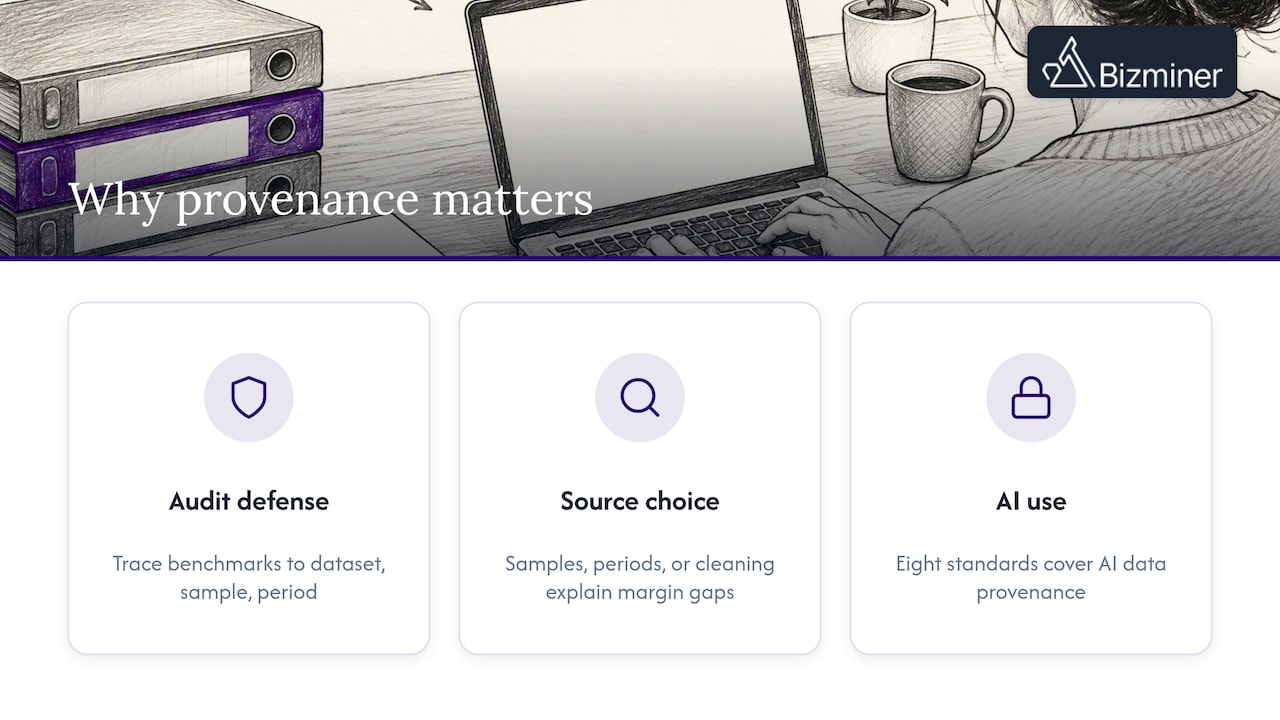
Defending a conclusion. When a client, auditor, examiner, or court asks where a benchmark came from, you need an answer that does not depend on memory. Provenance turns “we used industry data” into “we used this dataset, this sample, this period.”
Choosing between sources. Two vendors can publish different margins for the same industry. The difference usually lives in the sample, the period, or the cleaning. Provenance lets you tell which one fits your purpose.
Using AI responsibly. Models trained or prompted on data of unknown origin produce answers you cannot trace. A National Artificial Intelligence Advisory Committee document hosted by NIST lists the eight provenance standards proposed by the Data & Trust Alliance: source, legal rights, privacy and protection, generation date and method, data type, intended use, restrictions, and lineage. Those fields are a sensible checklist for any dataset you feed into an AI workflow, not only training data.
If your work touches lending, our guides on audit ready commercial underwriting data and AI for underwriting show how this plays out in credit decisions.
Standards you can ask a vendor to follow
You do not have to invent a provenance vocabulary. Two are worth knowing.
W3C PROV. A family of specifications for representing and exchanging provenance. Its core model describes entities, activities, and agents involved in producing data. Four of its twelve documents are W3C Recommendations, and the specifications are stable and widely referenced even though the working group concluded its work in 2013.
OASIS Data Provenance Metadata v1.0. A newer specification that provides a consistent framework to track data origin, movement, integrity, and quality, aimed especially at regulated and high-risk environments.
You are unlikely to ask a benchmark vendor for a PROV graph. But using the same concepts (who, what, which activity, which source) in your questions makes the answers comparable.
How organizations capture and maintain provenance
If you build or manage data internally, the MITRE practical guide on provenance capture is still a useful reference. It suggests organizations document data assets across programs, use non-intrusive observation at coordination points such as enterprise service buses, and apply schemas such as DCAT-US v3.0 to standardize catalog metadata.
A few principles hold up across the literature:
- Start with the decisions. Capture the provenance that someone will actually need to defend, not everything possible.
- Prefer low-cost, automatic capture. MITRE’s engineers warn that an overly complex model leads to a sparsely populated store, so they recommend non-intrusive capture that ensures data is actually collected.
- Make it readable by machines. The ACM authors note provenance should be available to applications, not just people, so that inputs can be validated automatically and systems can diagnose themselves.
- Protect the record. Provenance data should be secured against unauthorized access and alteration, or it stops being evidence.
What makes provenance hard
The same MITRE guide lists the usual obstacles: the cost of manual collection, the volume of data in large enterprises, the difficulty of querying massive provenance stores, and choosing a granularity that balances context with performance. Security researchers add that provenance-based intrusion detection helps analysts by giving a structured, causal record of events, though scaling to terabytes of enterprise data remains a hurdle.
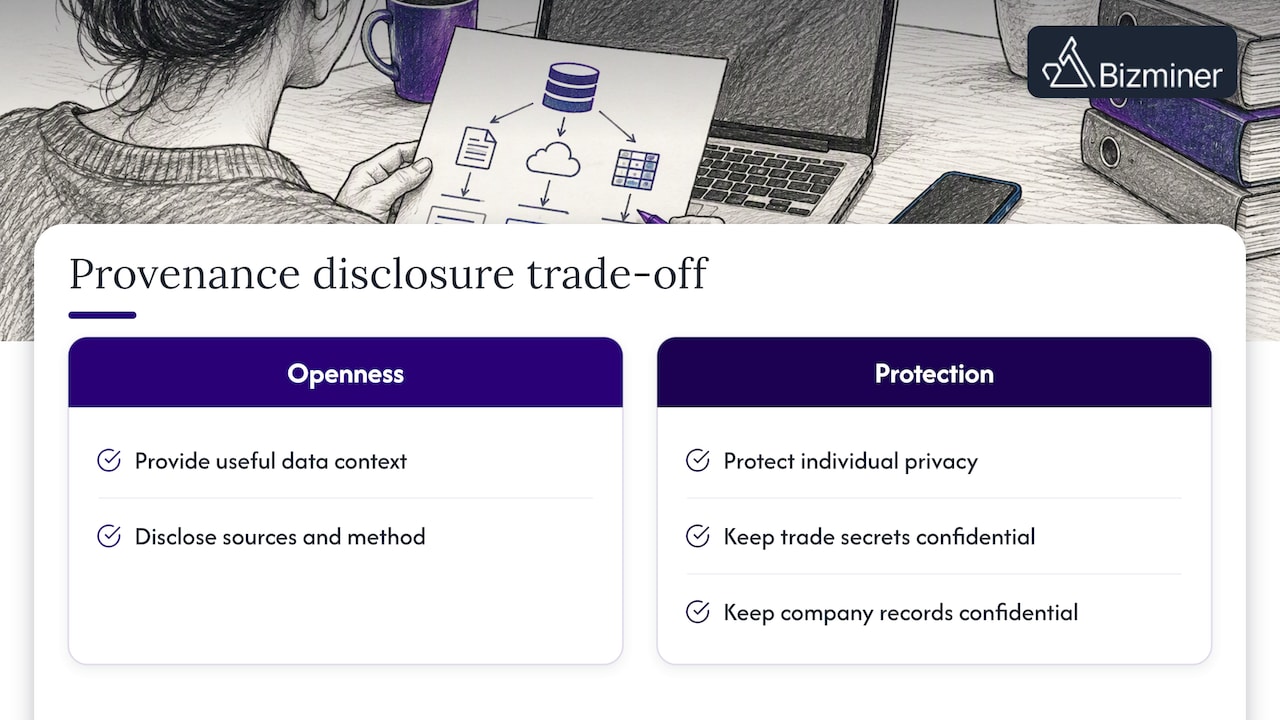
There is also a tension between openness and protection. The NAIAC findings describe a central trade-off: giving enough context for data to be useful while protecting individual privacy and proprietary trade secrets. In practice, a good vendor discloses sources and method in detail while keeping individual company records confidential. That is a reasonable line, and you should expect it.
A provenance checklist for evaluating business data
The ACM primer notes that professionals can use provenance to examine the assumptions behind reported statistics and assess whether data is trustworthy for a specific purpose. Here is that idea turned into questions you can ask any provider of industry benchmarks, market data, or company financials.
| Question | What a strong answer looks like |
|---|---|
| What are the original sources? | Named public and private datasets, listed per report |
| How large is the sample? | A stated count of businesses, with the segment it covers |
| What is the unit of analysis? | Industry code, geography, and company size band stated explicitly |
| What period does it cover? | A stated data year and refresh cadence |
| What was cleaned or excluded? | A written method, not “proprietary” |
| Can you reproduce it? | Same filters, same output, every time |
| Has it been tested externally? | Acceptance by courts, agencies, or examiners, stated precisely |
Two habits make this faster. First, ask for the source list and sample size before you ask for the price. Second, save the report alongside your work product, so the provenance travels with the conclusion. If you are doing diligence on a deal, our market data due diligence checklist covers the same ground in more depth, and our note on signals that improve financial forecasting with industry data shows which inputs deserve the closest scrutiny.
Perspective
We built Bizminer around a simple belief: a benchmark you cannot trace is a benchmark you cannot defend.
Most of the professionals we work with, accountants, advisors, lenders, and academics, are not short of numbers. They are short of numbers they can stand behind when a client, a credit committee, or a reviewer asks “where did this come from?” That is a provenance question, and it is why we put so much weight on granularity and source transparency.
Our reports are designed to let you filter by industry, geography, and company size, and to show larger sample sizes with detailed source lists. Our data has been accepted in U.S. Tax Court and is used by government agencies, and that bar shapes how we document it. We explain our approach on our page about how we get our data, so you can read it before you buy anything.
Our advice: whatever provider you choose, treat the source list as part of the product. If it is missing, you are being asked to take the number on trust.
Danny
From provenance to practice with Bizminer
When you need benchmarks you can document, we offer reports built across more than 9,000 unique markets, segmented by industry, geography, and company size. As published on our pricing page, Industry Financial Performance, Industry Market, and Company Profile reports are $249 each, and Financial, Market, Valuation, and Company reports are $349 each. Subscriptions and custom API feeds are available without a published price.
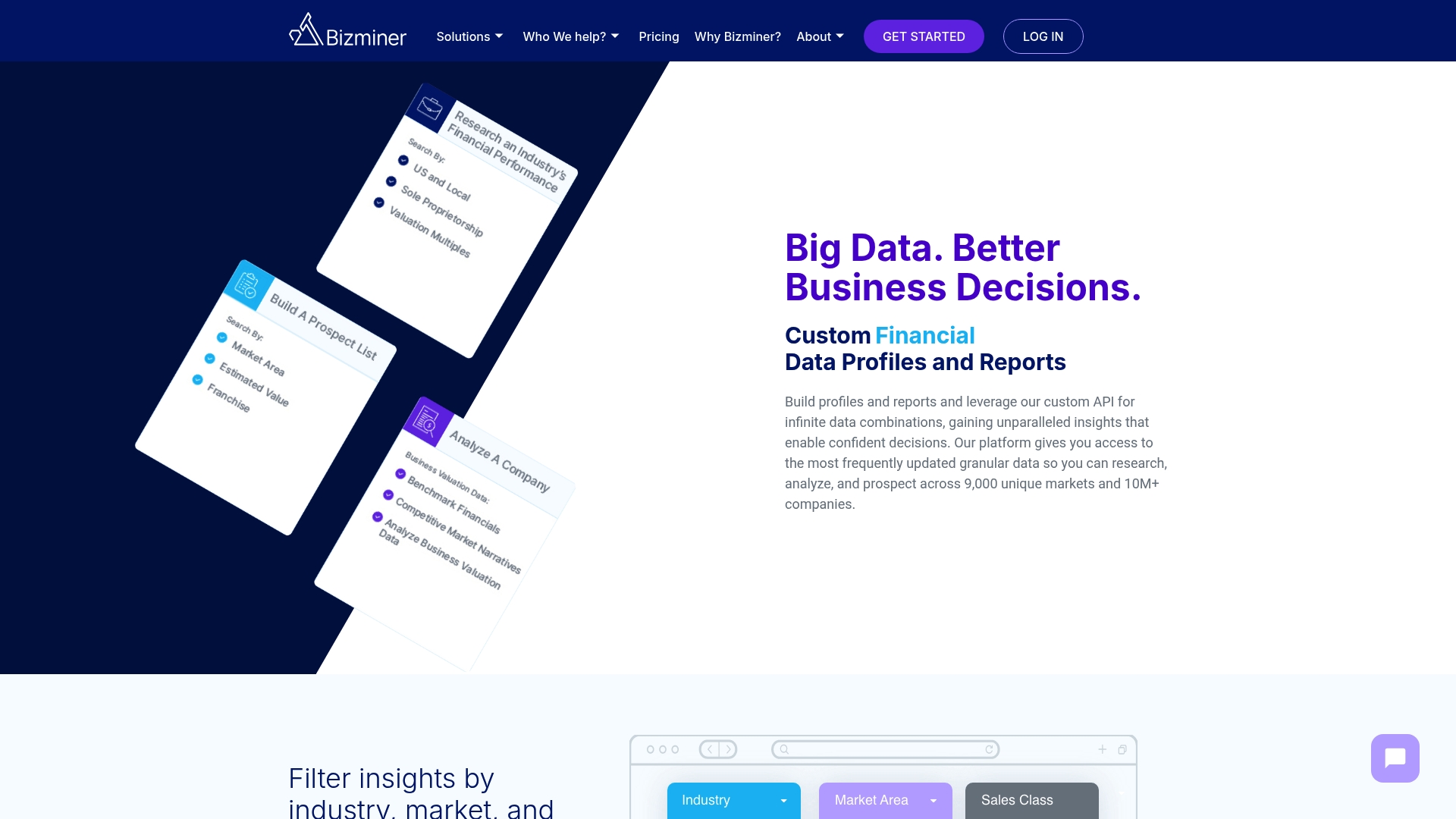
If you want the data inside your own workflow, our market data API is designed for accountants, lenders, and advisors who need repeatable pulls. Academic teams can see how we support reproducible research on our page about academic market data sources.
FAQ
What does provenance metadata mean?
Provenance metadata is a record of the entities, activities, and people involved in producing or influencing a piece of data. It tells you who created it and how it changed. You use it to judge authenticity, trust, and whether results can be reproduced.
Is data provenance the same as data lineage?
No. Lineage maps how data flows through systems at a macro level. Provenance records the detailed history of individual data points, including origin, authenticity, and transformations. Most mature teams track both, because the map and the story answer different questions.
What are the main types of data provenance?
The most common split is prospective provenance, the planned path data should follow, and retrospective provenance, the record of what happened. Database researchers also separate where-, how-, and why-provenance. You can capture any of them at file, record, or field level.
How do I check the provenance of business benchmarks?
Ask for the named sources, the sample size, the industry and geography definitions, the data period, and the cleaning method. Then confirm you can reproduce the figure with the same filters. If a provider cannot answer those questions, treat the benchmark as unverified.
Sources
- What Is Provenance, W3C XG Provenance Wiki
- What is Data Provenance? IBM
- A Primer on Provenance, Communications of the ACM
- Data Provenance: Origin Tracking and Chain of Custody, AFIP
- Data Provenance Metadata Version 1.0, OASIS
- NAIAC findings: towards standards for data transparency for AI models, NIST
- Provenance Capture and Use: A Practical Guide, MITRE
- TAPP: Defining standard provenance information for clinical research data
- Provenance-based Intrusion Detection Systems: A Survey
- Data Provenance: Definition, Types, and Why It Matters, Cyberhaven
- PROV: Provenance Data Model and Supporting Definitions, Metadata Standards Index