Industry data can support a position in U.S. Tax Court, but the court does not accept it because it carries an industry label. It accepts data when it is disclosed, explained by a qualified witness, and truly comparable to the taxpayer’s business and the tax year in dispute. Cases such as Bobry, Haffner’s, Lumber City and Gallagher show the same pattern: the data matters less than the fit and the paper trail behind it.
This guide is for accountants, valuers and advisors who prepare benchmarks for disputes. It covers the rules, the cases, the mistakes that get data limited or rejected, and a practical way to build a comparison set.
TL;DR
- Tax Court applies the evidence rules for nonjury federal trials in the District of Columbia, plus its own rules. Expert reports must disclose and explain the data they rely on.
- Industry averages work best as a reasonableness check, such as gross-profit margins against similarly sized companies, not as a substitute for the taxpayer’s records.
- Courts reject comparables that differ in size, product mix, growth, leverage or period, and data whose publisher warns against legal use.
- No court certifies a data source. Each decision turns on the facts and the expert’s method.
- Document filters, sample size and sources at the time you pull the data, so you can reproduce the benchmark later.
Table of Contents
- How Tax Court treats evidence
- Where industry data helps
- Why courts limit or reject industry data
- A defensibility checklist for benchmark data
- Sampling is a different tool
- Does the court endorse a data source?
- Building a comparison set that survives challenge
- Our perspective
- Pulling the data for a case
- FAQ
- Sources
How Tax Court treats evidence
The U.S. Tax Court is an independent federal trial court and the national forum for disputes between taxpayers and the IRS, and it seeks a uniform reading of the Internal Revenue Code (Tax Court information page). Because it is a trial court, you are building a record, not just an argument.
For most proceedings, the court applies the evidence rules used in nonjury trials in the U.S. District Court for the District of Columbia, as the IRS Chief Counsel Manual explains under Internal Revenue Code section 7453. The court’s Rules of Practice and Procedure add the specifics. Rule 143 covers general evidence, documentary evidence and expert-witness reports.
In practice, industry data reaches the court in three ways:
- Through an expert report. The expert relies on the data to value a business, test reasonable compensation, or estimate income or expenses. The report must identify what was considered and how it was applied.
- As a documentary exhibit. The data is offered directly, which means you must be ready to authenticate it and explain what it measures.
- As the IRS’s own yardstick. Examiners often compare a return to industry norms, and you may need to answer that comparison with better data.
Where industry data helps
The taxpayer carries the recordkeeping burden. Under 26 U.S.C. § 6001, a person liable for tax must keep records and comply with the rules the Secretary prescribes. Industry data does not replace those records. It gives the court a way to judge whether the records and the reported results are plausible.
The clearest example is Bobry v. Commissioner, where the court compared a company’s reported gross-profit margins with industry averages for similarly sized companies in the scrap-metal industry. The comparison was specific: one industry, one size band, one ratio.
Useful applications include:
- Gross margin and expense ratios as a check on reported income or deductions.
- Reasonable compensation analyses, where officer pay is compared to similar roles at similar companies.
- Valuation inputs, such as guideline companies, risk, growth and leverage benchmarks.
- Reconstructing income when records are incomplete, though this is the weakest position (see below).
Why courts limit or reject industry data
Most failures are not about the data being false. They come from comparability, transparency or relevance.
Data that is not comparable
In Lumber City Corp., the court found compensation analyses unpersuasive where survey data appeared noncomparable and an expert used a different asset range because the relevant range was unavailable. Using a nearby band when the right one is missing invites exactly that finding.
In Estate of Gallagher, summarized in a valuation firm’s case review, the court rejected the IRS expert’s guideline-company method because the selected companies differed materially in size, product mix, growth, leverage and distribution channels. Sharing a broad industry was not enough. Economic and functional comparability decided it.
Data the publisher disclaims
In Haffner’s Service Stations, the court stressed that data underlying an expert opinion is not automatically admitted just because the opinion is. It also criticized reliance on a publication that warned its data was not statistically accurate or suitable for legal proceedings. Read the fine print of any source before you build on it.
Industry averages used to rebuild a business
A law firm’s discussion of Feinberg v. Commissioner reports that the court rejected an expert report that reconstructed a taxpayer’s business from industry averages. The report lacked underlying sources and data, did not rest on personal knowledge of the business, and amounted to conjecture. Benchmarks should test records, not stand in for them.
Expert reports that hide the method
A 2024 NACVA QuickRead article summarizes what a reliable expert report shows: the data and information considered, the supporting exhibits, the methodology, and how the method was reliably applied to the facts under Federal Rule of Evidence 702 and Rule 26(a)(2)(B). If your benchmark filters cannot be listed and repeated, the report is exposed.
A defensibility checklist for benchmark data
Before a benchmark goes into a report, run it through these questions.
| Question | What a weak answer looks like | What a strong answer looks like |
|---|---|---|
| Is the industry defined precisely? | A broad sector or a two-digit grouping | A six-digit NAICS code matched to what the business actually does |
| Is the size band right? | “Small companies” | Revenue or asset range that brackets the taxpayer |
| Is the geography relevant? | National averages for a local business | Regional or local data, or a stated reason national data is appropriate |
| Is the period correct? | Data from other years | Data for the tax year at issue, or the valuation date |
| Is the sample documented? | Unknown sample size and origin | Sample counts and a source list you can hand over |
| Does the publisher allow this use? | Disclaimers against legal use | A source with a track record in formal proceedings |
| Can someone reproduce it? | Screenshots with no filters | A saved set of parameters and dates pulled |
The period question matters. In Sundstrand Corp. v. Commissioner, a case summary reports that the court excluded post-year financial data under Federal Rule of Evidence 403 because its value was outweighed by delay and wasted time. Aggregate data from later years did not speak to the pricing and profits of the years being tried.
Sampling is a different tool
Industry data is not the same as statistical sampling of the taxpayer’s own records, though the two get confused. Revenue Procedure 2011-42 says taxpayers may use statistical sampling to support return items when the Service permits it, and that samples failing its criteria will be rejected. It also treats the appropriateness of a probability sample as a facts-and-circumstances question, weighing analytical time and cost against whether books and records exist or carry more probative value.
The lesson carries over to benchmarks: the court asks whether a shortcut is justified when better evidence exists. Tax returns also show only part of a business’s economics, which is one reason lenders weigh tax returns and self-employed borrowers differently than examiners do. Whichever audience you face, say what the data measures and what it leaves out.
Does the court endorse a data source?
No. When a decision relies on industry data, it is deciding that this data, applied this way to these facts, was persuasive. The same source can be accepted in one case and criticized in another if the comparison set or the method differs. Haffner’s and Gallagher both show the court examining the fit, not the brand.
That is why a provider’s track record is a starting point, not a shield. Our data has been accepted in U.S. Tax Court and used by government agencies, and we still tell every user the same thing: the benchmark is only as defensible as the filters and documentation behind it.
Building a comparison set that survives challenge
A workable sequence looks like this:
- Pin down the business. Describe what it sells, to whom, and where. Choose the NAICS code that matches the revenue source, not the one on the tax return by habit.
- Set the size band. Bracket revenue or assets around the taxpayer, and note the range in the report.
- Choose geography on purpose. If local conditions drive margins, use regional data. If you use national data, explain why.
- Match the period. Use the tax year or valuation date, and avoid mixing in later years.
- Record the sample. Save the sample size, the source list and the date of the pull.
- Test against the records. Show where the taxpayer sits against the benchmark and explain the gaps with facts from the business.
- Disclose everything the expert considered. Attach exhibits and describe the method in plain language.
For deeper workflows, see our guides on building court-ready benchmarks, five filters for industry comps, and defensible CPA benchmarking. Valuers can start with business valuation data sources, and analysts who need regional cuts can read about industry data by geography.
Our perspective
We see the same failure repeatedly: a benchmark that was fine as a screening tool gets promoted into an exhibit without the work that makes it one. The data was not the problem. The filters were never recorded, the size band was approximate, or the sample was unknown.
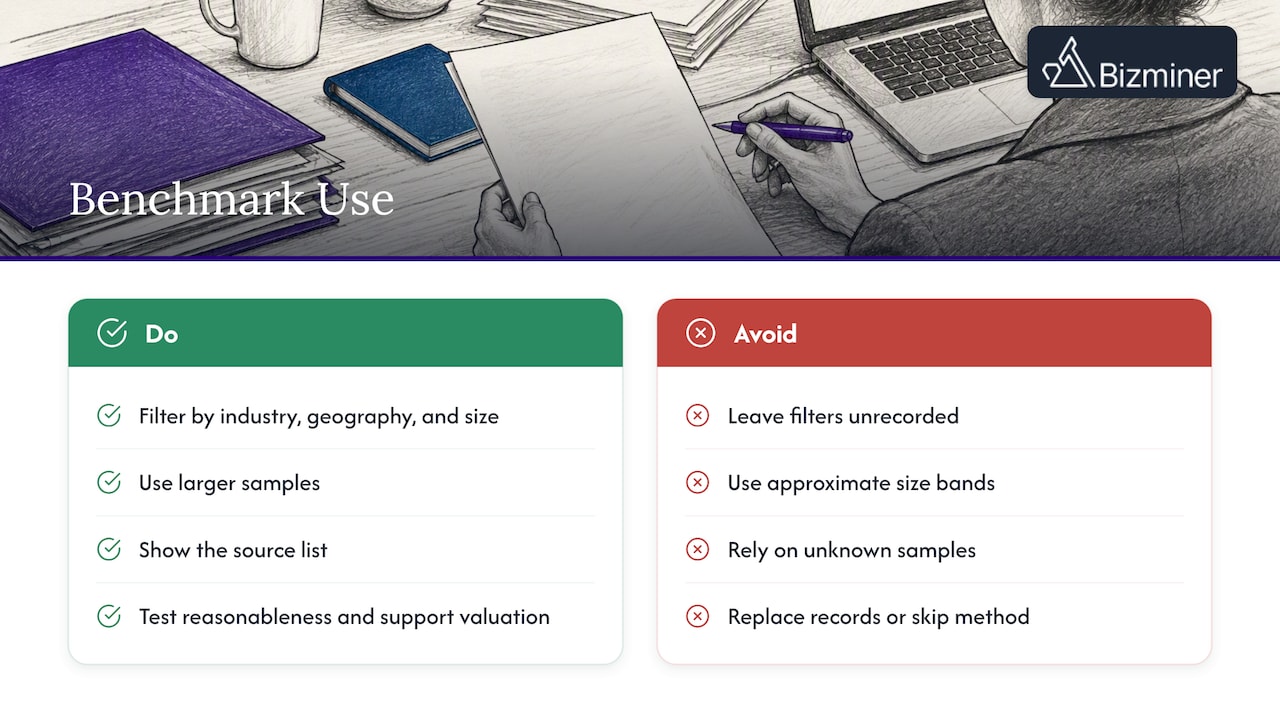
Our approach is to treat granularity as the defense. When you can filter by detailed industry, geography and company size, you shrink the gap between the benchmark and the taxpayer, and that gap is what opposing counsel attacks. Larger samples and a visible source list make the report easier for an expert to explain and for a judge to follow.
We also push users to keep the benchmark in its lane. It tests reasonableness and supports a valuation. It does not replace books and records, and it does not excuse a missing method. If your report would collapse without the benchmark, the report has a bigger problem.
— Danny
Pulling the data for a case
For a dispute, you typically need a financial performance benchmark for the industry, and often a company-level or valuation report to sit beside it. Our published one-off prices are $249 per report for Industry Financial Performance, Industry Market and Company Profile, and $349 per report for Financial Report, Market Report, Valuation Report and Company Report. Subscription and API feed pricing is not published, so check the pricing page for current options.
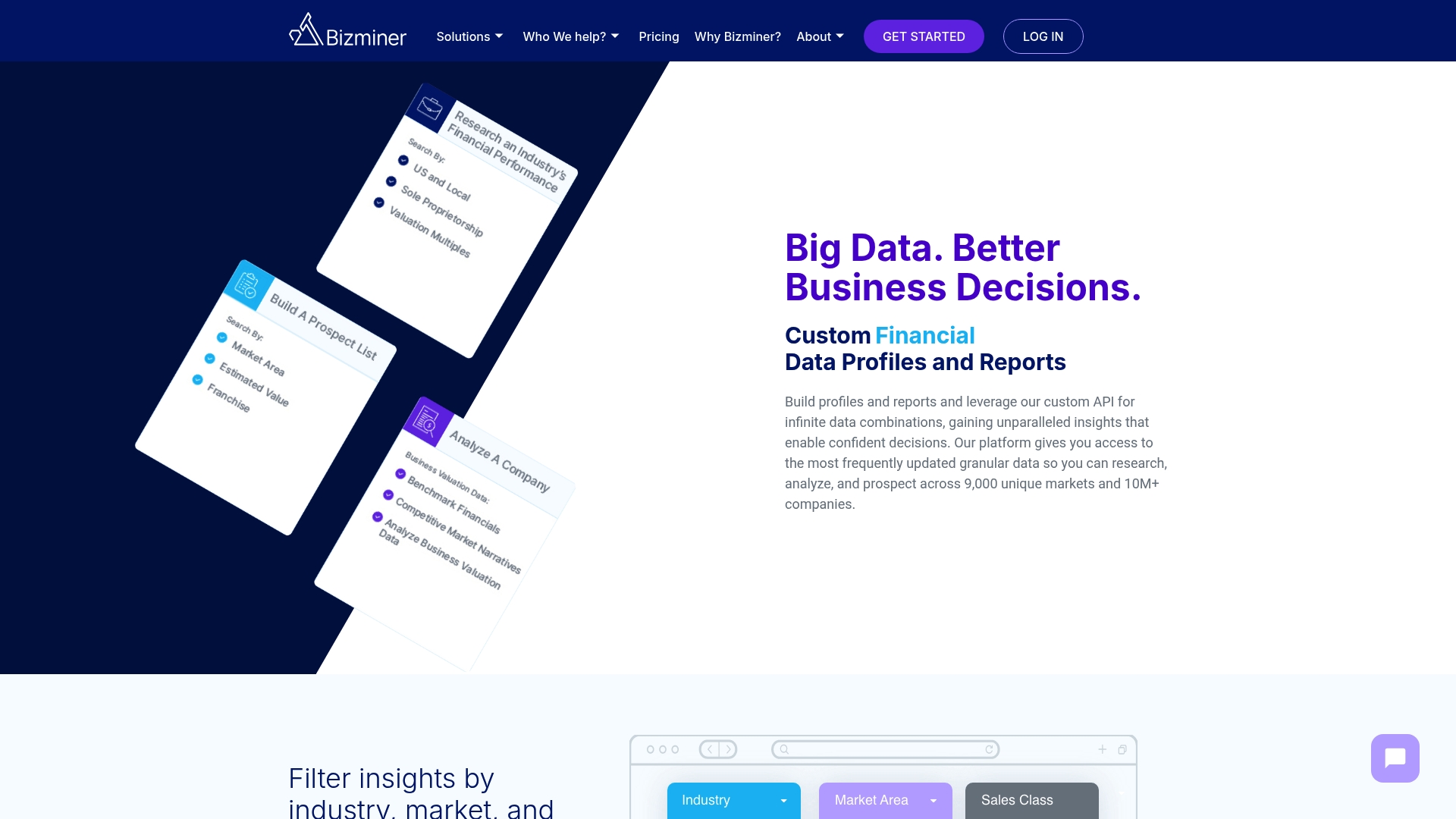
If you want to see how filtering works across more than 9,000 markets before you commit, the guide to Tax Court valuation data walks through it, and the custom report tools show what a tailored output looks like.
FAQ
Can I rely on industry averages alone to support a deduction?
It is risky. Courts have rejected reconstructions built mainly on industry averages when the sources were missing and the expert had no personal knowledge of the business. Use averages to show that your records are reasonable, and keep the records themselves as the primary proof.
Do I need an expert to introduce industry data?
Often, yes. Data used through an expert must be disclosed and explained in a compliant report, especially when it rests on statistical or technical information. Whether you can offer it another way depends on authentication and the court’s evidence rules, so ask the attorney handling the case.
What makes a benchmark noncomparable?
Differences in size, product mix, growth, leverage, distribution channels, geography or time period. Gallagher and Lumber City both turned on this kind of mismatch. Check each factor against the taxpayer before you finalize the set.
Does Tax Court approve specific data providers?
No. The court weighs the data and the method in each case. A prior acceptance shows a source can be used credibly, but it does not guarantee the next ruling.
Sources
- Court Information, United States Tax Court
- Rules of Practice and Procedure, United States Tax Court
- IRM 35.1.1 Tax Court Jurisdiction and Proceedings
- 26 U.S. Code § 6001
- Bobry v. Commissioner (1997)
- Lumber City Corp. (1996)
- Haffner’s Service Stations, Inc. (2002)
- Estate of Gallagher v. Commissioner case review
- The Use of Expert Testimony in Tax Court, Part II
- What the Tax Court Wants to See, QuickRead
- Revenue Procedure 2011-42
- Sundstrand Corp. v. Commissioner, 89 T.C. 810 (1987)