A lead is a person or company that has shown some interest in what you offer or has come to your attention. A prospect is a lead you have checked against your criteria and found to be a real fit: the right size, the right industry, the right location, and a plausible need and budget. A lead is a name. A prospect is a name you have a reason to call.
For an accounting firm, advisory practice, lender or small business development center, that distinction decides where your hours go. Firms that treat every inquiry as a prospect waste partner time. Firms that never build prospects wait for referrals. The fix is a short, written definition of each stage and company-level data to qualify the people who sit between the two. We cover both below.
TL;DR
- A lead has shown interest or been identified, but nobody has confirmed that they fit. A prospect has been qualified against your criteria.
- An opportunity comes after that: a prospect with a defined need, a scope and an expected value that you are actively pursuing.
- Qualification is where leads become prospects. For professional-services firms it rests on firmographics: industry, revenue band, size and location.
- Outbound prospecting starts with a list of fitting companies, not a pile of inquiries. Those lists are priced per record.
- Write down your stage definitions once. Teams argue about vocabulary far less than they argue about unclear criteria.
Table of Contents
- The short answer: where each term sits
- What counts as a lead
- What makes someone a prospect
- Lead vs prospect vs opportunity
- Is prospecting the same as lead generation?
- How a lead becomes a prospect: a practical process
- Why data quality decides the outcome
- How the stages differ by reader
- Building a prospect list from company data
- Common mistakes with lead and prospect definitions
- Our perspective
- FAQ
- Sources
The short answer: where each term sits
The words are used loosely, and sales teams, marketers and CRM vendors do not all draw the line in the same place. The most common and most useful convention runs like this:
| Stage | What you know | What happens next |
|---|---|---|
| Lead | A name, a company or an inquiry. Interest is shown or assumed. Fit is unknown. | Research and qualification |
| Prospect | The lead matches your criteria for industry, size, geography and need. | A first conversation or tailored outreach |
| Opportunity | A specific need, scope, decision-maker and approximate value are identified. | Proposal, negotiation, engagement letter |
| Client | They have signed or paid. | Delivery and renewal |
Two ideas hold the table together. Lead status needs no judgment from you: someone downloaded a checklist or attended a webinar, or a company appeared on a list. Prospect status requires a judgment, made on evidence, that the company is worth your pursuit.
What counts as a lead
A lead can arrive in several ways:
- A business owner fills in a contact form or requests a consultation.
- A banker, attorney or existing client mentions a name.
- Someone downloads your tax-planning guide or signs up for an event.
- You identify a company in a target industry through your own research.
In each case you know that a company exists and that there may be a conversation to have. You do not yet know whether it is the kind of business you serve well, or whether anyone there has a need you can solve. A lead from a referral tends to be warmer than a name from a list, but both are still leads until you qualify them.
What makes someone a prospect
A prospect is a lead that has passed qualification. The general idea appears across sales guidance. Marketing and sales teams commonly use the labels marketing-qualified lead and sales-qualified lead, and a sales-qualified lead is generally described as a prospect vetted and ready for a direct conversation with sales. In other words, the word “prospect” signals that someone has already done the checking.
For a professional-services firm, useful qualification questions are usually company-level:
- Industry. Is it one you serve, using a specific industry code rather than a broad label like “retail”?
- Size. Does its revenue or employee count sit in the band where your fees make sense for both sides?
- Location. Is it inside the states, counties or metro area you cover?
- Financial profile. Do its margins, growth or leverage suggest an advisory need, such as tax planning, a valuation, financing or succession?
- Contactability. Can you reach a decision-maker?
Notice that none of these needs a conversation. You can answer most of them before you pick up the phone, if you have the right data. That is why prospecting for a CPA or advisory firm looks different from consumer-style lead generation.
Lead vs prospect vs opportunity
People often search for the lead-versus-opportunity distinction too, because CRM software uses both words as record types. The difference is one of commitment.
A prospect is a good fit with a probable need. An opportunity exists when there is a specific, active deal: a company that wants a business valuation before a partner buyout, a lender with a loan request to assess, or a nonprofit that needs a market study to guide a local program. You can name the scope, the decision-maker and a rough fee.
In Salesforce, for example, a lead is converted into an account, a contact and, optionally, an opportunity. Salesforce’s lead conversion mapping shows how fields on the lead record carry across to those new records. That structure reflects the stages above: the lead is the raw record, and the opportunity is a pursued deal.
A simple test separates them:
- Lead: “Is this company interested, or might it be?”
- Prospect: “Is this the kind of company we should pursue?”
- Opportunity: “What exactly are we proposing, and when will they decide?”
Is prospecting the same as lead generation?
No, although they overlap. Lead generation creates or captures interest, usually by attracting inbound inquiries through content, events, referrals and search. Prospecting is the active work of finding and qualifying companies that fit, then reaching out to them first.
For most accounting, advisory and lending teams both matter, but they behave differently:
- Inbound lead generation is slow to build and brings inquiries of mixed quality. Each one needs triage.
- Outbound prospecting gives you control of who you approach. The quality of the result depends almost entirely on the quality of the list.
If your growth plan is “take on 15 new manufacturing clients with $5 million to $25 million in revenue in our region,” you do not need more leads. You need a list of qualified prospects that matches that sentence.
How a lead becomes a prospect: a practical process
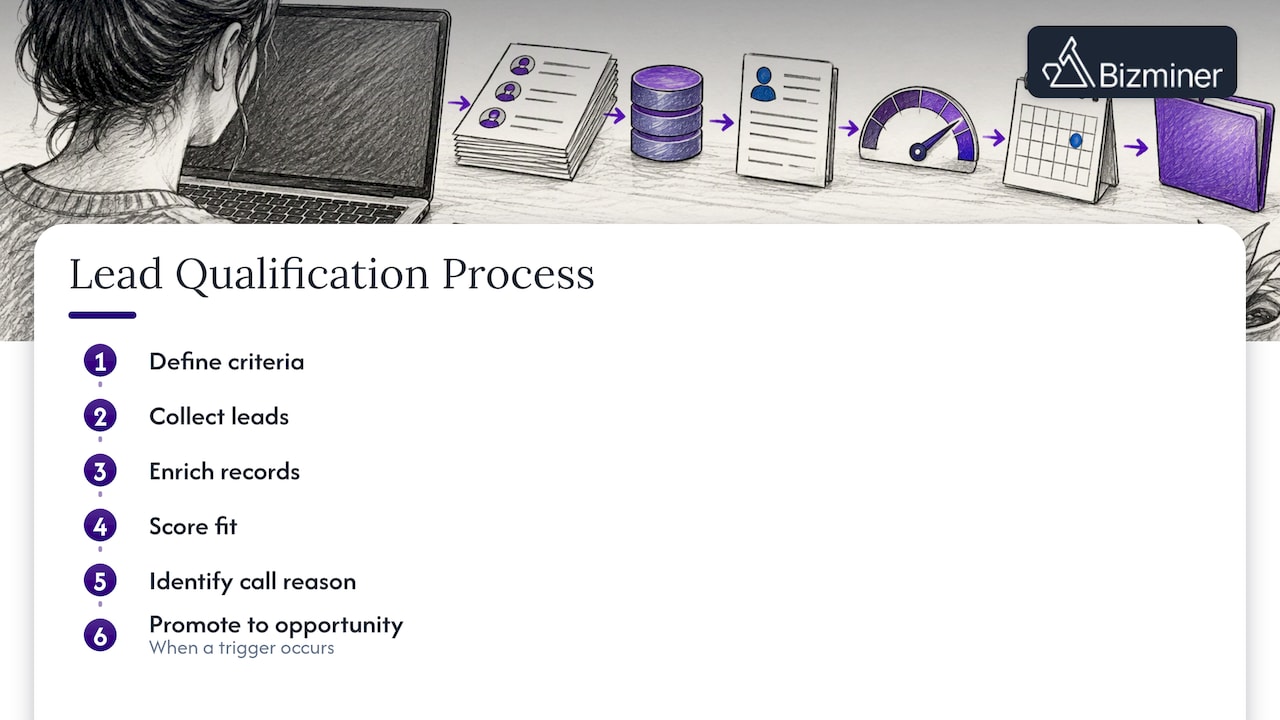
Step 1: Define your ideal client in numbers
Write the criteria as filters you can apply to a database: industry code, revenue band, headcount, state or county. “Growing small businesses” cannot be filtered. “Landscaping companies in three counties with revenue between $1 million and $5 million” can.
Step 2: Collect leads from every source
Put inquiries, referrals and list names into one place. Do not judge them yet. A single shared spreadsheet or CRM is fine, as long as each record has the company name and source.
Step 3: Enrich each record with company data
Add what you need to apply your filters: industry classification, size, location and financial indicators. This is the step where most teams stall, because the information is scattered across directories, filings and websites.
Step 4: Score against your criteria
Mark each lead as a fit, a maybe or not a fit. Only fits become prospects. Keep the maybes in a nurture list so you can recheck them when circumstances change, such as a growth jump or a change in ownership.
Step 5: Attach a reason to call
A prospect is more useful when you know why to approach it. Benchmarks help here: if a prospect’s margins sit below those of its industry peers, you have a specific, relevant conversation to open with. That is a far stronger opener than a generic introduction.
Step 6: Promote to opportunity on a defined trigger
Choose a clear event, such as a discovery meeting held or a scope discussed. When it happens, the prospect becomes an opportunity. Without a trigger, pipelines fill with stale prospects that nobody has the nerve to remove.
Why data quality decides the outcome
Qualification is only as good as the data behind it. If your industry codes are wrong, you pursue companies outside your niche. If you have no size data, you pitch a $400,000 engagement to a business that can afford $4,000. Teams using broad industry averages or national figures have the same problem in a different form: the numbers describe an industry, not the narrow segment your prospect competes in.
Granularity matters at both ends of the process. At the top, it narrows the universe to companies worth contacting. At the bottom, it supports the conversation: a benchmark filtered by niche, geography and size is credible with a business owner, a loan committee or a reviewer, while a broad average invites the answer “that is not my business.”
How the stages differ by reader
The same vocabulary applies across the groups we work with, but the mapping shifts a little:
- Accounting and advisory firms: leads are inquiries and referrals. Prospects are businesses in your target industries and size bands. Opportunities are scoped engagements such as tax planning, valuation or an outsourced finance function.
- Financial institutions: leads are businesses that appear in your market. Prospects are those whose financial profile fits your credit appetite. Opportunities are active loan requests.
- Small business development centers and nonprofits: leads are entrepreneurs and local businesses that reach out or appear in a community scan. Prospects are the segments your program can serve. Opportunities are funded or scheduled engagements.
- Academic programs: the funnel analogy teaches well. Students can build a lead list from public data, define qualification criteria, and justify them with industry benchmarks.
Building a prospect list from company data
Once your criteria are written as filters, a prospect list is the output of applying them to a database of companies. Bizminer sells prospect lists priced per record, in three tiers: Tier 1 at $0.65, Tier 2 at $0.60 and Tier 3 at $0.55 per record, one-off. That makes the cost of a campaign easy to estimate: a list of 1,000 records at the Tier 1 rate comes to $650, at Tier 2 to $600 and at Tier 3 to $550.
The same platform covers more than 9,000 unique markets, segmented by industry, geography and company size, so the criteria you wrote in Step 1 map directly to the way the data is organized. For the enrichment and call-reason steps, Bizminer also offers industry financial benchmarks and company-level reports. Industry Financial Performance, Industry Market and Company Profile reports are $249 each, and Financial, Market, Valuation and Company reports are $349 each, all one-off. The pricing page lists every option, including the subscription and the customizable API feed, which have no published price.
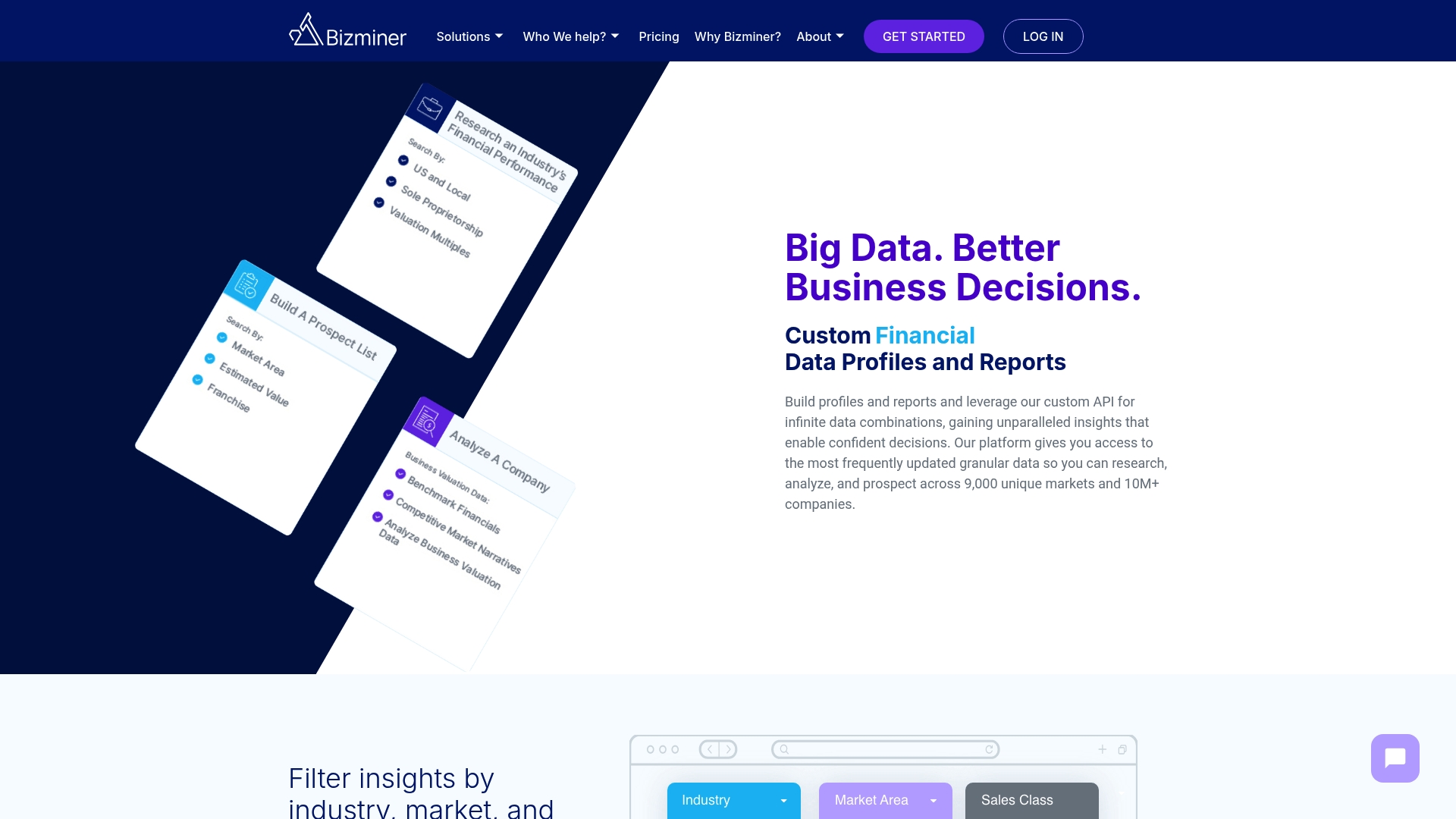
If you work in audit-sensitive settings, there is an additional reason to start from this data. Bizminer data has been accepted in U.S. Tax Court and used by government agencies, so a benchmark you cite in a first meeting with a prospect is the same one you can rely on later when the engagement involves valuation or defense. You can see what is available on the Bizminer site.
Common mistakes with lead and prospect definitions
Calling everything a prospect. If the count of prospects in your pipeline equals the count of names you have ever collected, the word has lost its meaning. Reserve it for qualified companies.
Qualifying on enthusiasm instead of fit. An eager business that is too small for your fees is a lead that stays a lead. A quiet business that fits perfectly may be your best prospect.
Letting marketing and sales use different definitions. Marketing teams commonly count a lead when someone engages with content. Sales teams count a prospect when someone could buy. Agree the handoff point in writing and name the person who owns it.
Skipping the nurture list. A lead that does not fit now may fit in a year. Keep the record and the date you last reviewed it.
Using one benchmark for every prospect. National averages hide the differences between a 10-person and a 200-person company in the same industry. Filter by size, region and niche before you quote a number.
Our perspective
Most of the confusion between leads and prospects is really a data problem. When a team cannot tell whether a company fits, it calls the company a lead and waits. When it can see the industry, the size, the location and the financial profile in minutes, the same company becomes a prospect on the first day.
That is why we built Bizminer around granularity: more than 9,000 markets, segmented by industry, geography and company size. Reports with larger sample sizes and detailed source lists let a CPA, an advisor or a lender move from “someone we heard about” to “a company we can speak to credibly” without guesswork. And because our data has been accepted in U.S. Tax Court and used by government agencies, the benchmark you use to open a conversation is one you can stand behind when the work gets serious.
Our advice is simple. Write your criteria as filters. Build the list from data. Attach a reason to every call. The vocabulary then takes care of itself.
Danny
FAQ
Is a prospect always better than a lead?
A prospect is further along, not necessarily better. A prospect has been checked against your criteria, so you have more reason to spend time on it. A lead may turn out to be an excellent prospect once you qualify it, which is why you should not discard leads unreviewed.
Can a prospect become a lead again?
In practice, yes. If a prospect stops responding or its situation changes, many teams move it back to a nurture list and treat it as an unqualified lead until there is a new trigger. What matters is that the status reflects what you currently know.
What is the difference between a lead and an opportunity?
A lead is an interested or identified company with unknown fit. An opportunity is a specific deal you are pursuing, with a defined need, a decision-maker and an expected value. CRM tools such as Salesforce create the opportunity record when a lead is converted, which mirrors that progression.
Where do prospects come from for a professional-services firm?
There are two main routes. Inbound inquiries and referrals produce leads that you then qualify. Outbound prospecting starts with a list of companies matching your industry, size and location filters. A list priced per record, such as Bizminer’s prospect lists, lets you size the campaign before you start.