Bank loan underwriting data combines loan-level fields, credit bureau information, and, when authorized, borrower cash-flow or bill-payment signals. These inputs determine risk, price, and approval decisions under U.S. regulatory guardrails set out in FR Y-14M reporting and the federal interagency guidance on alternative data. Cash-flow signals can widen access to credit for thin-file borrowers, but only inside a documented, fair-lending-tested framework, not as a shortcut around it.
TL;DR:
- Only loan-level features that predict repayment, can be explained to denied applicants, and comply with fair-lending laws are suitable for underwriting models.
- The FR Y-14M provides detailed loan and portfolio data from large banks, helping smaller institutions benchmark and monitor industry trends.
- Alternative data such as cash-flow, rent, and utility payments can expand credit access but must be used within documented, compliant frameworks and tested for reliability in stress periods.
- Ongoing validation, clear data provenance, and explainability are essential for safely implementing alternative data in credit models under regulatory supervision.
- Using industry benchmark reports like Bizminer helps underwriting teams assess whether borrower cash-flow profiles align with typical ranges for their sector, supporting audit readiness.
Table of Contents
- What Counts as Bank Loan Underwriting Data?
- Where Do Analysts Find FR Y-14M and Large-Bank Credit Data?
- Which Loan-Level Fields Do Underwriting Models Actually Use?
- What Alternative Data Do Banks Actually Use in Underwriting?
- What Compliance Rules Govern Alternative Data in Underwriting?
- How Do You Implement Alternative Data Underwriting Safely?
- An Analyst’s Take on Innovation Versus Prudence
- Where Bizminer Fits Into Underwriting Analysis
- Sources
- FAQ
What Counts as Bank Loan Underwriting Data?
Underwriting data splits into two buckets: the traditional loan-level fields banks have reported for decades, and the newer, authorized alternative signals regulators are still writing guardrails around. Traditional data means credit bureau scores, debt-to-income ratios, loan-to-value figures, income documentation, and payment history captured at origination and updated through the life of the loan. Alternative data means anything outside a standard credit file, most commonly a borrower’s bank account cash flow, rent payments, or utility and telecom billing history.
The Federal Reserve’s FR Y-14M reporting forms and instructions define the baseline for how large banks report loan-level performance data every month. Any bank credit assessment technique built today, whether a simple scorecard or a machine learning model, has to reconcile against that supervisory framework sooner or later.
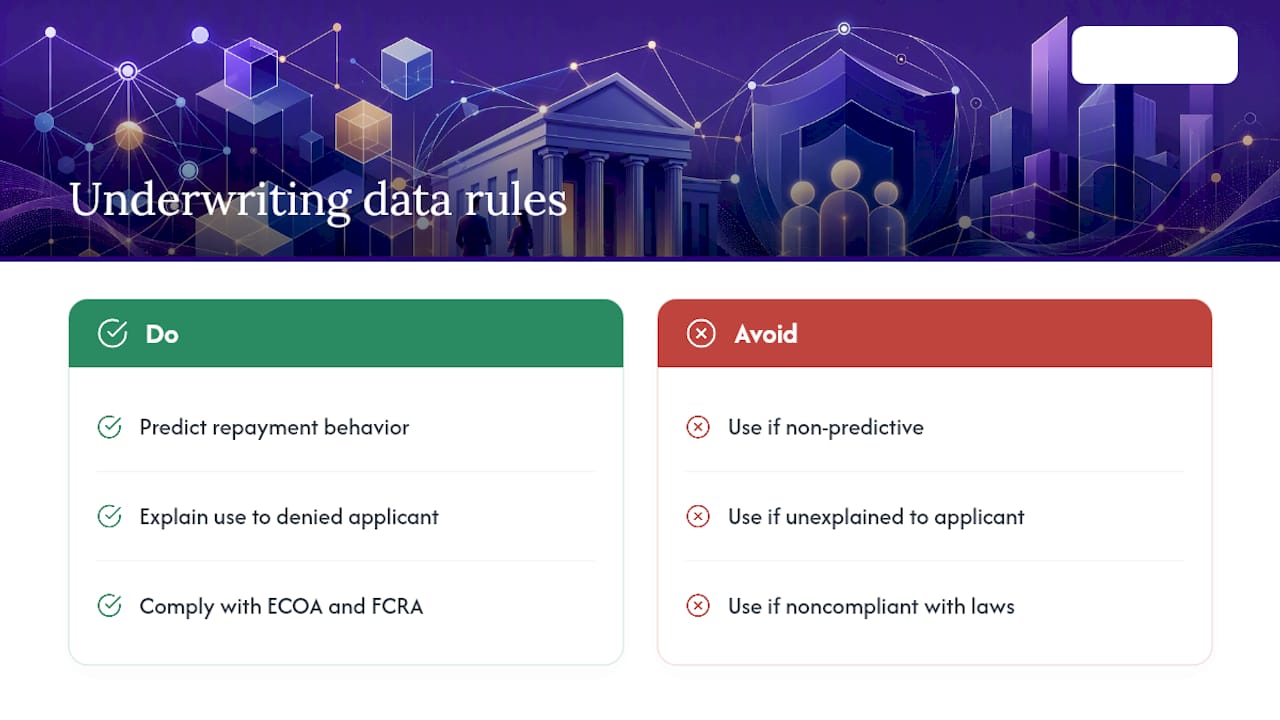
Three things determine whether a data source belongs in an underwriting model: does it predict repayment behavior, can it be explained to a denied applicant, and does its use comply with the Equal Credit Opportunity Act and the Fair Credit Reporting Act. Miss any one of those three and the data point becomes a liability rather than an asset, regardless of how strong its statistical lift looks in back testing.
Where Do Analysts Find FR Y-14M and Large-Bank Credit Data?
The FR Y-14M is a mandatory monthly loan-level collection required from bank holding companies with $100 billion or more in total consolidated assets. It covers three separate schedules: first-lien residential mortgages, home equity lines and loans, and credit card portfolios. Each schedule reports both loan-level attributes and portfolio-level summaries, and examiners use the collection primarily for stress testing under the Dodd-Frank Act supervisory framework.
Analysts outside the largest banks still rely on this data because the Federal Reserve Bank of Philadelphia publishes an aggregated version drawn from the same underlying collection, giving smaller institutions and researchers a benchmark they could never build from their own portfolios alone. That public release strips out firm-level identifiers but keeps enough granularity, credit score bands, vintage year, geography, to support meaningful comparison.
Here’s what analysts typically pull from these sources:
- Loan-level performance files segmented by vintage, product type, and credit score tier
- Aggregated delinquency and charge-off rates by origination quarter
- Variable definitions and data dictionaries that map raw item codes to plain-language field names
- Release notes documenting schedule changes, so historical comparisons account for reporting revisions
Portfolio surveillance teams use these files to spot when their own book is drifting away from industry norms in early payment default rates or LTV distribution, often months before internal metrics would flag the same shift.
Which Loan-Level Fields Do Underwriting Models Actually Use?
Every credit model, whether it’s a decades-old scorecard or a gradient-boosted machine learning pipeline, consumes a fairly consistent set of loan-level inputs. The differences show up in how those fields get weighted and combined, not in what gets collected in the first place.
The core fields underwriters and models rely on include:
- Origination credit score, along with the bureau and scoring model version used to generate it
- Debt-to-income ratio, both at origination and recalculated as balances change
- Loan-to-value ratio, tied to appraised or automated valuation figures
- Income documentation status, full documentation, stated income, or bank-statement based
- Occupancy type and collateral classification
- Payment history fields, including 30/60/90-day delinquency flags and cure rates
The FR Y-14M instructions give analysts a common language for these fields. Item M151 covers income documentation type, M152 covers debt-to-income ratio, and M154 covers origination credit score, according to the FR Y-14M data dictionary. When two institutions describe a field differently in their internal systems, mapping both back to the Y-14M item code resolves most disputes about what a variable actually measures.
Vintage analysis groups loans by origination quarter and tracks their delinquency curves over time, which is how risk teams isolate whether a bad quarter reflects underwriting drift or a broader economic shock. Delinquency cohort analysis does something similar but slices by current payment status rather than origination date, useful for servicing and collections prioritization rather than pure credit risk assessment.

What Alternative Data Do Banks Actually Use in Underwriting?
Alternative data, under the federal interagency framing, means information not typically found in a consumer’s credit file. The Interagency Statement on the Use of Alternative Data in Credit Underwriting, issued jointly by the Federal Reserve, CFPB, FDIC, NCUA, and OCC, lays out both the opportunity and the compliance expectations banks need to meet before using it.
The categories showing up most often in U.S. underwriting programs today:
- Cash-flow data, pulled from checking and savings account transactions with borrower authorization, showing income regularity, deposit patterns, and existing debt payments in near real time.
- Rent and utility payment history, useful for borrowers whose largest recurring obligation never appears on a traditional credit file.
- Telecom and cell phone billing data, which functions similarly to utility data as a proxy for payment discipline.
- Small-business transaction analytics, drawn from merchant processing or accounting software feeds, used to assess repayment capacity for business loans.
Cash-flow data gets singled out in the guidance as a comparatively lower-risk category, largely because it reflects the borrower’s own finances directly and can be explained to the consumer in plain terms. That’s part of why Second Look programs, which apply alternative data only to applicants who would otherwise be denied under standard criteria, have become a popular entry point. They limit alternative-data risk to a narrow slice of the applicant pool rather than running it across every decision.
The limitations matter just as much as the use cases. A cash-flow signal that looks predictive in a benign economic period can lose reliability fast in a downturn, if the underlying sample never included stressed borrowers. Consent management adds friction too, since a borrower has to actively authorize account access, and vendor risk climbs whenever a bank leans on a third party for data aggregation it doesn’t fully control.
Pro Tip: Pilot alternative data on your Second Look population first. It limits your fair-lending exposure to a defined subset while you build the monitoring infrastructure a full rollout will eventually need.
What Compliance Rules Govern Alternative Data in Underwriting?
Two consumer-protection statutes anchor everything else: the Equal Credit Opportunity Act, which prohibits discrimination in credit decisions, and the Fair Credit Reporting Act, which governs how consumer information gets collected, used, and disclosed. Any alternative-data variable that touches a credit decision has to pass through both filters before it goes live.
Model risk guidance layers on top of that. The Federal Reserve’s SR 11-7 supervisory letter, along with parallel OCC and FDIC guidance, requires banks to validate, test, and monitor models on an ongoing basis, not just at launch. That obligation gets harder to satisfy with opaque machine learning models. Regulators have flagged that black-box AI credit models create real friction with adverse-action notice requirements, since a lender has to tell a denied applicant the specific reasons for denial, and a model that can’t produce feature-level attribution can’t meet that bar.
Governance practices that hold up under examination tend to share a few traits:
- Documented data lineage from source to model input, including vendor contracts and consent records
- Pre-deployment testing across demographic groups to check for disparate impact
- Ongoing monitoring for concept drift, particularly after economic shifts
- A clear escalation path for engaging supervisors before scaling a new data source
Banks that treat explainability as a design requirement from day one, rather than a patch applied after a regulator asks questions, spend far less time rebuilding models under examination pressure.
How Do You Implement Alternative Data Underwriting Safely?
Sourcing comes first. Every alternative-data feed needs documented provenance, meaning you can trace a given data point back to an authorized account connection or a vetted vendor, with consent captured at the moment of collection, not reconstructed later from memory or a vendor’s assurance.
Quality control follows close behind. Backtesting against a stress cycle, not just recent benign years, tells you whether a signal holds up when borrowers are under real financial pressure. A model that performs beautifully on 2023 through 2025 data but has never seen a downturn is an untested model wearing a track record, not a validated one.
A short implementation checklist:
- Confirm vendor due diligence and documented consent before any data reaches the model
- Backtest against at least one stress period, not solely recent originations
- Set a recalibration cadence, quarterly or semiannual, rather than an open-ended “as needed” schedule
- Build production monitoring dashboards that flag drift in real time, not at the next annual review
Pro Tip: Keep a standing folder of your model’s audit-ready benchmark data update to date before an exam starts, not during it. Examiners notice the difference between prepared documentation and documentation assembled under deadline pressure.
An Analyst’s Take on Innovation Versus Prudence
Run cash-flow pilots on your Second Look population before touching the broader book. Insist on explainability and full documentation before any adverse-action decision leans on alternative data. For benchmark context that holds up under examination, Bizminer is worth having in the toolkit.
— Danny
Where Bizminer Fits Into Underwriting Analysis
Bizminer is the alternative to building benchmark data from scratch when your team needs audit-ready industry context fast. Underwriting and credit risk teams use Bizminer’s industry financial benchmarks to check whether a borrower’s cash-flow profile or debt ratios sit inside or outside normal range for their specific NAICS category, something a generic credit score can’t tell you.
Data accepted in U.S. Tax Court and used by government agencies matters directly to underwriting teams that need documentation to survive an examination, not just a model that scores well internally. The Company Profile and Financial Report products have a one-time purchase price per report, and teams that need ongoing access can build a custom API feed into their existing underwriting pipeline. If your team is evaluating benchmark sources for a pilot program, start by pulling one custom report for the industry segment you’re testing and compare it against your model’s assumptions before you scale.
This article is general information, not a substitute for advice from a qualified financial advisor. Consult a qualified financial professional about your own circumstances before acting on anything here.
Sources
- Interagency Statement on the Use of Alternative Data in Credit Underwriting (full interagency PDF)
- FR Y-14M reporting forms and instructions
- CFPB statement on black-box credit models and need for explainability
FAQ
Do Banks Do Their Own Underwriting, or Outsource It?
Most banks perform underwriting in-house using proprietary scorecards and models, though many license third-party credit data, benchmark reports, and scoring tools to support those decisions. Community banks and credit unions frequently rely more heavily on external data and vendor models than large institutions with dedicated risk analytics teams.
Is OCR Used in Bank Loan Processing?
Yes, optical character recognition is widely used to extract data from pay stubs, tax forms, and bank statements during loan processing. It speeds up income verification and document review, though the extracted data still needs to pass the same accuracy and compliance checks as manually entered fields.
What Are the Five C’s of Credit Underwriting?
The five C’s are character, capacity, capital, collateral, and conditions. Character reflects credit history and repayment reputation, capacity is the borrower’s ability to repay based on income and debt load, capital is their own money at stake, collateral is the asset securing the loan, and conditions cover the loan terms and broader economic environment.
How Many Americans Have a 750 Credit Score?
Specific figures vary by scoring model and reporting period and aren’t consistently published across sources, so no single verified statistic applies here. A FICO score generally falls in the “very good” range and typically qualifies a borrower for competitive rates on most loan products.
What Makes Alternative Data Different From Traditional Credit Data?
Traditional credit data comes from consumer credit files, bureau scores, and standard loan applications. Alternative data, as defined in the interagency guidance, includes cash-flow, rent, and utility payment information not typically captured in a credit file, and its use requires the same fair-lending and consumer-protection compliance as any other underwriting input.